

Government, ex-PM Khan's party agree on holding elections on same date — finance minister

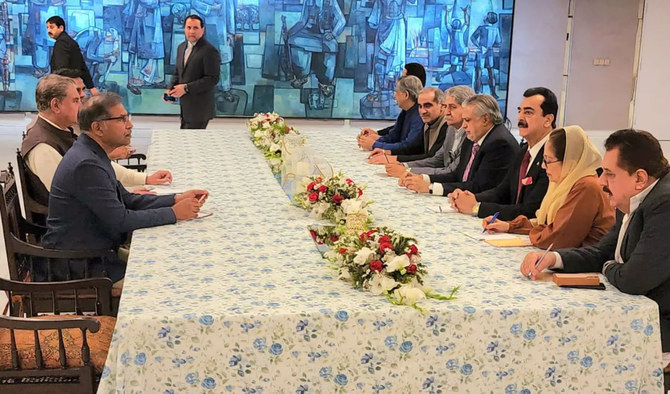
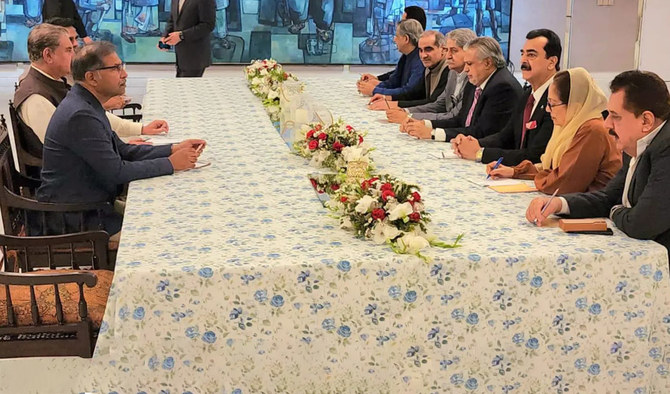
Representatives of Pakistan Democratic Movement (PDM) and ex-PM Imran Khan's PTI party hold talks to reach consensus on elections, in Islamabad on May 2, 2023. (Photo courtesy: @smqureshi.pti/Instagram)
Short Url
Updated 03 May 2023
Follow

Government, ex-PM Khan's party agree on holding elections on same date — finance minister

  • PTI, government hold third round of talks to resolve political deadlock, form consensus on elections
  • Government, PTI say consensus not yet reached on date of elections, dissolution of other assemblies

ISLAMABAD: The government and former prime minister Imran Khan's Pakistan Tehreek-e-Insaf (PTI) party have formed a consensus on holding elections across the country on the same date, Finance Minister Ishaq Dar said on Tuesday. 

Dar's announcement came after a PTI delegation completed its third round of negotiations with the government as both sides attempt to form a consensus on holding elections across the country. 

The controversy was triggered when the PTI and its ally dissolved the provincial assemblies of Khyber Pakhtunkhwa and Punjab provinces in January to force the government to call early elections across Pakistan. Pakistan's constitution says elections must be held within 90 days of the dissolution of an assembly when it expires before its tenure ends. 

Historically, Pakistan has held voting for provincial and national assemblies on the same day. PM Shehbaz Sharif's coalition government has reiterated it would only agree to elections being held on the same day across Pakistan.

In an effort to resolve the political impasse, Pakistan's top court directed both sides to hold discussions and form a consensus on the date for elections. 

"I think it is huge progress," Dar told reporters after the meeting. "To form a consensus that elections should take place all over the country on the same day and that there should be caretaker governments throughout the country, it is huge progress."

Dar said both sides have yet to decide on a date for elections, adding that they were trying to show "flexibility" over the matter. 

Former prime minister Yousaf Raza Gillani said the government and opposition had also agreed to accept the results of the upcoming elections whenever they are announced. 

"We have said that whoever wins elections, [the other side] will accept it. There should not be chaos in the country later," Gillani added. 

In Pakistan, allegations of rigging and street protests after election outcomes are announced are common. Former PM Khan held a sit-in protest in Islamabad against the government of then prime minister Nawaz Sharif in 2014, protesting against alleged rigging. 

Separately, PTI Vice President Shah Mahmood Qureshi, who led the party's team in the negotiations, said the PTI had asked the government to dissolve Sindh, Balochistan, and national assemblies on or before May 14 and hold elections after 60 days. 

He said a "constitutional cover" would be given to these measures. 

"To give that constitutional cover, the PTI is ready to go to the National Assembly," Qureshi said. "And, we are ready for a one-time or one-off amendment."

Qureshi said both sides had not formed a consensus yet on the dates of the dissolution of the rest of the assemblies and the holding of elections. 

"We came close, but we were not able to form a consensus," he said.  


Pakistan reviews austerity measures amid Middle East crisis, urges strict nationwide implementation

Updated 11 March 2026
Follow

Pakistan reviews austerity measures amid Middle East crisis, urges strict nationwide implementation

  • Deputy Prime Minister Ishaq Dar chairs review meeting of austerity steps
  • Officials briefed on salary cuts, school closures, four‑day week, petrol conservation

ISLAMABAD: Pakistan’s government on Wednesday assessed progress on a sweeping set of austerity measures introduced to mitigate the country’s economic strain from sharply rising global oil prices and supply disruptions linked to the ongoing war in the Middle East.

Prime Minister Shehbaz Sharif this week announced a series of austerity steps, including a four‑day work week for government offices, requiring 50  percent of staff to work from home, cutting fuel allowances for official vehicles by half, grounding up to 60  percent of the government fleet and closing all schools for two weeks to conserve fuel amid the global oil crisis.

The measures were unveiled in response to global oil market volatility triggered by the conflict involving the United States, Israel and Iran, which has disrupted supply routes such as the Strait of Hormuz and pushed crude prices sharply higher, straining Pakistan’s heavily import‑dependent energy sector.

“The meeting stressed the importance of strict and transparent adherence to the austerity measures, promoting fiscal responsibility and prudent use of public resources,” Deputy Prime Minister and Foreign Minister Senator Mohammad Ishaq Dar said in a statement.

He was chairing a meeting of the Committee for Monitoring and Implementation of Conservation and Additional Austerity Measures, constituted under the directions of the PM, bringing together federal and provincial officials to review execution of the broad cost‑cutting plan. 

Dar emphasized the government’s commitment to enforcing the PM’s austerity steps nationwide. The committee’s review also covered reductions in departmental expenditure, deductions from salaries of senior officials earning over Rs. 300,000 ($1,120), and coordination with provincial administrations to ensure uniform implementation of the plan.

Participants at the meeting reiterated that all ministries and divisions must continue strict monitoring and reporting, with transparent oversight mechanisms, as Pakistan navigates the economic pressures from the prolonged Middle East crisis and its fallout on global energy and trade markets.