

Inflation in Pakistan surges to historic high at 36.4% due to rising fuel, energy prices

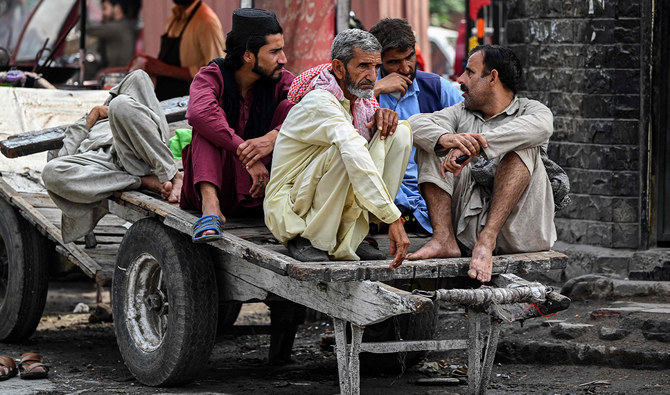
Daily wage labourers wait for customers to hire them at Raja bazaar in Rawalpindi, Pakistan, on May 1, 2023. (AFP)
Short Url
Updated 02 May 2023
Follow

Inflation in Pakistan surges to historic high at 36.4% due to rising fuel, energy prices

  • Prices in Pakistan rose by 2.4 percent in April 2023, official data shows
  • Pakistan’s food inflation clocked in at 49.5 percent year-on-year basis

Islamabad: Pakistan's inflation measured by the consumer price index (CPI) rose to a historic high of 36.4 percent, data from the statistics bureau said on Tuesday, as the country reels from a surge in fuel and energy prices. 

Inflation in Pakistan rose to 35.4 percent on a year-on-year basis in March while food inflation in urban centers of the country jumped to 47.1 percent in February. 

Desperate to avoid an acute balance of payments crisis as it faces rising external debt and dwindling foreign exchange reserves, Pakistan is actively trying to revive a stalled $6.5 billion loan program with the International Monetary Fund (IMF). One of the IMF’s foremost conditions to unlock the bailout program was to scrap subsidies and raise the prices of fuel and energy. 

In its monthly report, the Pakistan Bureau of Statistics (PBS) said prices increased by 2.4 percent in the country this month. 

“On a month-on-month basis, it [CPI inflation] increased to 2.4 percent in April 2023 as compared to an increase of 3.7 percent in the previous month and an increase of 1.6 percent in April 2022,” the PBS said.

Food inflation for April 2023 was clocked in at 49.5 percent (an average of rural and urban areas) versus 16.7 percent recorded in April 2022.

The data reflects Pakistan’s inflation has outpaced price gains in Sri Lanka, which has eased to 35.3 percent in April as its economy shows signs of recovery. 

Apart from the IMF’s tough conditionalities, price gains in Pakistan have been driven largely due to Pakistan’s weak currency, which has depreciated by 20 percent against the US dollar, causing imports to become costlier. 


Pakistan says Qatar to elevate economic partnership to ‘higher strategic level’

Updated 5 sec ago
Follow

Pakistan says Qatar to elevate economic partnership to ‘higher strategic level’

  • Qatari emir accepts invitation to visit Pakistan later this year, Sharif’s office says
  • Doha talks also addressed rising tensions between Pakistan and Afghanistan

ISLAMABAD: Pakistan said on Tuesday Qatar had agreed to elevate bilateral economic cooperation to a “higher strategic level” during talks between Prime Minister Shehbaz Sharif and Qatari Emir Sheikh Tamim bin Hamad Al Thani in Doha, according to a statement from the Prime Minister’s Office.

The meeting with Qatar’s head of state marked the highest-level engagement of Sharif’s visit and comes as Islamabad seeks to attract Gulf investment to support economic stabilization under a $7 billion International Monetary Fund (IMF) program while coordinating with regional partners on rising security tensions.

Qatar is a key economic partner for Pakistan, hosting nearly 300,000 Pakistani workers and previously announcing plans to invest $3 billion in sectors including transport, aviation, energy, health, media and technology. The two countries also maintain defense cooperation and structured political and business dialogues.

“His Highness Sheikh Tamim bin Hamad Al Thani reiterated Qatar’s commitment to a deepening economic partnership to a higher strategic level,” Sharif’s office said in the statement.

According to the statement, the two leaders reviewed the entire spectrum of bilateral relations and reaffirmed their commitment to strengthening longstanding ties.

The Qatari emir also accepted Sharif’s invitation to visit Pakistan later this year, the Prime Minister’s Office said.

Earlier during the visit, Sharif held talks with Qatar’s Prime Minister Sheikh Mohammed bin Abdulrahman bin Jassim Al Thani, where discussions focused on expanding cooperation in trade and investment, energy, defense, manpower and labor, and culture.

“They reaffirmed the strong brotherly relations between Pakistan and Qatar and expressed satisfaction at the growing momentum in political, economic and institutional ties,” Sharif’s office said.

“Discussions focused on enhancing cooperation in the fields of trade and investment, energy, defense, manpower and labor and culture, with both sides stressing the importance of their task force to accelerate cooperation in all these areas.”

Sharif also met Qatar’s State Minister for Trade Dr. Ahmed bin Mohammed Al-Sayed and a delegation of the Qatar Businessmen Association (QBA), where he highlighted Pakistan’s investment-friendly reforms and invited Qatari investors to explore opportunities in infrastructure, logistics, energy, agriculture, technology and export-oriented manufacturing, according to the prime minister’s office.

The business outreach reflects Islamabad’s broader push to convert political goodwill with Gulf partners into tangible investment inflows as it works to sustain macroeconomic stability and growth.

TENSIONS WITH AFGHANISTAN 

The Doha talks also addressed rising tensions between Pakistan and Afghanistan following cross-border military exchanges in recent days.

Pakistan last week carried out airstrikes inside Afghanistan against what it described as Tehreek-e-Taliban Pakistan (TTP) targets, after blaming recent militant attacks in Islamabad, Bajaur and Bannu on fighters operating from Afghan territory, which Kabul denies. Afghan Taliban authorities said the strikes killed civilians and described them as a violation of Afghanistan’s sovereignty.

The issue also came up during a separate meeting between Sharif and Qatar’s Deputy Prime Minister Sheikh Saoud Al-Thani.

“Regional developments were also discussed, in particular the situation in Iran and Afghanistan,” Sharif’s office said in a statement. “Both sides emphasized the importance of dialogue, de-escalation and collective efforts to promote peace and stability in the region.”

Similar cross-border strikes last year triggered weeklong clashes before Qatar and Turkiye helped mediate a tenuous ceasefire between Islamabad and Kabul.