


NEW YORK CITY: Millions of people in Sudan are facing a humanitarian disaster as the armed conflict between the Sudanese Armed Forces and paramilitary group the Rapid Support Forces becomes a “full-blown catastrophe,” UN and Sudanese officials warned on Monday.
During a briefing at the UN headquarters in Geneva on the latest developments, officials from the Office for the Coordination of Humanitarian Affairs said 16 million people in Sudan, a third of the population, are in need of assistance, and 3.7 million, mainly from Darfur province, have been displaced from their homes as a result of the violence that began on April 15.
Hassan Hamid Hassan, the Sudan’s permanent representative to the UN in Geneva, said the Rapid Support Forces launched unprovoked attacks against the army and its installations just hours before a scheduled meeting between the leaders of both forces.
Fighting erupted in the capital, Khartoum, more than two weeks ago between troops loyal to Abdel Fattah Al-Burhan, the head of Sudan’s regular army, and his former deputy Mohammed Hamdan Dagalo, who commands the Rapid Support Forces, a heavily armed militia previously aligned with the army.
The two generals seized power from a joint military-civilian transitional authority in a 2021 coup, two years after the country embarked on a shift to democracy following the overthrow of authoritarian President Omar Al-Bashir after months of public protests.
Hassan said at least 30 hospitals and other medical facilities in Sudan can no longer be used as a result of the continuing fighting. Meanwhile tens of thousands of people have been displaced and are at serious risk because of the lack of medical assistance and food shortages, he added.
“The situation in Sudan is worrisome,” said Hassan, adding that at least 512 people have been killed and 4,200 wounded since the fighting began, according to the country’s Health Ministry.
Abdou Dieng, the UN’s acting resident and humanitarian coordinator in Sudan, said millions of Sudanese are in need of immediate assistance and millions more are confined to their homes, unable to access basic necessities.
Speaking from the city of Port Sudan on the Red Sea coast, he said that according to the World Health Organization, one in four of the lives lost so far as a result of the conflict could have been saved had their been better access to medical help.
Many health facilities have been forced to close while those that are still operating face challenges, including shortages of medical supplies and blood stocks, he added.
Dieng blamed both sides in the conflict for the breakdown of order and the deteriorating humanitarian situation in the country.
“In internal parts of Sudan, mainly in Khartoum and Darfur, we have seen a complete lack of respect by the warring parties for their obligations under international humanitarian law and the protection of civilians and civilian infrastructure, including humanitarian personnel and assets,” he said.
His office and its staff have relocated to Port Sudan and will remain there to lead the efforts to help Sudanese civilians, he added.
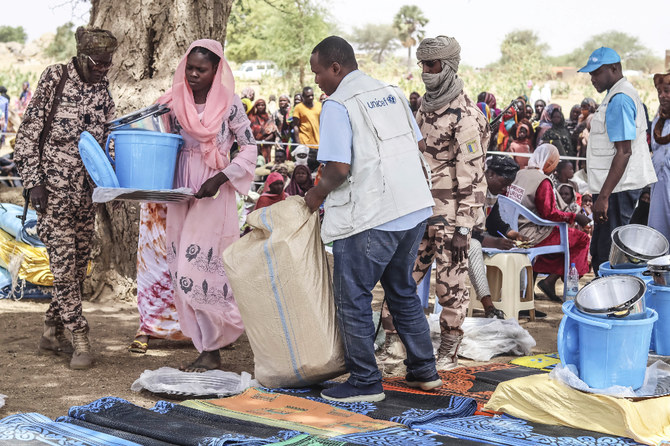
Raouf Mazou, a UN assistant secretary-general and assistant high commissioner for operations at UNHCR, the UN’s Refugee Agency, said an estimated 73,000 people have arrived in neighboring countries, including Chad (30,000), South Sudan (20,000) and Egypt, since the conflict began, and the UN is helping host countries to register and provide immediate help to refugees.
He added: “In consultation with all concerned governments and partners, we have arrived at a planning figure of 815,000 people that may flee into the seven neighboring countries.”
Of those, 580,000 are expected to be Sudanese nationals, and 235,000 South Sudanese citizens who might return to their country in what the UN describes as “adverse conditions.”
Anthony Neal, coordinator of the Sudan INGO Forum, which facilitates communication and action between international humanitarian and development agencies operating in Sudan, said the country was already facing a difficult and complex humanitarian crisis before the current conflict began.
He said the current situation is even more complicated and presents many challenges to nongovernmental organizations, given that many of their staff have had to relocate because of the fighting, and the effects the conflict is having on the banking sector, which is limiting the ability of organizations to pay workers and support their operations.


