


RIYADH: Members of the so-called Trilateral Mechanism and the Quad on Friday welcomed the announcement by the Sudanese Armed Forces and the Rapid Support Forces to extend the current ceasefire for an additional 72 hours and called for its full implementation.
"We also welcome their readiness to engage in dialogue toward establishing a more durable cessation of hostilities and ensuring unimpeded humanitarian access," the two groups said in a joint statement carried by the Saudi Press Agency. The statement was also released by the US State Department.
"This initial phase of diplomacy to establish a process to achieve a permanent cessation of hostilities and humanitarian arrangements will contribute to action on development of a de-escalation plan as outlined in the April 20 African Union communique, which was endorsed by the League of Arab States, the European Union, the Troika, and other bilateral partners," the statement said.
The Trilateral Mechanism comprises the African Union, the Intergovernmental Authority on Development, and the United Nations. The Quad is made up of Saudi Arabia, the UAE, the UK, and the US.
Fighting goes on
The joint statement comes amid reports of continuing violence in the capital Khartoum and the western region of Darfur despite the cease-fire agreements.
At least 512 civilians and combatants have been killed since the fighting broke out on April 15 between the Sudanese Armed Forces led by Gen. Abdel Fattah Al-Burhan and the Rapid Support Forces (RSF) paramilitary group led by Gen. Mohamed Hamdan Dagalo.
Another 4,200 people were reported injured as of the latest count.
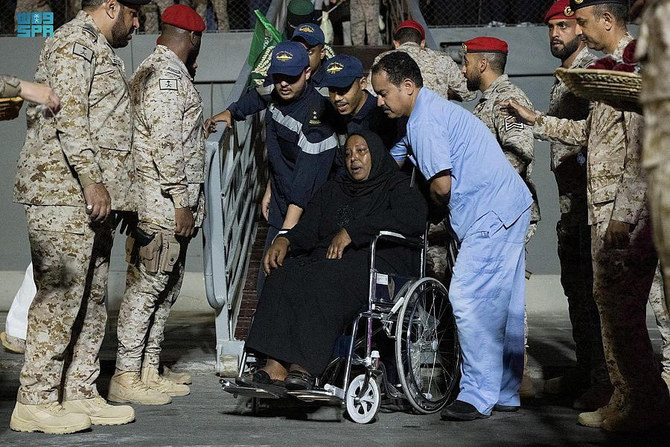
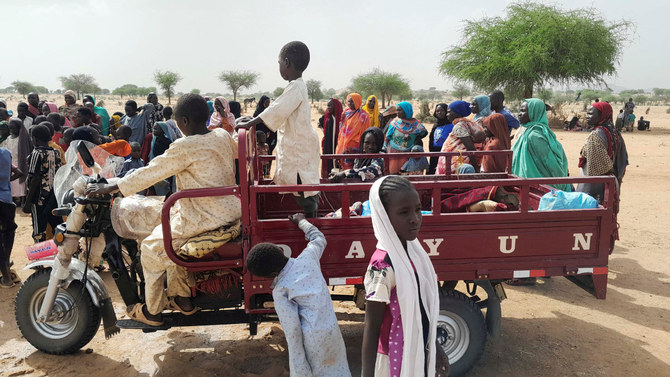
Tens of thousands of people have fled the impoverished North African country. A total of 2,744 people, including 119 Saudis and people from 76 other countries, have been transported from Sudan to Saudi Arabia since the Kingdom’s evacuation process started on April 24.
On April 26, the largest evacuation was carried out, transporting 1,687 people from 58 nationalities from Port Sudan.
After toppling an internationally recognize civilian government in an October 2021 coup, Al-Burhan and Dagalo are now locked in a power struggle that is threatening to destabilize a fragile region.
The army on Wednesday said it agreed to a new three-day cease-fire through Sunday following one due to expire on Thursday night. On Thursday, the military reiterated it would extend the truce and said it would honor it unilaterally.
Responding for the first time, the RSF said on Thursday it too approved another 72-hour truce starting Friday.
The army said it controls most of Sudan’s regions and is defeating a large RSF deployment in Khartoum where some residential areas have turned into war zones.
Despite a partial lull in fighting since the first 72-hour cease-fire started, air strikes and anti-aircraft fire could be heard on Thursday in the capital and the nearby cities of Omdurman and Bahri, witnesses and Reuters journalists said.
Fighting has spread to the vast Darfur region, where conflict has simmered ever since civil war erupted two decades ago.
The Darfur Bar Association, a rights group, said at least 52 people had died in attacks by well-armed “militias” on residential neighborhoods in the city of El Geneina, as well as its main hospital, main market, government buildings and several shelters for internally displaced people.
Militiamen from nomadic Arab tribes entered El Geneina as the fighting between the RSF and army created a security vacuum in recent days, said one resident, who asked to withhold his name due to fear of retribution. They were met with armed members of the Masalit tribe, with clashes extending across the city,
(With Reuters)


