

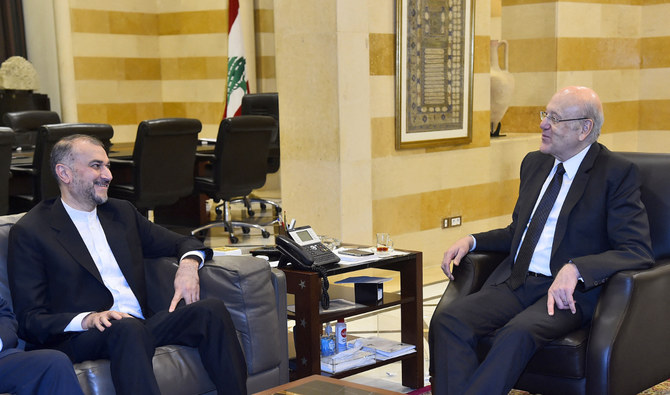
Iranian FM supports Lebanese dialogue to elect new president

Lebanese caretaker Prime Minister Najib Mikati (R) meets with Iranian Foreign Minister Hossein Amir-Abdollahian (L) at the Governmental Palace in Beirut on April 27, 2023. (AFP)
Short Url
Updated 27 April 2023
Follow

Iranian FM supports Lebanese dialogue to elect new president

  • Foreign ambassadors urge meaningful reforms to save economy
  • Envoys voice dismay over slow progress in politicians’ efforts to tackle crisis

BEIRUT: Iran’s Foreign Minister Hossein Amir-Abdollahian has called on Lebanon’s parliamentary rivals to overcome their political deadlock and elect a president.

However, the minister, who met with Lebanese officials on Thursday, failed to convey any Iranian initiative to resolve the country’s political crisis.

Instead, he noted that Tehran was ready to support “any agreement between the Lebanese parties regarding the presidential election.”

Amir-Abdollahian will hold a press conference on Friday to conclude his official visit to Lebanon.

The Iranian official’s visit to Beirut followed political developments in the region and the Saudi-Iranian understanding. It also falls on the 18th anniversary of the withdrawal of Syrian forces from Lebanon.

“There have been new developments in the region in recent weeks, and this will be in the interest of all the region, the Islamic world, and Lebanon,” he said.

Amir-Abdollahian said that Iran has always supported dialogue and negotiations when it comes to tension and crises in the region, and does not believe that wars are the solution to such issues.

“We are concerned about the military clashes in Sudan, and we will continue to exert our efforts and focus on strengthening peace in the region, especially in Afghanistan, Yemen, Ukraine, Sudan and Libya,” he said.

The Iranian official met with Parliamentary Speaker Nabih Berri, caretaker Prime Minister Najib Mikati, and his Lebanese counterpart Abdullah Bou Habib.

Following his meeting with Bou Habib, Amir-Abdollahian said: “We discussed comprehensive cooperation between Iran and Lebanon, and stressed our full readiness to enhance cooperation in all fields.”

He said that Iran encouraged all parties in Lebanon to speed up the presidential elections and supported any election or agreement regarding the next president.

“The officials in Lebanon, and all the parties, have the ability and the necessary competence to reach an agreement and consensus on electing a president,” he added.

Lebanese lawmakers have failed to elect a new president for six months amid continuing divisions between Hezbollah and its allies on the one hand, and MPs of parties opposing Hezbollah’s policy in Lebanon on the other.

Hezbollah insists on supporting candidate Suleiman Frangieh for the presidency, while several political parties and reformist MPs oppose this option.

Amir-Abdollahian arrived in Beirut on Wednesday on an official visit that included other countries in the region.

In a statement at Rafic Hariri International Airport, he highlighted “Iran’s strong support for the Lebanese government and people, the Lebanese army, and the resistance in Lebanon.”

He also underlined “the new, positive and constructive developments in the region,” noting that “Lebanon’s security, prosperity, well-being and progress will be in the region’s interest.”

Bou Habib said that an Iranian offer to provide assistance in the electricity sector was discussed during his meeting with Amir-Abdollahian.

Iran made an offer to Lebanese officials in 2021 to set up two power plants — one in the south and another in a southern suburb of Beirut — each providing about 1,000 megawatts, within a period of 18 months, at a low cost.

The electricity issue constitutes half of Lebanon’s financial crisis, with the total deficit in this sector over the last two decades amounting to about $36 billion, or about 45 percent of the total public debt.

However, Lebanon was reluctant to accept the offer, fearing US sanctions imposed on Iran.

Meanwhile, the ambassadors of Canada, France, Germany, Italy, Japan, the UK, US and EU issued a joint statement on the situation in Lebanon, saying: “This month marks one year since Lebanon reached a staff-level agreement or SLA with the International Monetary Fund.

“The agreement promised over $3 billion in assistance to support Lebanon’s economic recovery.

“The government pledged to quickly implement a comprehensive package of structural reforms (prior actions) in order to reach a formal agreement with the IMF.

“It is disappointing that Lebanon’s political actors have made only limited progress in implementing these prior actions,” the statement read.

The ambassadors added: “While some conditions have been met, the bank secrecy law proved insufficient, no progress has been made with respect to allocating financial sector losses, and authorities must work to audit Lebanon’s major banks and unify Lebanon’s exchange rates.

“The urgency could not be more obvious. The country faces one of the worst economic crises in modern history.

“People in Lebanon are suffering. Inflation has reached 186 percent. The Central Bank’s external reserves continue shrinking.”

They also warned: “The IMF itself has said that, if reforms are not implemented rapidly, Lebanon will be trapped in a never-ending crisis.

“With or without an IMF program, decisive structural reforms are necessary to enable Lebanon’s recovery.”

The joint statement added: “The absence of a president and an actual government is one of the great obstacles to complete reforms.

“The answers to Lebanon’s economic crisis can only come from within Lebanon and they start with meaningful reforms.

“Now is the time for the Lebanese authorities to seize the opportunity presented by an agreement with the IMF.

“Otherwise, the economy will deteriorate further, with ever more severe consequences for the Lebanese people.”

The envoys’ statement comes amid a worsening financial crisis, with value of the national currency dropping by more than 98 percent.


Iran launches missiles at Israel as attacks in Middle East commence for a sixth day

Updated 22 min 18 sec ago
Follow

Iran launches missiles at Israel as attacks in Middle East commence for a sixth day

  • IRGC: Strikes against Iran would result in “the complete destruction of the region’s military and economic infrastructure”
  • Drones and missiles intercepted in different countries, including Turkiye and Saudi Arabia, after IRGC warning

DUBAI: Iran launched missiles at Israel early Thursday as aerial attacks in the Middle East commenced for a sixth day after an American submarine sank an Iranian warship and Iran threatened the destruction of military and economic infrastructure across the region.
Israel announced the incoming attack shortly after its military said it had begun new strikes in Lebanon targeting the Iranian-backed Hezbollah militant group in Beirut’s southern suburbs.
The fighting continued after the US and Israel intensified their bombardment Wednesday of Iran’s security forces and other symbols of power.
The tempo of the strikes on Iran was so intense that state television announced the mourning ceremony for Iranian Supreme Leader Ayatollah Ali Khamenei, who was killed at the start of the conflict, would be postponed. Millions attended the funeral of his predecessor, Ayatollah Ruhollah Khomeini, in 1989.
The US and Israel launched the war Saturday, targeting Iran’s leadership, missile arsenal and nuclear program while suggesting that toppling the government is a goal. But the exact aims and timelines have repeatedly shifted, signaling an open-ended conflict.
President Donald Trump praised the US military Wednesday for “doing very well on the war front, to put it mildly.” Fellow Republicans in the US Senate stood with Trump on Iran as they voted down a resolution seeking to halt the war.
Iran fired on Bahrain, Kuwait and Israel as the conflict spiraled. Turkiye said NATO defenses intercepted a ballistic missile launched from Iran before it entered Turkiye’s airspace.
The war has killed more than 1,000 people in Iran, more than 70 in Lebanon and around a dozen in Israel, according to officials in those countries. It has disrupted the supply of the world’s oil and gas, snarled international shipping and stranded hundreds of thousands of travelers in the Middle East.

Buildings of Iranian military and security forces targeted
US Defense Secretary Pete Hegseth said a torpedo from an American submarine sank an Iranian warship Tuesday night in the Indian Ocean.
Sri Lankan authorities said 32 people were rescued from the ship, while the country’s navy said it recovered 87 bodies.
Israel said it hit buildings associated with Iran’s Basij, the all-volunteer force of the paramilitary Revolutionary Guard whose bloody crackdown on protesters in January left thousands dead.
The Israeli military hit buildings associated with Iran’s internal security command. Israel and the US have said they want to see Iranians overthrow the country’s theocracy, and strikes against Iran’s internal security forces may be aimed at hastening that.
However, Iranian Foreign Minister Abbas Araghchi has said his country’s forces have decentralized leadership, with units acting largely on their own, which could blunt the effect of attacks on top command and control hubs.
Iranian state television showed the ruins of buildings in Tehran and interviews with people saying the attacks damaged their homes. Strikes were also reported in the city of Qom targeting a building associated with a clerical panel set to pick Iran’s next supreme leader. Iranian media said it was empty at the time.
Shifting timelines for US operations
During his Pentagon briefing, Hegseth did not give a definitive timeline for US operations.
“You can say four weeks, but it could be six. It could be eight. It could be three,” he said. “Ultimately, we set the pace and the tempo. The enemy is off balance, and we’re going to keep them off balance.”
Adm. Brad Cooper, the top US military commander in the Middle East, said American forces have damaged Iran’s air defenses and taken out ballistic missiles, launchers and drones.
US and Israeli military officials say launches from Iran have declined as the war has progressed. Israel’s Homefront Command announced it was easing restrictions that closed workplaces nationwide. It said workplaces could reopen Thursday if there’s a shelter nearby. Schools would remain closed.
Still, explosions sounded early Thursday in Israel, which said its defensive systems were moving to intercept Iranian missiles.
At least 1,045 people have been killed in Iran, the country’s Foundation of Martyrs and Veterans Affairs said Wednesday. Eleven people have died in Israel. Six US troops have been killed.
The death toll has exceeded 70 in Lebanon, where the health ministry said Wednesday that three people died when drone strikes hit two vehicles on a Beirut highway. The Israeli military said it was targeting a Hezbollah member.
Israel says its offensive had been planned for midyear
Israeli Defense Minister Israel Katz said the offensive against Iran was originally planned for mid-2026, but “the need arose to bring everything forward to February.”
He listed events inside Iran, Trump’s positions and the possibility of “creating a combined operation” as reasons.
The protests in Iran put unprecedented pressure on its leadership. Trump threatened military action in response to the crackdown before shifting his attention to Iran’s disputed nuclear program.
White House press secretary Karoline Leavitt said Wednesday that the US launched its operation partly out of concern Iran might strike American personnel and assets in the region first. A phone call between Trump and Israeli Prime Minister Benjamin Netanyahu before the airstrikes began was also “important with respect to the timeline,” she said.
Energy supplies in the crosshairs
Iran’s paramilitary Revolutionary Guard issued its most-intense threat yet, saying the strikes against it would result in “the complete destruction of the region’s military and economic infrastructure.”
A Maltese-flagged container ship was attacked Wednesday while passing through the Strait of Hormuz, the narrow mouth of the Arabian Gulf through which about a fifth of the world’s oil is shipped. The ship was hit by two missiles, sparking a fire, according to Malta’s transport minister, Chris Bonett. Its 24 crew members were rescued.
Tanker traffic through the strait has fallen by around 90 percent compared to prewar levels, shipping tracker MarineTraffic.com said Wednesday.
Oil prices have soared as Iranian attacks have disrupted traffic through the strait, and global stock markets have been hammered over worries that the spike in oil prices may grind down the world economy.
Iran’s clerics are choosing a new supreme leader
Iran’s leaders are scrambling to replace Khamenei, who ruled the country for 37 years. It’s only the second time since the 1979 Islamic Revolution that a new supreme leader is being chosen.
Potential candidates range from hard-liners committed to confrontation with the West to reformists who seek diplomatic engagement. Mojtaba Khamenei, Khamenei’s son, has long been considered among them — though he has never been elected or appointed to a government position.
In a sign that Iran’s leadership will only seek to consolidate its power as it faces its biggest crisis in decades, the head of the judiciary warned that “those who cooperate with the enemy in any way will be considered an enemy.”
Israel’s defense minister, Katz, said on X that Iran’s next supreme leader — if he continues to threaten Israel, the US and others — “will be a target for elimination.”