

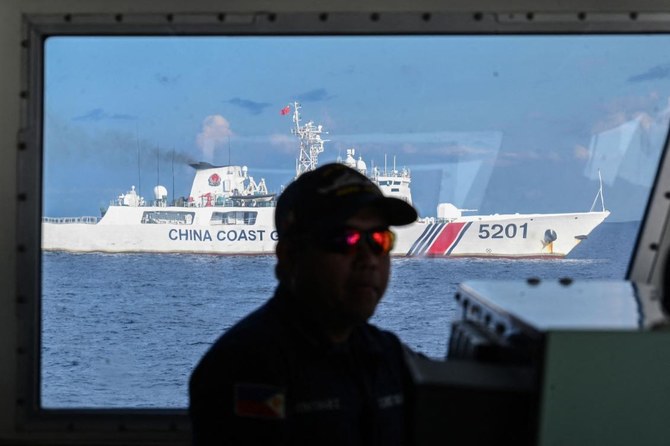

ABOARD THE BRP MALABRIGO: A Chinese coast guard ship cut off a Philippine patrol vessel carrying journalists in the disputed South China Sea, causing a near-collision, an AFP team on board another boat saw.
The near-miss off the Spratly Islands on Sunday was the latest in a steady string of incidents between China and the Philippines in the contested waterway.
AFP was one of several media outlets invited to join two Philippine Coast Guard boats on a 1,670-kilometer (1,040-mile) patrol of the South China Sea, visiting a dozen islands and reefs.
The BRP Malapascua and BRP Malabrigo were shadowed by Chinese navy and coast guard ships, and ordered to leave the waters several times during the six-day journey.
“We would have collided on the bow had I not cut the engine and thrown it in reverse,” Malapascua commanding officer Rodel Hernandez told reporters of Sunday’s close call, describing it as an encounter between “David and Goliath.”
The incident happened after the Philippine coast guard boats approached Second Thomas Shoal, where Philippine marines are stationed in a run-down navy ship grounded to assert Manila’s territorial claim in the waters.
As the 44-meter Malapascua neared the shoal, a Chinese Coast Guard vessel more than twice its size sailed into its path.
Hernandez said the Chinese ship came within 45 meters of his boat and only his quick actions avoided the steel-hulled vessels crashing into each other.
AFP watched the incident from the Malabrigo, which was less than a kilometer away.
A second Chinese coast guard vessel was seen nearby.
Hernandez said Chinese boats routinely blocked his and other Philippine coast guard ships during their patrols near the shoal.
However, Sunday was the “closest” he had seen vessels from the rival fleets come to a collision.
The Malapascua and Malabrigo had broadcast their intention to sail into the shoal to conduct a “site survey” and asked the Chinese vessels to “stay clear from our passage.”
But the Chinese coast guard responded over the radio that the Philippine boats were illegally sailing in China’s territorial waters, and told them to leave.
Second Thomas Shoal is about 200 kilometers from the major Philippine island of Palawan and more than a thousand kilometers from China’s nearest major landmass of Hainan island.
Over the past decade, China has ripped up thousands of hectares of reef in the Spratlys to create militarised islands with runways, ports and radar systems.
“If we ceased our watch they would soon take over Ayungin as well, so we need to be there always and challenge their harassment,” Hernandez said, using the Philippine name for the shoal.
The incident came just a day after Philippine President Ferdinand Marcos hosted Chinese Foreign Minister Qin Gang for talks in Manila aimed at defusing tensions in the contested waterway.
Beijing claims sovereignty over almost the entire South China Sea, including the Spratly Islands, ignoring an international ruling that the assertion has no legal basis.
To back Beijing’s claim, hundreds of Chinese coast guard and other vessels patrol the waters, swarming reefs and harassing and attacking fishing and other boats.
On Saturday, the Philippine coast guard identified more than a hundred Chinese vessels parked at Whitsun Reef, which the Philippines claims as part of its exclusive economic zone.
The Philippine coast guard ordered the vessels to leave, but they were ignored.
Since taking office last June, Marcos has insisted he will not let China trample on the Philippines’ rights in the sea — in contrast to his predecessor Rodrigo Duterte who was reluctant to criticize Beijing.
Marcos has meanwhile gravitated toward the Philippines’ traditional ally, the United States, as he seeks to strengthen their defense ties.
This shift has alarmed China, which has accused Washington of trying to drive a wedge between Beijing and Manila.
Manila this month announced the locations of four more military bases it is allowing the United States to use on top of the five agreed on under the 2014 Enhanced Defense Cooperation Agreement, or EDCA.
The four additional bases include sites near the South China Sea and another not far from self-ruled Taiwan, which Beijing claims as its territory.
China has warned the expanded EDCA could endanger regional peace, and accused Washington of having a “zero-sum mentality.”
The largest-ever war games between the Philippines and the United States, which end Friday, have also drawn Beijing’s ire.
On Wednesday, Marcos watched US and Philippine troops fire rockets at a decommissioned warship representing an enemy vessel in the South China Sea, the first time the allies had held such an exercise.
The annual Balikatan maneuvers followed a three-day Chinese military exercise that simulated targeted strikes and a blockade around Taiwan.
Marcos said Monday he would discuss with US President Joe Biden at the White House next week the “need to tone down the rhetoric” over the South China Sea, Taiwan and North Korea.
“The discussion is heating up, some harsh words are being exchanged and we are worried,” Marcos told a Philippine broadcaster.
Meanwhile, the Philippine Coast Guard has been trying to draw international attention to China’s activities in the South China Sea.
But with only three patrol vessels to monitor the vast waters, it is a challenge, said Commodore Jay Tarriela, the Philippine Coast Guard spokesman for the West Philippine Sea.
Out on the high seas, Malabrigo’s captain Commander Julio Colarina was defiant.
“The Philippines might be a small nation, but our country has a coast guard with a big heart that is willing to serve the Filipino people and an overwhelming loyalty and bravery to protect the republic,” Colarina said.


