

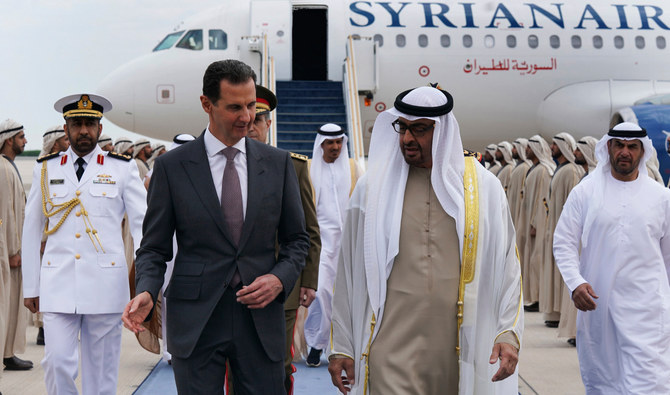

BEIRUT: Syrians living on opposite sides of the largely frozen battle lines dividing their country are watching the accelerating normalization of ties between the government of Bashar Assad and Syria’s neighbors through starkly different lenses.
In government-held Syria, residents struggling with ballooning inflation, fuel and electricity shortages hope the rapprochement will bring more trade and investment and ease a crippling economic crisis.
Meanwhile, in the remaining opposition-held areas of the north, Syrians who once saw Arab countries as allies in their fight against Assad’s rule feel increasingly isolated and abandoned.
Turkiye, which has been a main backer of the armed opposition to Assad, has been holding talks with Damascus for months — most recently on Tuesday, when the defense ministers of Turkiye, Russia, Iran and Syria met in Moscow.
A 49-year-old tailor in Damascus who gave only his nickname, Abu Shadi said he hoped the mending of ties between Syria and the Gulf countries would improve the economy and kick-start reconstruction in the country.
“We’ve had enough of wars — we have suffered for 12 years,” he said. “God willing, relations will improve with all the Gulf countries and the people will benefit on both sides. There will be more movement, more security and everything will be better, God willing.”
In the opposition-held northwest, the rapprochement is a cause for fear. Opposition activists took to social media with an Arabic hashtag translating to “normalization with Assad is betrayal,” and hundreds turned out at protests over the past two weeks against the move by Arab states to restore ties with Assad.
Khaled Khatib, 27, a worker at a nongovernmental organization in northwest Syria, said he is increasingly afraid that the government will recapture control of the remaining opposition territory.
“From the first day I participated in a peaceful demonstration until today, I am at risk of being killed or injured or kidnapped or hit by aerial bombardment,” he said. Seeing the regional warming of relations with Damascus is “very painful, shameful and frustrating to the aspirations of Syrians,” he said.
Rashid Hamzawi Mahmoud, who joined a protest in Idlib earlier this month, said: “The (UN) Security Council has failed us — so have the Arab countries, and human rights and Islamic groups,” he said.
Syria was ostracized by Arab governments over Assad’s brutal crackdown on protesters in a 2011 uprising that descended into civil war. However, in recent years, as Assad consolidated control over most of the country, Syria’s neighbors have begun to take steps toward rapprochement.
The overtures picked up pace since a deadly Feb. 6 earthquake in Turkiye and Syria.
Joseph Daher, a Swiss-Syrian researcher and professor at the European University Institute in Florence, Italy, said Assad could potentially be invited to the next Arab League summit, but even if such an invitation isn’t issued for May, “it’s only a question of time now.”
Government officials and pro-government figures in Syria say the restoration of bilateral ties is more significant in reality than a return to the Arab League.
“The League of Arab States has a symbolic role in this matter,” Tarek Al-Ahmad, a member of the political bureau of the minority Syrian National Party, said. “It is not really the decisive role.”


