

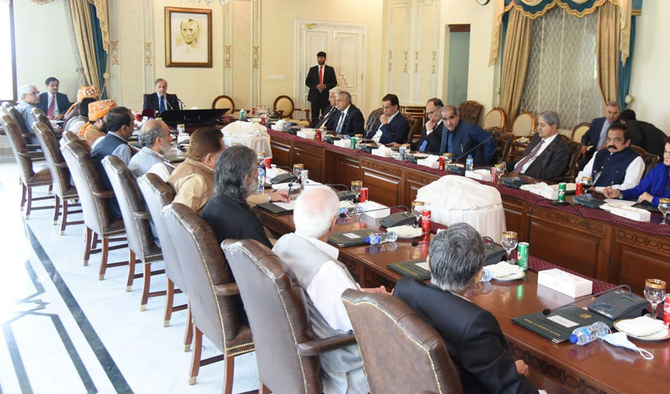

ISLAMABAD: After months of acrimony between the government and the opposition, Prime Minister Shehbaz Sharif said on Wednesday that the parties in his coalition government were of the opinion that the "doors of dialogue" with ex-PM Imran Khan's party should not be closed.
The prime minister's statement comes a day before Pakistan's top court resumes hearing an important case related to the delay in elections in Pakistan's eastern Punjab and northwestern Khyber Pakhtunkhwa provinces. The crisis was triggered when former PM Khan's party, in an effort to pressurize the government to hold snap elections, dismissed his government in both provinces.
After much political wrangling, the Supreme Court ordered polls to be held in Punjab on May 14, angering the government which wants provincial and national elections to be held across the country on the same day. According to Pakistan's constitution, however, elections must be held 90 days after the dissolution of a provincial assembly before its term of expiry.
Over the past couple of weeks, Khan's Pakistan Tehreek-e-Insaf (PTI) party and the ruling Pakistan Muslim League-Nawaz (PML-N) have showed willingness to hold talks to resolve the political impasse in the country. In an interview with a private news channel earlier this week, Khan said "joint elections" across the country could be held on the same day in July, provided Sharif dissolves the National Assembly in May.
Pakistan is racked with political instability at a time when its economy is in the doldrums, as its national currency has undergone massive devaluation over the past couple of months while inflation has skyrocketed. Pakistan has so far remained unsuccessful in getting the International Monetary Fund (IMF) to revive a $1.1 billion loan program it desperately needs to avoid default.
To discuss the political crisis in the country, Sharif chaired a high-level meeting with the heads of all coalition parties in the government at the PM House in Islamabad on Wednesday.
“There is an overwhelming opinion [among the ruling alliance] that the doors of dialogue [with the opposition] should not be closed,” he said, reiterating the 13-party alliance’s stance that elections should be held throughout the country on the same date.
Sharif said that while a format for the talks was yet to be decided, the ruling alliance was of the opinion that its stance could be conveyed to the PTI through the speaker of the National Assembly.
“A parliamentary committee can take up the matter [of negotiations], so that the nation could know that this allied government has made all-out efforts to ensure everyone unites on one-day polls,” he said.
The controversy over elections has also pitted the government against the judiciary, with the ruling party accusing three senior judges of the apex court of being "biased" against it. The Supreme Court had ordered the government to issue Rs21 billion ($72 million) to Pakistan's election regulator to hold polls in Punjab and KP. Last week, the top court ordered political parties to decide a date for elections through consensus. Otherwise, it said elections in Punjab would be held on May 14.
“Their [the Supreme Court] job is not arbitration, but their job is to give judgments as per law and constitution,” Sharif said, adding that the parliament had not accepted the apex court’s judgment that called for elections in Punjab on May 14.
“This matter [of the election funds] should also be brought before the parliament,” he said.
Separately, National Assembly Speaker Raja Pervez Ashraf vowed to write a letter to Chief Justice Umar Ata Bandial and other judges of the apex court to convey the “sentiments and thoughts” of Pakistani legislators about the top court's orders to hold polling in Punjab and Khyber Pakhtunkhwa, and its verdict to release funds to the ECP in this regard.
His announcement to do so came during a session of the National Assembly, in which Pakistani legislators thumped their desks loudly and called for all institutions to respect the supremacy of the parliament.
"Whenever the judges express their thoughts, we call out to them with respect," Foreign Minister Bilawal Bhutto-Zardari said. "Likewise, they will also have to call out to us with respect."


