BANGKOK: Former UN chief Ban Ki-moon on Tuesday urged the Myanmar military to halt violence in the conflict-racked country and engage with its opponents to end the bloody crisis.
Myanmar has been in turmoil since the military ousted civilian leader Aung San Suu Kyi’s government in February 2021, sparking fighting across swathes of the country and tanking the economy.
Diplomatic efforts to resolve the crisis have stalled, with the junta ignoring international criticism of its brutal crackdown on dissent and refusing to engage with its opponents.
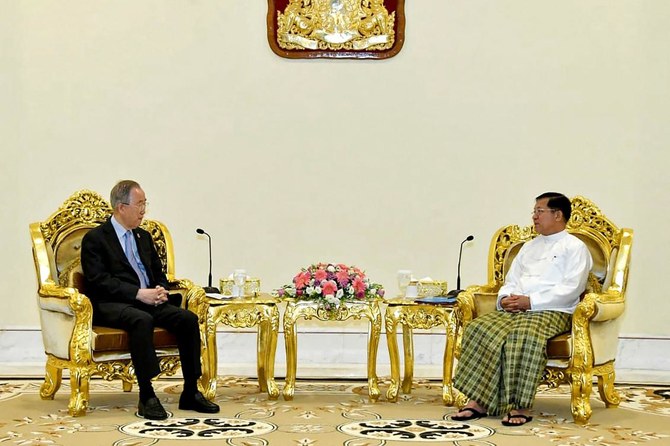
The military “must take the first steps,” Ban said following a two-day trip to Myanmar where he met junta chief Min Aung Hlaing and senior military officials.
Ban also said the National Unity Government (NUG) — a shadow administration dominated by lawmakers from Suu Kyi’s party which is working to overturn the coup — must be part of any “lasting solution.”
The military has shown no willingness to engage with its opponents, including the NUG, which it has designated as a “terrorist” organization.
Rights groups accuse the junta of massacres, torching villages and using air and artillery strikes to punish communities suspected of harboring its opponents.
A military airstrike on a village in a resistance hotspot this month killed more than 170 people, according to media and locals.
The junta justified its power grab with unproven allegations of fraud in 2020 polls won resoundingly by Suu Kyi’s party, and has promised to hold fresh elections.
“Holding elections under current conditions risks further violence and division, and the results not being recognized by the people of Myanmar,” Ban said.
The statement made no mention of whether Ban had sought a meeting with Suu Kyi, who is currently serving a 33-year jail term following a series of closed-door trials that rights groups say were a sham.
Ban’s visit made the front page of the state-backed Global New Light of Myanmar on Tuesday, which did not mention his calls for dialogue and a halt to violence.
He and junta chief Min Aung Hlaing had “exchanged views on the latest progress of Myanmar and cordially discussed it with constructive attitudes,” the paper said, without providing details.
Ban visited Myanmar in his capacity as a member of “The Elders” group of world leaders founded by Nelson Mandela, which works to promote peace and defuse conflicts.

Former UN chief Ban Ki-moon urges Myanmar junta to end violence
https://arab.news/jz8wh
Former UN chief Ban Ki-moon urges Myanmar junta to end violence
- Myanmar has been in turmoil since the military ousted civilian leader Aung San Suu Kyi’s government in February 2021
Pakistan rules out talks with Afghanistan, says more than 330 Afghan fighters killed in operations
- More than 330 Afghan fighters killed in operations
ISLAMABAD: Pakistan has ruled out talks with Afghanistan until there is an end to “terrorism” emanating from Afghan soil, officials said on Friday. The statement follows the killing of more than 330 Afghan fighters in cross-border skirmishes this week.
The latest clashes between the neighbors erupted after Pakistani airstrikes on Afghan territory last weekend triggered retaliatory attacks along the border on Thursday, escalating long‑simmering tensions over Pakistan’s claim that Afghanistan shelters Pakistani Taliban militants. Afghanistan denies this, saying Pakistan is deflecting blame for its own security failures.
Pakistani Information Minister Attaullah Tarar said his country had killed 331 Afghan fighters, destroyed over 100 posts and targeted 37 military locations across Afghanistan. Afghan officials have said more than 50 Pakistani soldiers have been killed and several Pakistan posts captured. Neither casualty figures nor battlefield claims by either side could be independently verified.
Meanwhile, Mosharraf Zaidi, Prime Minister Shehbaz Sharif’s spokesperson for foreign media, ruled out any talks with Afghanistan until Kabul addresses the issue, while the US expressed support for what it called Pakistan’s “right to defend itself” against attacks from Afghanistan’s Taliban rulers.
“There won’t be any talks, there is nothing to talk about ... Terrorism from Afghanistan has to end,” Zaidi told state-run Pakistan TV Digital, saying Islamabad would continue to target militant havens inside Afghanistan.
“Pakistan’s responsibility is to protect its citizens. If we know that there is a terrorist in point A and we know that there is a terrorist enabler at point A, we will find a weapon to land at point A and eliminate the threat.”
Zaidi said he did not expect Pakistan to deviate from this position: “We have clearly articulated what we are doing and what we plan on continuing to do and what it will take for us to stop doing what we are doing.”
He added: “And we will expect that both the international community and the regime in question, the Afghan Taliban, will come to their senses and will help reduce instability and disorder in this region.”
Pakistan is a major non-NATO ally of Washington, while the US considers the Afghan Taliban a “terrorist” group.
“The United States supports Pakistan’s right to defend itself against attacks from the Taliban, a Specially Designated Global Terrorist group,” Reuters quoted a State Department spokesperson as saying.
US diplomat Allison Hooker said on X she had spoken with Pakistan Foreign Secretary Amna Baloch on Friday.
The State Department spokesperson said Washington was aware of the escalation in tensions and “outbreak of fighting between Pakistan and the Afghan Taliban,” adding the US was “saddened by the loss of life.”
“The Taliban have consistently failed to uphold their counterterrorism commitments,” it said. “Terrorist groups use Afghanistan as a launching pad for their heinous attacks.”
Meanwhile, Afghan Taliban spokesperson Zabihullah Mujahid called for talks to resolve the crisis.
“We have always emphasized peaceful resolution, and now too we want the issue to be resolved through dialogue,” he said on Friday afternoon.
Asked what Pakistan desired, Tarar said: “Neutralizing the threat and ensuring that Pakistan is safe. Because for us, we’ve been good neighbors, we’ve been very friendly neighbors, we’ve been very, very generous neighbors. Our generosity, unfortunately, has often been seen as our weakness. So the objective, aim is to neutralize the threat and make Pakistan safe.”
He added it was too early to comment on a ceasefire as it was an evolving situation.


