


KARACHI: When Namra Khalid returned to her hometown, the southern Pakistani port city of Karachi, in 2020 after completing a degree in architectural design from the United States, the metropolis was experiencing one of the worst cases of urban flooding in its history following record-breaking rains.
While rains are common in many parts of Pakistan during the monsoon season, the seaside metropolis of Karachi, the most populous city in the country, received 484 millimeters of rain in 2020, the highest since 1931, according to the Pakistan Meteorological Department. The flooding killed 41 people and caused widespread infrastructural damages as well as hours-long traffic jams that disrupted the lives of over 15 million Karachi residents.
To make matters worse, the record rains came just a few years after a severe heat wave killed more than 2,000 people in the city and other areas of the Sindh province.
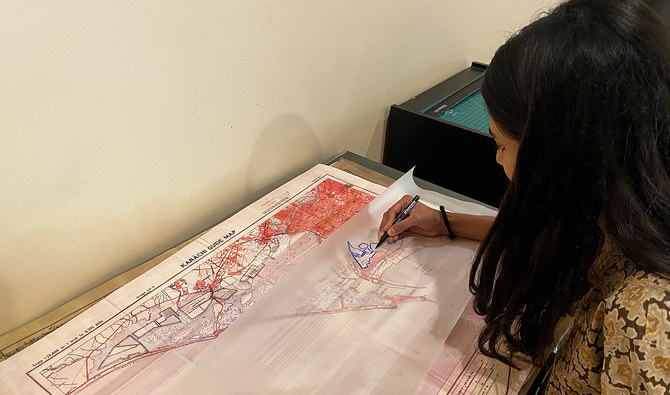
Both extreme weather events compelled Khalid, 25, to contemplate Karachi’s fast descent into becoming unlivable, and two years later, she established Karachi Cartography to create a climate map of the city. In recognition of her work, Khalid was chosen as one of the three winners of the 2023 Young Climate Prize, in the Visionary category, by Around The World and received the award at the Guggenheim Museum in New York on Saturday, April 22.
“I was always interested in how climate change was changing the world in general, and also Karachi,” Khalid told Arab News in an interview in Karachi ahead of winning her award.
She said the people of Karachi were for years used to heatwaves and to even a small amount of rain blocking roads and creating chaos in the port city.
“But it was nothing compared to what is happening now. Now there's rain, and then all of Karachi is pretty much under water for sometimes even months,” Khalid said. “So, I wanted to know what is causing this and I decided to map out the socio-climatic evolution of the city.”
The architectural designer turned urban researcher began by looking for old maps of Karachi in Pakistani libraries and archives, and quickly realized that they were either unavailable or inaccessible due to lack of digitization.
“Then there was another issue that a lot of our maps are still disputed colonial property, they're either in India, or they're in the UK,” Khalid said.
Realizing that many maps might be part of people’s private collections or hanging in drawing rooms as pieces of decoration, Khalid decided to make an Instagram page as an “open call” for people to share whatever maps they owned.
To her surprise, she received about 200 maps, some from as far back as the 1700s.
“And then we start figuring out, ‘Oh, this is how this thing changed and that thing changed,’” she said. “So, there’s a huge difference, and that’s causing issues.”
Indeed, Karachi is 30 times larger now than it was at the end of World War II and has experienced mass migrations and explosive population growth, which comes with its growing pains, as Khalid discovered.
When the partition of British India took place in 1947, Karachi was a colonial port city of about 400,000 people. It has now grown into a crowded, industrial, polluted city of more than 15 million people, with some estimates putting the population at around 20 million.
Most of the growth, Khalid explained, had been “unplanned” and took place without any eye to its climate impacts. But why use old maps?
“I think one of the biggest mistakes that we make as urban planners, as designers in the city, is that we start creating solutions right there and then without figuring out the problem,” Khalid said. “Maps tell you what went wrong.”
And that’s the aim of Karachi Cartography, the designer explained: to put all the maps of Karachi, “from India to London to Czechoslovakia … together in one repository of maps.”
“And the next thing we're doing is using this information to chart the evolution of the entire city.”
According to the National Institute of Oceanography, Karachi, officially the 12th most populous city in the world, is set to be submerged in water by 2060, or less than 37 years. Karachi Cartography, which now has 13 team members and 100 collaborators, aims to design and implement strategies for adaptation and resilience.
“Around 62.2 percent of Karachi’s population lies in the extremely vulnerable [area], the rest are also vulnerable, so it is necessary that we start bringing some change today,” Khalid said.
“Otherwise, we will be in a huge problem … It’s absolutely necessary, it’s absolutely necessary that authorities, common citizens, everyone at this point work together because it’s a huge task to save a city as big as ours.”


