

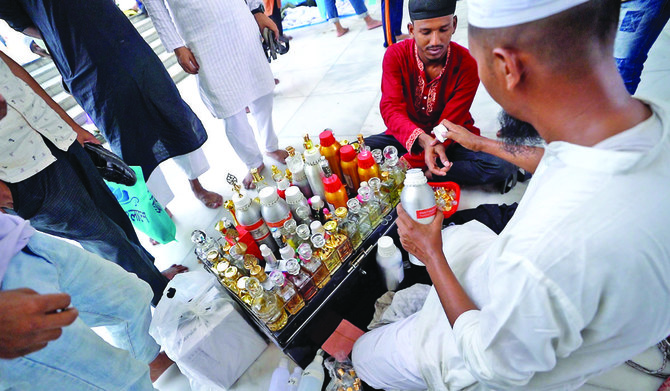

DHAKA: At the largest attar market near the Baitul Mukarram National Mosque in the center of Dhaka, shoppers swarm perfume stalls looking for the best scent to wear for this year’s Eid Al-Fitr.
Most of them will think about one particular fragrance that originated in the Middle East, a region that has been associated with perfumery since time immemorial.
In South Asia, its olfactory influence has been present at least since the 10th century, when Arab perfume makers devised sophisticated techniques of distillation, enabling essential oils to be manufactured on a large scale.
In Bangladesh, the alcohol-free oils are referred to by their original Arabic name, attar — a word whose social importance grows especially during religious celebrations and holidays in the Muslim-majority country, as Islamic tradition encourages people to smell nice when they meet others.
“Usually, we experience good sales during Ramadan and Eid ... Imported goods are in high demand here,” Milon Mahmud, who sells attar at the market, told Arab News.
“People like them due to the variety of scents and fragrances and high quality. That’s why many people use them.”
Mahmud sells attars from Saudi Arabia and the UAE, which are alcohol-free.
“People can offer prayers while wearing them,” he said, estimating that sales during Ramadan could reach $4,000 when he sells around 5 milliliters of attar for 200 taka ($2).
In comparison, the same amount of local perfume oils would cost about 10 times less. But the gap in quality is proportionately big, according to attar sellers.
Alhaj Faruk Islam, who similar to Mahmud runs a perfume stall in the Baitul Mukkarram Market, said: “Our local products are not comparable with attar from Saudi Arabia ... This attar lasts long, our local fragrances don’t.
“This attar is pure in quality, while our local products are adulterated.”
Those who come to the market to buy scents know exactly what they are looking for. They are familiar with different brands and types of oil, with most preferring fragrances coming from the Gulf region.
Hafej Mohammad Mahbub, a buyer who was shopping ahead of Eid, said: “I like attar of different scents, especially the perfume Sultan, because it smells like roses.
“Attars coming from Saudi Arabia and the UAE are free from adulteration, while perfumes from other regions are not pure enough. That’s why people love attar from these countries.”
Abdul Hannan said the fragrances brought back good memories from his childhood, four decades ago.
“I am a great lover of attar fragrances. In my childhood, I would see my father apply attar on every occasion. It was him who encouraged me to do so as well,” he added.
For Hannan, the practice he inherited from his father has something spiritual to it as well.
He said: “I prefer to use attar during special events, to be precise during any religious festivals. With attar, when I stand to offer prayers, it creates complete serenity in my mind.
“I can feel something celestial; a sense of purity surrounds me. Sometimes, it takes me to my childhood also.”


