Biden thanks Saudi Arabia as Kingdom evacuates over 150 Saudis, foreign nationals from Sudan

More than 300 people have been killed since the fighting erupted on April 15 between forces loyal to Sudan's army and the Rapid Support Forces (RSF). (File/AFP)
Short Url
Updated 24 April 2023
Follow

Biden thanks Saudi Arabia as Kingdom evacuates over 150 Saudis, foreign nationals from Sudan

  • 5 ships carrying 158 people from 11 different countries arrived from Sudan
  • Evacuated people were transported to Jeddah in Saudi Arabia

JEDDAH: More than 150 people from various nations reached the safety of Saudi Arabia on Saturday in the first announced evacuation of civilians from Sudan, where fighting between the army and paramilitaries entered a second week following a brief lull.

Foreign nations have said they are preparing for the potential evacuation of thousands more of their nationals, even though Sudan’s main airport remains closed.

As the Kingdom’s naval forces transported the civilians, including diplomats and international officials, across the Red Sea from Port Sudan to Jeddah, fighting resumed in Sudan’s capital Khartoum after a temporary truce saw gunfire momentarily die down on Friday, the first day of Eid Al-Fitr.

Fighting has left hundreds dead and thousands wounded while survivors cope with shortages of electricity and food.

Saudi Arabia’s Foreign Ministry announced the “safe arrival” of 91 of its citizens along with nationals from Kuwait, Qatar, the UAE, Egypt, Tunisia, Pakistan, India, Bulgaria, Bangladesh, the Philippines, Canada and Burkina Faso.

It added that diplomats and international officials were among those who arrived in the evacuation operation carried out by the Royal Saudi Navy with the support of various branches of the armed forces.

US President Joe Biden thanked the Kingdom, Djibouti and Ethiopia for facilitating the plan to get US personnel out of Khartoum. 

“I thank Djibouti, Ethiopia, and Saudi Arabia, which were critical to the success of our operation,” he said in a statement on Saturday, calling for a ceasefire to allow “unhindered humanitarian access, and respect the will of the people of Sudan”. 

The Saudi ministry said in a statement: “The Kingdom worked to provide all the basic needs of foreign nationals in preparation for their departure to their countries.

“The first evacuation vessel from Sudan has arrived, carrying 50 (Saudi) citizens and a number of nationals from friendly countries,” the official Al-Ekhbariyah television said.

The first boat docked at the Red Sea port of Jeddah where the four other ships carrying 108 people from 11 different countries was expected to arrive later from Sudan, the broadcaster said.

Al-Ekhbariyah carried footage of large vessels arriving in Jeddah’s port. It also released a video showing women and children carrying Saudi flags on board one of the ships.

Those who have arrived in Jeddah include the crew of a Saudi passenger plane that was hit by gunfire while preparing to take off from Khartoum at the start of the fighting on April 15, according to Saudi state TV.

A convoy of vehicles carried the evacuees to Port Sudan from where they boarded ships to Jeddah, according to the Saudi broadcaster.

Saudi Arabia’s Deputy Foreign Minister Waleed Al-Khuraiji received the first batch of citizens and foreign nationals, upon their arrival today at King Faisal Naval Base in the Western Fleet in Jeddah on board the His Majesty King Jubail ship.
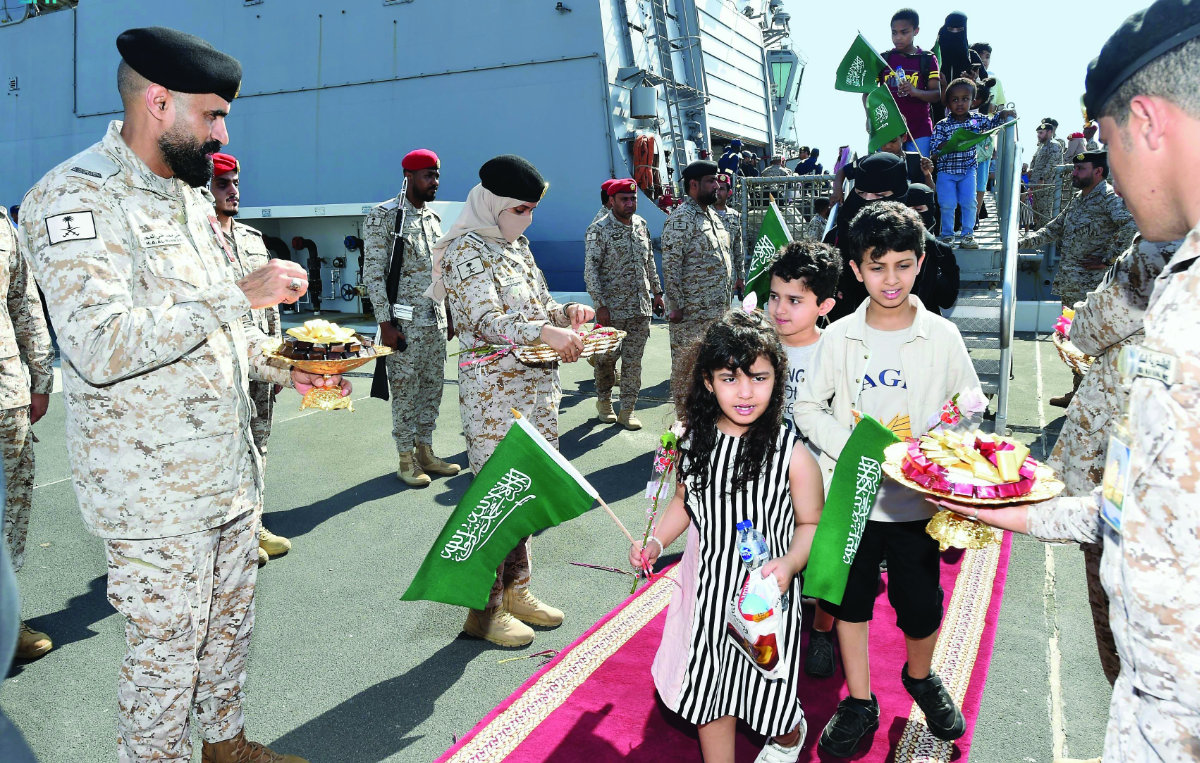


Saudi security forces welcome Saudi citizens and other nationals with chocolates and flowers as they disembark in Jeddah from a ship that rescued them from Sudan. (SPA)

He said the journey was long, starting from Khartoum, passing through a number of regions in Sudan until reaching Port Sudan, and was done in cooperation with government agencies in the Kingdom, praising the role of the Ministry of Defense that implemented the plan.
“We all celebrate the return of our sons and the sons of brotherly and friendly countries to the Kingdom Saudi Arabia, which coincided with the celebration of Eid Al-Fitr,” he said.
Those evacuated expressed their thanks and appreciation to the Saudi government and the concerned authorities in the Kingdom for their efforts to secure their transportation and facilitate their arrival procedures to the Kingdom.

Earlier on Saturday, the Kingdom’s Foreign Ministry announced that Saudi Arabia will start arranging the evacuation of its citizens and several nationals from other “brotherly and friendly” countries from Sudan as clashes intensify despite an Eid truce.

In a statement, the Saudi foreign ministry said the evacuated people will be flown to Saudi Arabia.

The decision comes “in the implementation of the directives” of Saudi Arabia’s King Salman and Crown Prince Mohammed bin Salman “to oversee the care and wellbeing of citizens of the Kingdom in the Republic of Sudan,” the foreign ministry said.

Kuwait’s Foreign Minister Sheikh Salem Abdullah Al-Jaber Al-Sabah said his country carried out an emergency operation to evacuate Kuwaiti citizens stranded in Sudan.

Sheikh Salem confirmed that all citizens wishing to return to the country had arrived safely in Jeddah, and that work was currently underway to secure their transfer to Kuwait.

The minister praised the efforts of Kuwait’s Ambassador to Sudan Dr. Fahd Mashari Al-Dhafiri, all members of the embassy in Khartoum and also extended his sincere thanks and gratitude to the Saudi authorities for coordinating and providing all the facilities for the transfer and evacuation of citizens to Jeddah.

He also thanked the Sudanese authorities and everyone who contributed to securing the safety of Kuwaiti citizens and enabling them to communicate with their families to ensure their safe return to their country.

Opinion

This section contains relevant reference points, placed in (Opinion field)

Saturday’s evacuations mark the first major civilian rescue since violence in Sudan broke out on April 15.

Eid this year in Sudan is being marked by fear, grief and hunger.Eid is meant to be spent “with sweets and pastries, with happy children, and people greeting relatives,” Khartoum resident Sami Al-Nour said. Instead, there has been “gunfire and the stench of blood all around us.”

The Sudanese army said it was coordinating efforts to evacuate diplomats from the United States, Britain, China and France out of the country on military airplanes, as fighting persisted in the capital, including at its main airport.

The military said that army chief Gen. Abdel Fattah Burhan had spoken to leaders of various countries requesting safe evacuations of their citizens and diplomats from Sudan.

Foreign countries have struggled in vain to repatriate their citizens, a task deemed far too risky as clashes between the Sudanese army and a rival powerful paramilitary group have raged in and around Khartoum, including in residential areas.

The main international airport near the center of the capital has been the target of heavy shelling as the paramilitary group, known as the Rapid Support Forces, has tried to take control of the complex, complicating evacuation plans. With Sudan’s airspace closed, foreign countries have ordered their citizens to simply shelter in place until they can figure out evacuation plans.

The country has been roiled by bloody fighting for the past week that has killed over 400 people so far, according to the World Health Organization.

(With AFP and AP)

Saudi Arabia’s $346 million lifeline for Yemen

Updated 20 sec ago
Follow

Saudi Arabia’s $346 million lifeline for Yemen

  • New SR 1.3 billion package targets salaries, liquidity shortages and state stability at pivotal moment for Aden government
  • Economic backing reinforces reform momentum and positions security as a foundation for Yemen’s long-term recovery

LONDON: When Riyadh announced on Wednesday a new SR 1.3 billion ($346.6 million) package to support Yemen’s government budget, salaries, and operational costs, it underscored more than a financial gesture. It reaffirmed a steady doctrine: diplomacy through economic stabilization.
Saudi Arabia’s military and humanitarian engagement in Yemen has long drawn global attention. Yet its economic role — through direct budgetary support, deposits, and large development projects — has been equally central to shaping the country’s fragile path toward recovery.
The latest aid signals Riyadh’s conviction that fiscal stability underpins enduring political and security progress.
The Kingdom has rolled out numerous economic and humanitarian initiatives in recent years.
Project Masam, a Saudi-funded demining program launched in June 2018 under KSrelief and in partnership with Yemen’s Executive Mine Action Center, has cleared more than 450,000 explosive devices.
In September 2025, KSrelief and the UN migration agency, IOM, launched two $4.45 million projects: one replacing costly water trucking in Ma’rib with permanent water systems and the other rehabilitating education facilities in Aden, Lahj, and Taiz for conflict-affected communities.
This builds on the Saudi Program for Development and Reconstruction of Yemen’s portfolio of hundreds of infrastructure projects spanning education, health, water, energy, transport, agriculture, fisheries, and governance capacity-building, offering a lifeline to millions amid what the UN has often called the world’s worst humanitarian crisis.
Yet this directive, guided by the Saudi leadership and channeled through the SDRPY, comes at a turning point for Yemen’s governance.
Fresh from recent leadership changes, the country faces acute economic strain. Public institutions grapple with severe liquidity shortages and salary arrears that threaten to erode what little trust remains in the state.
The SDRPY package is intended to strengthen economic, financial and monetary stability, enhance government capacity, improve governance and transparency, and empower the private sector to drive sustainable growth.
With a gross domestic product of just $19-20 billion, ranking roughly 125th in the world, the package is designed to kickstart Yemen’s derelict economy and break the vicious cycle whereby collapse fuels aid dependency, rendering the state all but ungovernable.
“There is no doubt that the recent Saudi support to the Yemeni government comes at an important time, following the formation of the new government headed by Dr. Shaea Al‑Zandani and its return to the interim capital Aden to manage affairs from within the country,” Gulf analyst Abdulhadi Al-Habtoor told Arab News.
“As Saudi Defense Minister Prince Khalid bin Salman announced, the support is meant to cover operational expenses and salaries, responding to the urgent needs of the Yemeni government.
“In my view, this assistance will also help the government continue the economic reforms it began in the past period, with a focus on transparency, combating corruption, and unifying state revenues under the Yemeni central bank.”
Yemen’s public payroll — the lifeline of any society — has nearly collapsed. Teachers, soldiers, medical staff, and administrative workers in government-controlled areas have gone months without pay.
Even when salaries do arrive, rampant depreciation of the Yemeni rial has eroded their value, forcing families to borrow money, sell belongings, or skip meals to survive.
Economically, the package targets Yemen’s gravest structural challenge: the inability to pay around half a million civil servants regularly.
Saudi officials said the funds will bolster the salary component of Yemen’s budget, ensure consistent disbursements, and lay the foundations for long-term financial stability.
“Yemen remains Saudi Arabia’s top regional priority,” Salman Al-Ansari, a Saudi geopolitical researcher, told Arab News. “Saudi Arabia is the world’s largest humanitarian and development partner to Yemen, providing more than $20 billion in support over the past decade.
“More than two million Yemenis live and work in the Kingdom, reflecting the deep human ties between our peoples. Paying salaries to our brothers and sisters in Yemen is only one part of a broader Saudi commitment to help Yemenis rebuild their lives and restore stability.”
The implications stretch beyond payroll. By circulating liquidity across Yemen’s regions, the package aims to restore purchasing power, stabilize household incomes, and revive confidence in local markets.
Over time, this could reactivate small businesses, strengthen supply chains, and weaken parallel economies run by militias and informal networks — bringing a semblance of normalcy to a country where despair once seemed all-consuming.
“We should also not forget that this Saudi support came after the recent events in eastern Yemen (Hadramout and Al‑Mahra) and the unrest caused there by the Southern Transitional Council before its dissolution — developments that negatively affected the living conditions of residents,” said Al-Habtoor.
“This latest support is expected to restore normalcy across the liberated provinces, reinforce the unity of the legitimate government’s ranks, and strengthen efforts to confront the Houthi terrorist group, which still controls the Yemeni capital, Sana’a.”
Riyadh’s approach stands out for its continuity.
Since 2012, Saudi Arabia has injected an estimated $12.6 billion in economic assistance to Yemen — through deposits at the central bank, monetary transfers, and direct grants — to avert fiscal collapse and curb the inflationary spiral that has undermined local governance.
The aid aligns with the Kingdom’s core regional narrative: security and development are inseparable.
Saudi Defense Minister Prince Khalid bin Salman recently emphasized that Riyadh’s support “embodies the Kingdom’s commitment to strengthening security and stability and contributing to building a better future for Yemen and its people.”
This logic has shaped much of Saudi Arabia’s current strategy in Yemen: prioritizing gradual economic rehabilitation — through liquidity support and targeted projects — over grand reconstruction pledges.
The Defense Ministry’s statement in January that Saudi Arabia had launched 28 developmental projects worth SR 1.9 billion across key sectors including health, energy, and education solidified this integrated approach: stabilizing essential services while re‑energizing public infrastructure.
In Yemen, such measures carry profound social and political weight. Regular salaries and operational funding signal legitimacy, keeping public employees connected to the state apparatus and preventing the hollowing out of governance.
In a landscape long defined by fractured authority, financial continuity becomes a simple act of state‑building.
Critics, however, note that the scale of need dwarfs the amount of aid. Yemen’s economy — operating at a fraction of pre-conflict capacity amid oil export blockades, inflation spikes, and declining donor support — is projected to have shrunk 1.5 percent in real GDP in 2025 and remains institutionally divided.
Yet, from Riyadh’s perspective, short‑term stabilization must precede structural change, a philosophy that echoes its domestic economic doctrines alike, where fiscal buffers unlock diversification.
The $346 million support, then, functions on two intertwined fronts: a humanitarian lifeline for millions facing wage insecurity, and a geopolitical anchor preserving Yemen’s sovereignty against further collapse.
Analysts view it as calibrated diplomacy: less transactional relief, more sustained leadership in a volatile neighborhood vital to Saudi interests.
As Yemen navigates yet another uncertain year, Saudi Arabia’s latest support may not solve the crisis, but it reiterates a principle increasingly central to Riyadh’s foreign policy: that economic endurance is the cornerstone of security.