


KHARTOUM: Street fighting between the forces of two rival generals eased in parts of Sudan’s capital by Friday evening, witnesses reported, after repeated calls for an end-of-Ramadan cease-fire to the nearly week-long conflict.
More than 400 people have been killed and thousands wounded since the fighting erupted Saturday between forces loyal to army chief Abdel Fattah Al-Burhan and his deputy, Mohamed Hamdan Daglo, who commands the powerful paramilitary Rapid Support Forces (RSF) and is commonly known as Hemeti.
The army announced Friday that it had “agreed to a cease-fire for three days” to “enable citizens to celebrate Eid Al-Fitr and allow the flow of humanitarian services,” which UN Secretary-General Antonio Guterres and US Secretary of State Antony Blinken had called for a day earlier.
Daglo said in a statement posted online that he had “discussed the current crisis” with Guterres, and was “focused on the humanitarian truce, safe passages, and protecting humanitarian workers.”
Blinken welcomed both the army’s announcement and an earlier one by the RSF, a powerful force formed from members of the Janjaweed militia involved in years of violence in the western Darfur region.
“It is clear, however, that fighting is continuing and there is serious mistrust between the two forces,” Blinken said, urging both sides to “pause the fighting” and “permit full and unimpeded humanitarian access.”
Witnesses in several areas of Khartoum reported a rare lull in the fighting Friday evening, after explosions had rocked the city for the seventh straight day.
Eid is meant to be spent “with sweets and pastries, with happy children, and people greeting relatives,” resident Sami Al-Nour told AFP. Instead, there has been “gunfire and the stench of blood all around us.”
Soldiers and paramilitaries fought fierce street battles in densely populated districts of Khartoum, with witnesses reporting blasts near the army headquarters in the city of five million people.
On Friday evening, the army accused the RSF of violating the truce, including by “indiscriminately bombing” the airport and presidential palace.
Two previous cease-fires earlier in the week had failed to take hold.
Plans are being made to evacuate foreign nationals, with the United States, South Korea and Japan deploying forces to nearby countries and the European Union weighing a similar move.
On Friday, the US State Department said the fighting had made Sudan too risky for an evacuation of embassy personnel from Khartoum.
The Pentagon has mobilized in the east Africa region to bring out US staff from the Sudan capital.
Later, the RSF said it was ready to “partially” open “all airports” in Sudan for neighboring countries to evacuate their citizens.
It could not be independently verified which airports were under RSF control.
The World Health Organization (WHO) said 413 people had been killed and 3,551 wounded in the fighting across Sudan, but the actual death toll is thought to be higher, with many wounded unable to reach hospitals.
The International Committee of the Red Cross urged “immediate and unimpeded humanitarian access,” saying it was a “legal obligation under international humanitarian law.”
Analysts have warned that the conflict could affect countries across the region, with the UN saying up to 20,000 people have already fled to neighboring Chad.
On Friday, for the first time since hostilities began, Burhan appeared on television.
“For Eid this year, our country is bleeding: destruction, desolation and the sound of bullets have taken precedence over joy,” he said in a pre-recorded message.
“We hope that we will come out of this ordeal more united... a single army, a single people... toward a civilian power.”
The International Crisis Group (ICG) said urgent steps were needed to stop a descent into “full-blown civil war,” warning that “the nightmare scenario that many feared in Sudan is unfolding.”
The World Food Programme said the violence could plunge millions more into hunger in a country where 15 million people — one-third of the population — need aid.
It has suspended its Sudan operations after three WFP workers were killed a week ago.
On Friday, the UN migration agency said one of its employees died after his vehicle was caught in crossfire.
Burhan and Daglo’s dispute centered on the planned integration of the RSF into the regular army, a key condition for a deal aimed at restoring Sudan’s democratic transition.
“What’s taking place was inevitable,” said Khartoum resident Ibrahim Awad. “A country ruled by two leaders cannot move forward, there can’t be two armies.”
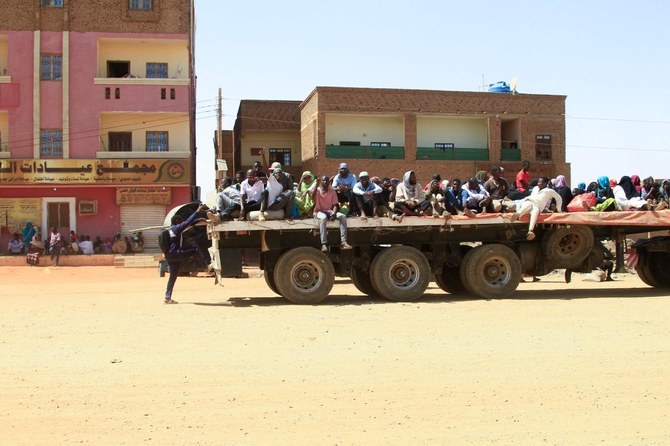
Civilians are becoming increasingly desperate, with thousands risking the dangerous streets to flee Khartoum.
More than two-thirds of hospitals in Khartoum and neighboring states are now “out of service,” the doctors’ union said. At least four hospitals in North Kordofan state were shelled.
The WHO added early Saturday that it had “verified 11 attacks on health care since the start of the conflict,” with facilities in affected areas “nearly non-functional due to staff fatigue and lack of supplies.”
In El Fasher in Darfur, around 800 kilometers (500 miles) southwest of Khartoum, Doctors Without Borders (MSF) said the situation was “catastrophic.”
“There are so many patients that they are being treated on the floor,” said MSF project coordinator Cyrus Paye.
The military toppled autocratic president Omar Al-Bashir in April 2019 following massive protests against his three decades of iron-fisted rule.
In October 2021, Burhan and Daglo joined forces to oust a civilian government installed after Bashir’s downfall, derailing an internationally backed transition to democracy.
“With neither Burhan nor Hemeti appearing ready to back down, the situation could get much worse,” the ICG think tank said.
“Even if the army eventually does secure the capital, and Hemeti retreats to Darfur, a civil war could well follow, with potentially destabilising impact in neighboring Chad, the Central African Republic, Libya and South Sudan.”


