
KARACHI: Bangles, among the most popular ornaments worn by women and girls during the festival of Eid Al-Fitr, have been hit hard by inflation, with manufacturers and sellers complaining of high production costs leading to a 40 percent decline in sales.
In Pakistan, Chand Raat, or Moon Night, the eve of Eid, is marked by Muslims preparing for the festival by stocking up on food, henna and bangles. But soaring prices have pushed Pakistanis to tighten their purse strings this festive season, one of the toughest in years as households struggle to contend with soaring energy and food bills.
Muslim majority Pakistan, home to more than 230 million people, is facing one of its worst economic crises in recent history. The South Asian nation has less than a month’s worth of foreign exchange reserves and is awaiting a bailout package of $1.1 billion from the IMF that has been delayed since November over issues related to fiscal policy adjustments.
Consumer price inflation in Pakistan jumped to a record 35.37 percent in March from a year earlier, with at least 16 people killed in stampedes for food aid during Ramadan.
The bangle industry is also suffering.
“The sales of bangles this year have declined by almost 40 percent, and the prices have doubled since last year,” Muhammad Shahrukh, a wholesale dealer at Karachi’s Liaquatabad Market, told Arab News.
“As a consequence of current price and sales trends, some of the dealers have started looking for alternative options to survive.”

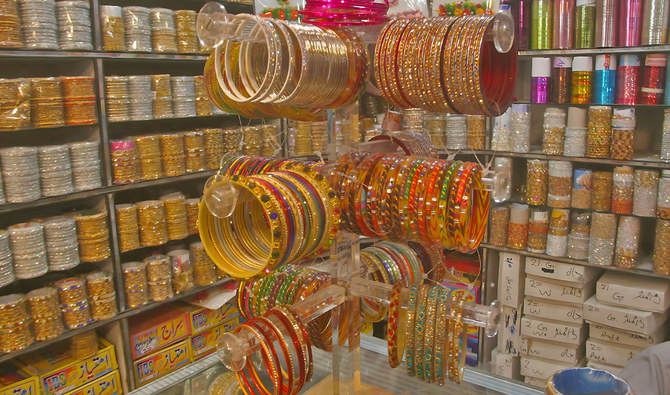
Different variety of bangles are displayed at a wholesale market in Karachi, Pakistan, on April 16, 2023 ahead of Eid Al-Fitr. (AN photo)
Bangles manufacturing is a traditional handicraft in Pakistan, particularly in the province of Sindh, with Hyderabad city as a manufacturing hub where skilled artisans mold and cut glass and other materials and then decorate the bangles with paint, beads and other ornamental items. The finished products are mostly sold locally and also exported to neighboring Afghanistan.
But this year, Pakistani manufacturers said the average cost of production had surged by more than 65 percent compared to 2022 due to an increase in the prices of imported raw material amid a massive depreciation of the Pakistani rupee against the US dollar.
“The prices of basic raw materials have surged by about 65 percent when we compare them with last year,” Hassan Jamal Siddiqui, a spokesperson for the Glass Bangles Manufacturers Association (GBMA), told Arab News from Hyderabad. “That was when the rupee exchange rate was around Rs180 to a dollar.”
Siddiqui added that the price of sodium carbonate was Rs4,200 last year, which had now surged to Rs11,750 per bag. Similarly, prices of all other raw materials, including gas, borax decahydrate, potassium dichromate and coloring chemicals, had increased manifold since last year.
“The main raw materials used in bangles are imported from Japan, China, Canada, Germany and Russia,” Siddiqui said. “Obviously, the dollar has appreciated against the Pakistani rupee, and the prices of raw materials have also increased more than double.”
Glass bangle manufacturers also encountered problems with procuring raw materials as the government, faced with an acute balance of payments crisis, last year imposed restrictions on imports to prevent the outflow of US dollars. Consequently, commercial banks stopped issuing letters of credit (LCs), leaving importers struggling to arrange the greenback for already placed orders.
“The issue with the opening of letters of credit gave way to black marketing of raw materials that contributed to the price hike,” Siddiqui said, adding that current production had declined by about 30 percent, while many factories had permanently shut down operations.
“There were around 70 bangles manufacturing factories in Hyderabad, but as of today, the number has dropped to only 35,” Siddiqui said.
The bangles manufacturing industry, which once provided job opportunities to over 700,000 people, he said, now only had about 100,000 jobs:
“The bangles industry in Hyderabad is gradually receding into the past,” Siddique added.
Sales too were down, bangle dealer Muhammad Arif said, as people were “prioritizing the purchase of essential goods required for their survival over buying of bangles.”
Consumers also said inflation had hit their buying choices this Eid.
“I have four daughters, and they were demanding new bangles for this Eid celebration, but I have convinced the elders to use the previously bought bangles and now would buy a new set for the younger one,” Samina Khalid, a homemaker, said.
“That is how we manage our household affairs under current circumstances with fixed incomes and skyrocketing prices.”