

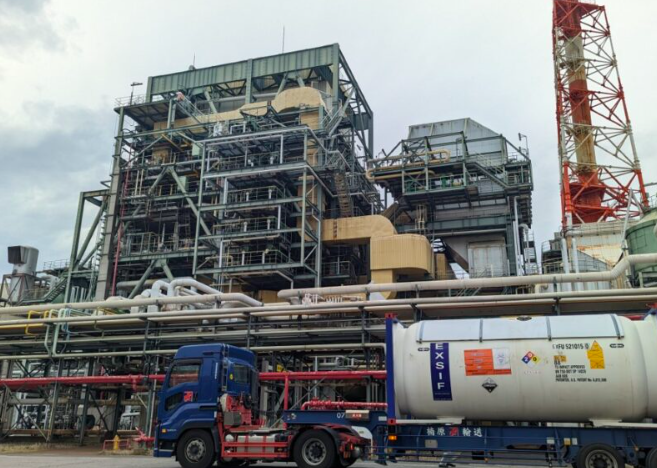
Aramco and SABIC dispatch first accredited low-carbon ammonia shipment to Japan

The shipment is the result of a successful multiparty collaboration across the low-carbon ammonia value chain (Supplied)
Short Url
Updated 20 April 2023
Follow

Aramco and SABIC dispatch first accredited low-carbon ammonia shipment to Japan

A first shipment of independently-certified low-carbon ammonia has arrived in Japan for use as fuel in power generation.

This initiative is part of broader efforts by Aramco and Saudi Basic Industries Corp. Agri-Nutrients to establish a global supply network for this lower-carbon fuel.

Aramco and SABIC AN also aim to supply low-carbon ammonia to other players to meet their early demand needs.

The shipment is the result of a successful multiparty collaboration across the low-carbon ammonia value chain.

The ammonia was produced by SABIC Agri-Nutrients with feedstock from Aramco, and sold by Aramco Trading Company to the Fuji Oil Company.

Mitsui OSK Lines was tasked with shipping the liquid to Japan, then the low-carbon ammonia was transported to the Sodegaura Refinery for use in co-fired power generation, with technical support provided by Japan Oil Engineering Co..

The ammonia is categorized as low-carbon because CO2 from the associated manufacturing process was captured and utilized in downstream applications.

Japan’s Ministry of Economy, Trade and Industry has announced plans to increasingly harness ammonia as a fuel for power generation and for ship propulsion, as part of the country’s 2050 decarbonization goals.

The low-carbon ammonia that reached Japan is part of broader efforts by Aramco and SABIC AN to establish a global supply network for this lower-carbon fuel.

Aramco and SABIC AN aim to supply low-carbon ammonia to other players to meet their early demand needs.

Olivier Thorel, Aramco senior vice president of chemicals, said: “This is another milestone that highlights the possibilities for low-carbon hydrogen and ammonia made from Aramco feedstock, with the potential to play a role in a lower-carbon future.

“Not only is low-carbon ammonia a means to transport lower-carbon hydrogen, it is an important energy source in its own right that can help decarbonize key sectors – including power generation for both utilities and industries. By dispatching this accredited low-carbon ammonia to Japan, we are helping chart a course for the development of this vital commodity.”

Abdulrahman Shamsaddin, SABIC AN CEO, said: “Our aim is to capitalize on this important milestone to grow and expand our positive contribution toward carbon neutrality. SABIC Agri-Nutrients made a public commitment not only to become carbon neutral by 2050 but also to collaborate with customers to help them achieve their net-zero emission targets.

“Customers in the energy, fertilizer and chemical sectors are looking for suppliers of lower-carbon hydrogen and ammonia. And we can meet their demand by leveraging our long-standing strengths across the value chain.”

Shigeto Yamamoto, FOC representative director and president, said: “As Japan aims to achieve carbon neutrality by 2050, low-carbon ammonia is expected to be a next-generation fuel that can contribute to the reduction of CO2 emissions.

“In order to reduce CO2 emissions from our own operations, we have been working on co-firing ammonia, which is a by-product of the petroleum refining process, in the boiler at our Sodegaura Refinery, and we plan to burn low-carbon ammonia imported this time with the cooperation of our partners in the same boiler.

"We will continue these efforts to contribute to the construction of the ammonia supply chain.”

Mohammed Al-Mulhim, Aramco Trading Company CEO, said: “This landmark achievement is an example of excellent collaboration across businesses within Aramco, SABIC, Aramco Trading and our Japanese partners, and indeed a major boost for our sustainability efforts.”

Toshiaki Tanaka, MOL Representative Director, executive vice president executive officer, said: “Ammonia is expected to be in great demand as a next-generation, clean energy source. Japan aims to achieve a carbon-neutral society by 2050, and we are very pleased to transport independently-certified low-carbon ammonia from Saudi Arabia to Japan.

“We are aiming for a track record of safe, reliable services across multiple transportation modes, in accordance with our customers’ needs. By combining accumulated knowledge and proactively participating in a broad range of value chains, we hope to contribute to the decarbonization of society.”


Saudi Aramco achieves significant progress in its gas production plan

Updated 26 February 2026
Follow

Saudi Aramco achieves significant progress in its gas production plan

RIYADH: Saudi Aramco has announced the achievement of significant progress in its plan to expand gas production, with the start of production at the Jafurah field, the largest unconventional gas field in the Middle East, and the commencement of operational activities at the Tanajib Gas Plant, one of the largest gas plants in the world.

The oil giant aims to increase its sales gas production capacity by approximately 80 percent by 2030 compared to 2021 production levels, reaching nearly 6 million barrels of oil equivalent per day from total gas and associated liquids production, according to the Saudi Press Agency.

This is expected to generate additional operating cash flows ranging between $12 billion and $15 billion in 2030, subject to future demand for sales gas and liquids prices.

President and CEO of Saudi Aramco, Amin Al-Nasser, said: “We are proud to commence production at the Jafurah field and begin operations at the Tanajib Gas Plant. These are major achievements for Saudi Aramco and the future of energy in the Kingdom. Our ambitious gas program is expected to become a key source of profitability.”

He affirmed that these mega-projects contribute to meeting the growing domestic demand for gas, supporting industrialization and development in several key sectors, in addition to producing significant quantities of high-value liquids.

Al-Nasser expressed his gratitude for the support, trust, and attention that Saudi Aramco receives from the Custodian of the Two Holy Mosques, King Salman bin Abdulaziz Al Saud, and His Royal Highness Prince Mohammed bin Salman bin Abdulaziz Al Saud, crown prince and prime minister, noting that this has had the most profound impact on the company’s achievements and distinguished projects that serve the Kingdom’s Vision 2030.

The gas extracted from the Jafurah field is expected to support the Kingdom’s growth targets in key sectors such as energy, artificial intelligence, major industries, and petrochemicals, potentially providing a major boost to the Kingdom’s economy and strengthening its position among the world’s top ten gas producers.

Saudi Aramco began first producing unconventional shale gas from the Jafurah field in December 2025, with technology playing a pivotal role in unlocking the potential of the Jafurah field and establishing it as a global benchmark for unconventional gas development. 

Since its inception, the project has leveraged technology to help reduce drilling and stimulation costs and enhance well productivity, contributing to its strong economic prospects.

The Jafurah area covers 17,000 sq. km and is estimated to contain 229 trillion standard cubic feet of raw gas and 75 billion barrels of condensates. The Jafurah field project aims to produce 2 billion standard cubic feet per day of sales gas, 420 million standard cubic feet per day of ethane, and approximately 630,00 barrels per day of gas liquids and condensates by 2030.

The Tanajib Gas Plant is a key pillar in Aramco’s strategy to increase gas processing capacities and diversify its energy product portfolio, helping to foster long-term economic growth. 

Operations began in December 2025, and its raw gas processing capacity is expected to reach 2.6 billion standard cubic feet per day in 2026. The start of operations at the Tanajib Plant coincided with the commencement of production from the Marjan field expansion and development program. 

The plant is distinguished by its digital integration, enhanced operational efficiency, capability to execute complex projects, and optimal use of resources. It processes raw gas associated with crude oil production from the offshore Marjan and Zuluf fields.

Aramco’s gas expansion is expected to create thousands of direct and indirect job opportunities, generating significant added value and strengthening its position as a reliable energy provider. 

It also helps meet the growing demand for natural gas and enhances its supply to national industries. 

The expansion strategy supports efforts aimed at achieving the optimal energy mix for local electricity generation, advancing the Kingdom’s liquid fuel displacement program, which will have a positive environmental impact, supporting the Kingdom’s ambition to achieve net-zero emissions by 2060, enhancing energy security, and contributing to building a more diversified national economy.