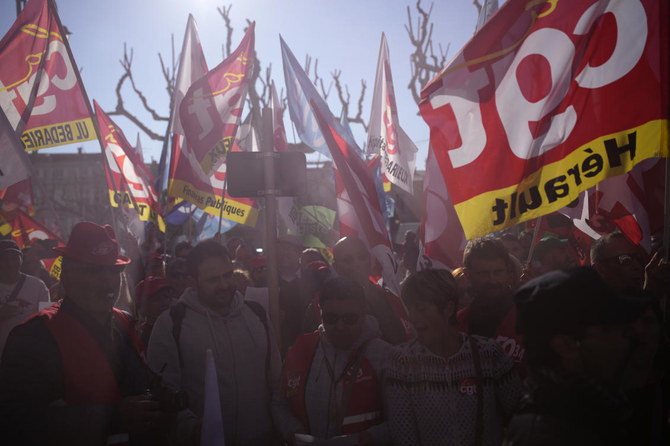
GANGES, France: French police fired teargas Thursday in a village in southern France where President Emmanuel Macron visited a school, a day after he was booed and heckled over his unpopular pension reform.
After facing angry voters on Wednesday in eastern Alsace, the 45-year-old head of state traveled to the southern Herault region on Thursday to discuss education.
The trips outside Paris are intended to signal his desire to turn the page on his unpopular pensions changes and demonstrate he is not hiding from voters, many of whom have been outraged by the way the legislation was passed.
Saying he wanted to “acknowledge and pay teachers better,” the 45-year-old former investment banker announced at a school in the village of Ganges that they would receive between 100-230 euros ($110-250) more a month after tax from September.
In the run up to his speech, police fired teargas when hundreds of people shouting “Macron, resign!” and blowing whistles tried to advance toward the school.
Local authorities also announced a ban on “portable sound equipment” which a spokesman said was meant to target amplifiers and speakers.
But the regional head of the CGT union, Mathieu Guy, told AFP that protesters had also been prevented from entering the secure area close to the school with pans as well as local flutes, known as “fifres.”
Macron’s left-wing political opponents urged their supporters to bash pans during Macron’s televised address to the nation on Monday evening and the age-old protest tactic appears to be becoming an audible sign of discontent at Macron’s policies.
The apparent pan ban led to ridicule on Thursday, with Communist party spokesman Ian Brossat saying he “couldn’t wait for the legislation which will ban the sale of saucepans.”
“Is it possible to leave a democratic crisis behind by banning saucepans?” asked leading Greens MP Sandrine Rousseau.
Speaking to voters on Wednesday, Macron argued again that raising the retirement age from 62 to 64 was necessary to help France reduce its public spending and bring the country into line with its European neighbors.
He signed the legislation into law on Friday evening after a green light from the country’s constitutional court.
Other protests continued on Thursday, with union members entering the headquarters of the pan-European stock exchange Euronext in the main Paris business district.
Demonstrators also forced their way into the headquarters of the LVMH luxury goods empire last Thursday.
Some rail workers also went on strike again on Thursday, forcing the cancelation of one in five regional trains and some commuter services.


Teargas fired as Macron faces more hostile crowds in rural France
https://arab.news/m8xub
Teargas fired as Macron faces more hostile crowds in rural France

- The trips outside Paris are intended to signal his desire to turn the page on his unpopular pensions changes
- In the run up to his speech, police fired teargas when hundreds of people shouting "Macron, resign!"


UK drops plans for mandatory digital ID for workers in latest U-turn, media reports
- The digital ID would be held on people’s mobile phones, the government said
- The plan drew criticism from political opponents and warning it could infringe on civil liberties
LONDON: Britain is set to drop plans to make it mandatory for workers to hold a digital identity document, The Times newspaper, the BBC and other media reported on Tuesday, potentially marking another policy U-turn for the Labour government.
Prime Minister Keir Starmer announced in September last year that his government would require every employee to hold a digital ID in an attempt to tackle illegal migration and reduce the threat from the populist Reform UK party.
The government said the digital ID would be held on people’s mobile phones and become a mandatory part of checks employers must make when hiring staff.
The plan drew criticism from political opponents, with some arguing it would not deter illegal migration and others warning it could infringe on civil liberties.
The Times said the government abandoned the plan amid concerns it could undermine public trust in the scheme, noting that when introduced in 2029, digital IDs would be optional rather than mandatory.
Other forms of documentation, such as an electronic visa or passport, would still be valid, The Times said.
“We are committed to mandatory digital right to work checks,” a government spokesperson said. “We have always been clear that details on the digital ID scheme will be set out following a full public consultation which will launch shortly.”
The spokesperson said current checks rely on a “hodgepodge” of paper-based systems, with no record of whether they were ever carried out, leaving the process open to fraud and abuse.
If plans for a mandatory digital ID are dropped, it would mark another policy climbdown for Starmer.
In December, the government scaled back a plan to raise more tax from farmers, months after it backed down on cuts to welfare spending and scaled back a proposal to reduce subsidies on energy bills for the elderly.


