

Pakistan’s foreign minister to make most senior-level trip to India in seven years

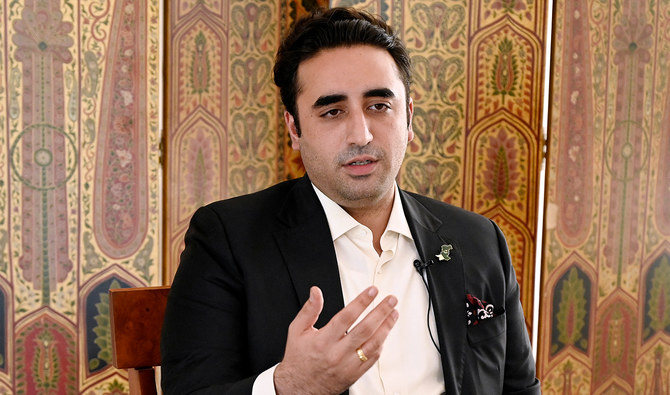
Pakistan's Foreign Minister Bilawal Bhutto Zardari, speaks during an interview at the Embassy of Pakistan in Washington, DC, September 27, 2022. (AFP/FILE)
Short Url
Updated 20 April 2023
Follow

Pakistan’s foreign minister to make most senior-level trip to India in seven years

  • Foreign Minister Bilawal Bhutto-Zardari will visit India in May for the Shanghai Cooperation Organization meeting
  • The announcement comes as a surprise since Pakistan downgraded its relations with India in 2019 over Kashmir

ISLAMABAD: Foreign minister Bilawal Bhutto-Zardari will visit India next month to attend the Shanghai Cooperation Organization's (SCO) meeting, his ministry’s official spokesperson confirmed on Thursday, making it the most senior-level visit from Pakistan to the country in seven years. 

The development comes as a surprise since Pakistan decided to downgrade diplomatic relations with India after the administration in New Delhi revoked the special constitutional status of the disputed Himalayan region of Kashmir in August 2019 to integrate it with the rest of the Indian union. 

Pakistan also revisited its trade relations with its eastern neighbor and voiced concern that Indian officials were violating international law by trying to change the demography of Muslim-majority Kashmir under its administration. 

This is the first time that a senior foreign office representative from Pakistan will visit India since 2016, the last visit being undertaken by the then advisor to the prime minister on foreign affairs, Sartaj Aziz, who attended the 'Heart of Asia' conference in Amritsar.
Earlier this year, Pakistan’s foreign office confirmed India’s invitation to its foreign minister to attend the SCO meeting, though it said it was not in a rush to send an acceptance. 
“Foreign Minister Bilawal Bhutto-Zardari will be leading the Pakistan delegation to the Shanghai Cooperation Organization (SCO) Council of Foreign Ministers (CFM) being held on 4-5 May 2023 in Goa, India,” said the foreign office spokesperson, Mumtaz Zahra Baloch.  

“The Foreign Minister is attending the SCO CFM meeting at the invitation of the current Chair of SCO CFM, Dr. S. Jaishankar, Minister for External Affairs of the Republic of India.” 

She added that Pakistan’s participation in the meeting reflected its commitment to the SCO charter and processes and the importance that the country accorded to the region in its foreign policy priorities. 

“Foreign Minister Bilawal Bhutto Zardari had also attended the last meeting of the Council of Foreign Ministers held in July last year in Tashkent,” she continued. 

Pakistan and India continue to have rocky relations, though the Pakistani foreign minister’s upcoming visit to the neighboring country could turn out to be a step toward normalization. 

Prime Minister Shehbaz Sharif also offered talks to India recently which prompted Indian officials to say that they wanted normal relations with Pakistan in a “conducive atmosphere.” 

Former prime minister Imran Khan's opposition Pakistan Tehreek-e-Insaf (PTI), party raised questions on the timing and purpose of FM Bhutto-Zardari's India visit, saying that it “amounts to surrendering our position” on Indian-administer Kashmir.  

“This government has shown that they are capable of surrendering everything to make Modi happy,” senior PTI leader Chaudhry Fawad Hussain told Arab News. 

“The foreign minister will backstab the struggle of the people of Kashmir,” he added. 

Former parliamentary secretary for foreign affairs, Andleeb Abbas, said Pakistan's foreign policy under Prime Minister Sharif’s government is "directionless" as the government should have highlighted Indian atrocities in Indian-administered Kashmir. 

She also said Sharif should have raised the issue of Muslims getting killed in India, instead of trying to normalize relations with the country. 

“The foreign minister should have taken the people of Pakistan into confidence over the purpose and timing of his visit to India before the formal announcement of his trip,” she told Arab News. 

International affairs analyst Dr. Huma Baqai referred to the development as a "positive" one, and urged political parties to refrain from indulging in politics as it is a national issue. 

“We have been hostage to the Kashmir conflict for decades now and people on both sides [Pakistan and India] remain at the losing end,” Dr. Huma Baqai, an expert on international affairs, told Arab News.  

“Both countries should move on to normalize their relations for the benefit of their people,” she said, adding that the SCO meeting was a global event and it would be a mistake if Pakistan’s foreign minister did not participate in it. 

“We both [Pakistan and India] should start negotiations to settle our disputes amicably and our foreign minister’s trip to India could pave the way for it,” she added. 


Nearly 25% of Pakistan’s primary schools enrolling girls operate as single-teacher ones— report

Updated 13 sec ago
Follow

Nearly 25% of Pakistan’s primary schools enrolling girls operate as single-teacher ones— report

  • Pakistan needs over 115,000 more teachers in primary schools enrolling girls to meet global benchmark of one teacher per 30 students, says report
  • Sixty percent of Pakistani primary schools enrolling girls are overcrowded, while 32% lack clean drinking water or toilets, says Tabadlab report

ISLAMABAD: Nearly 25% of Pakistan’s primary schools that enrolls girls operate as single-teacher ones, a report by a leading think tank said this week, calling on the government to devolve teacher recruitment powers, upskill underutilized teachers and introduce reforms to hire and promote faculty members. 

Pakistan faces an acute education crisis which is reflected in the fact that it has the world’s second-highest number of out-of-school children, an estimated 22.8 million aged 5-16 who are not in educational institutions, according to UNICEF. 

While poverty remains the biggest factor keeping children out of classrooms, Pakistan’s education crisis is exacerbated by inadequate infrastructure and underqualified teachers, cultural barriers and the impacts of frequently occurring natural disasters. 

According to “The Missing Ustaani,” a report published by Islamabad-based think tank Tabadlab and supported by Malala Fund and the Pakistan Institute of Education (PIE), Pakistan needs over 115,000 more teachers in primary schools with girls’ enrolment to meet the basic international benchmark of ensuring one teacher per 30 children. Currently, the average Student-to-Teacher Ratio (STR) across Pakistan’s primary schools with girls’ enrolment is 39:1, it said. 

“Approximately 60% of these schools are overcrowded, necessitating the recruitment of over 115,000 additional teachers nationwide,” the report said on Monday. “Compounding this, nearly 25% of primary schools with girls’ enrolment operate as single-teacher schools, placing immense pressure on the quality of education.”

It said the situation is more dire in Pakistan’s poverty-stricken southwestern Balochistan province, where nearly 52% of the schools are single-teacher only ones while the percentage decreases slightly in the southern Sindh province to 51 percent. 

The report said while the STR improves to 25:1 at the middle school level, acute shortages of subject specialists emerge as the top-priority concern for quality education in these schools.

“Furthermore, around 32% of primary schools with girls’ enrolment and 18% of middle schools face ‘critical infrastructural shortages’— lacking clean drinking water or toilets in addition to high STRs— which significantly affects girls’ attendance and learning, particularly during adolescence,” the report said. 

The report cited a set of priority recommendations to address Pakistan’s systemic teacher deployment challenges and improve educational equity for girls. 

It urged the government to devolve recruitment authority to school or cluster levels to enable timely, context-specific hiring. It also called upon authorities to reform teacher transfer and promotion policies to introduce school-specific postings with minimum service terms. 

This, it said, would reduce arbitrary transfers and improving continuity in classrooms. The report advised authorities to upskill surplus or underutilized primary teachers to support instruction at the middle school level, helping address subject-specialist shortages.

“Together, these reforms offer a pathway toward a more equitable, efficient, and responsive teaching workforce— one capable of improving learning outcomes and ensuring that every girl in Pakistan has access to a qualified teacher,” the report said. 

To tackle Pakistan’s education crisis, Prime Minister Shehbaz Sharif declared an ‘education emeregency’ in September 2024, stressing the importance of education for all.