

Indonesian hackers vow to continue cyberattacks on Israel

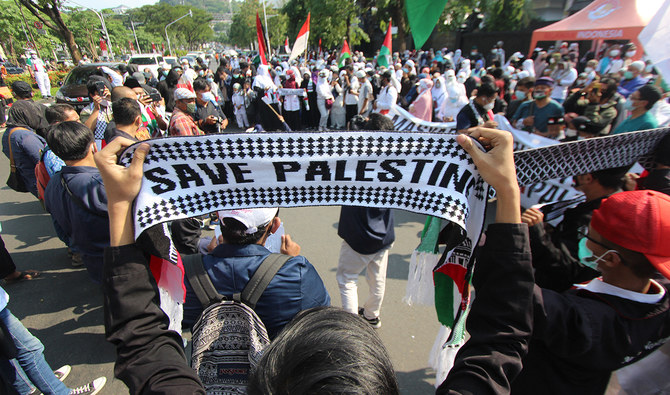
Demonstrators gather in support of Palestinians during a rally in Semarang on May 21, 2021, amid ongoing conflict between Israel and the Palestinian Territories. (AFP/FILE)
Short Url
Updated 20 April 2023
Follow

Indonesian hackers vow to continue cyberattacks on Israel

  • ‘Hacktivist’ group targeted Israeli police, health ministry, central bank
  • VulzSec Team says it has obtained sensitive data from Israeli institutions

JAKARTA: Indonesian hackers are going to continue to breach the websites of Israeli government institutions, a group claiming a wave of cyberattacks that made headlines this week told Arab News.

The attacks by hackers from the world’s largest Muslim-majority nation came amid a series of similar breaches targeting Israeli agencies this month, which have been claimed by hacker groups from other countries, amid assaults by Israel’s security forces on Palestinian worshippers at Al-Aqsa Mosque during the holy month of Ramadan.

The Indonesian hacker group, which calls itself VulzSec Team, said it had successfully breached various government systems in Israel, including the police, health ministry, transport institutions as well as the central bank, and had obtained from them sensitive information.

Some of the data, mainly from the health ministry, which according to the group come from the recent attacks, has already been published on its Facebook page, with parts of it censored.

Arab News could not immediately verify the claims, while Tel Aviv has not commented yet on the cyberattack from Indonesia.

“In the future we will be more focused on other institutions and try to breach other systems in Israel,” VulzSec Team told Arab News, adding that they censor the data they share and would not upload sensitive information as there were no bad intentions behind the hacks.

VulzSec Team said its “Operation Israel” was launched “for humanitarian reasons to support the aspirations of Palestinian people’s rights” and aimed to raise awareness over their belief of “freedom among human beings, including the freedom for Palestinians from Israeli attacks.”

The Indonesia hacking campaign and the earlier ones by other groups, including Anonymous Sudan, appear to be carried out by “hacktivists,” or those who utilize internet tools to express their discontent.

For Ardi Sutedja, chairman and founder of Indonesia Cyber Security Forum, it has been a growing trend as people have been switching their attention from physical to virtual things.

“Oftentimes there’s this strong solidarity among people, but they fail to think of the long-term consequences that when they do such activities, it will surely be countered in various ways,” he told Arab News, adding that there might be a counterattack from Israel.

“When it comes to Israel, it is known that when they experience a cyberattack, they will counterattack, and we don’t know what sort of counter cyberattack they will use,” Sutedja said.

“This is against a state which has (technology) sophistication that we don’t even know the limits of.”


Thousands of Gaza children suffer from famine conditions

Updated 7 sec ago
Follow

Thousands of Gaza children suffer from famine conditions

  • “The number of children admitted is five times higher than in February, so we need to see the numbers come down further”

GENEVA: Thousands of children have been admitted for treatment for acute malnutrition in Gaza since an October ceasefire that was supposed to enable a major increase in humanitarian aid, the UN children’s agency said on Tuesday.
UNICEF, the biggest provider of malnutrition treatment in Gaza, said that 9,300 children were treated for severe acute malnutrition in October, when the first phase of an agreement to end the two-year Israel-Hamas war came into effect.

FASTFACTS

• UNICEF, the biggest provider of malnutrition treatment in Gaza, said that 9,300 children were treated for severe acute malnutrition in October. • While this is down from a peak of over 14,000 in August, the number is still significantly higher than during a brief February-March ceasefire.

While this is down from a peak of over 14,000 in August, the number is still significantly higher than during a brief February-March ceasefire and indicates that aid flows remain insufficient, UNICEF spokesperson Tess Ingram told a Geneva press briefing by video link from Gaza.
“It’s still a shockingly high number,” she said.
“The number of children admitted is five times higher than in February, so we need to see the numbers come down further.” Ingram described meeting underweight babies weighing less than 1 kilogram born in hospitals “their tiny chests heaving with the effort of staying alive.”
UNICEF is able to import considerably more aid into the enclave than it was before the October 10 agreement but obstacles remain, she said, citing delays and denials of cargoes at crossings, route closures and ongoing security challenges.
“We have seen some improvement, but we continue to call for all of the available crossings into the Gaza Strip to be open,” she added. There are not enough commercial supplies entering Gaza, she added, saying that meat was still prohibitively expensive at around $20 a kilogram.
“Most families can’t access this, and that’s why we’re still seeing high rates of malnutrition,” she said.
In August, a UN-backed hunger monitor determined that famine conditions were affecting about half a million people — or a quarter of Gaza’s population.
Children were severly affected by hunger as the war progressed, with experts warning that the effects could cause lasting damage.