



PESHAWAR: Pakistan’s charge d’affaires in Afghanistan has resumed his diplomatic responsibilities to “push forward bilateral ties” between the two neighboring countries, four months after surviving an attack, a senior Pakistani embassy official confirmed on Wednesday.
The Pakistan embassy in Afghanistan was targeted by militants in December last year, making authorities in Islamabad describe the incident as an “assassination attempt” against its top diplomat, Ubaid-ur-Rehman Nizamani.
While Nizamani was not hurt in the attack, a Pakistani security guard was “critically injured” and was later flown to Peshawar for medical treatment.
The attack was claimed by Daesh, though Pakistan said it was going to verify if the group was indeed behind the attack on its diplomatic facility.
“After four months, the Chargé d’Affaires and head of the mission arrived back in Kabul last Friday (April 14) to resume his assignment,” Tahir Nawaz, Press Counsellor at the Pakistani Embassy in Kabul, told Arab News.
“He has formally started meeting Afghan dignitaries and other stakeholders to push forward bilateral ties.”
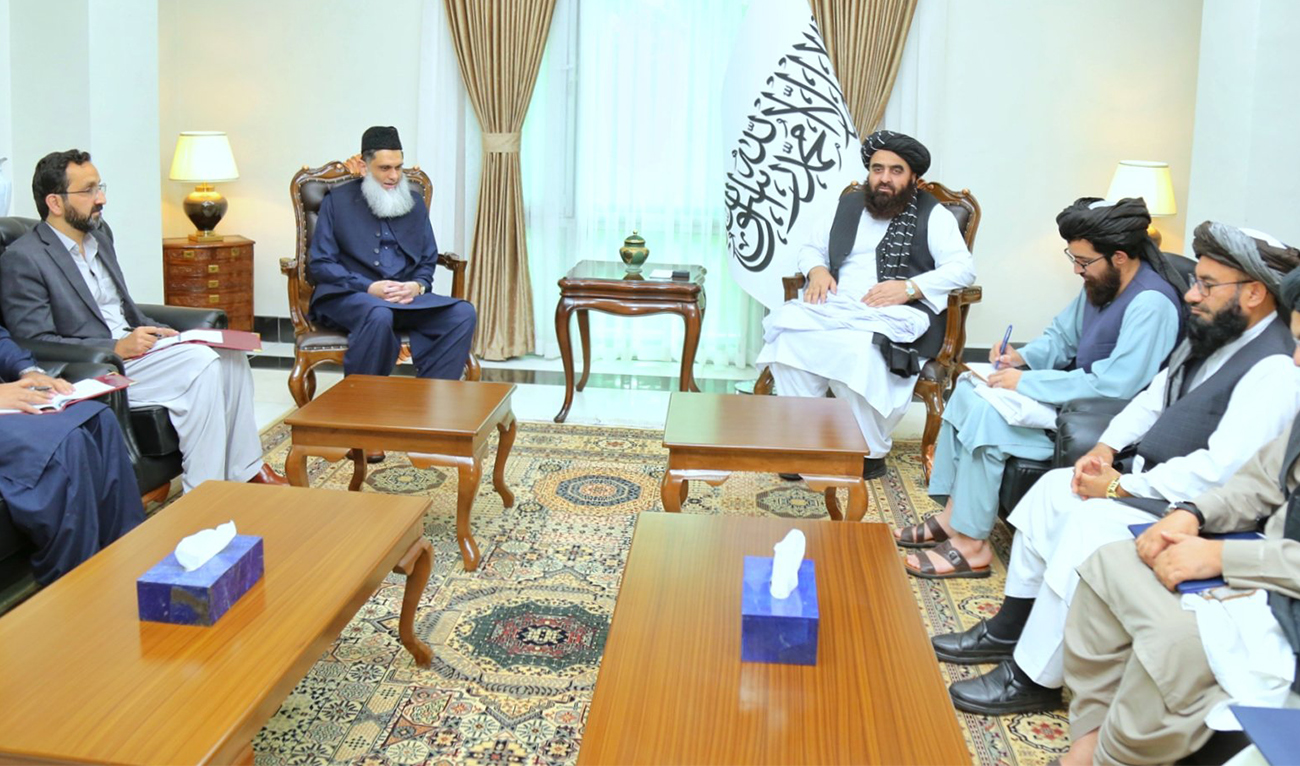
Pakistan's chargé d’affaires in Afghanistan, Ubaid-ur-Rehman Nizamani (center left) meets with the interim Afghan foreign minister, Amir Khan Muttaqi, in Kabul, Afghanistan, on April 18, 2023. (@QaharBalkhi/Twitter)
The official said Nizamani held a marathon meeting with Afghanistan’s acting Foreign Minister, Amir Khan Muttaqi, on Tuesday to discuss issues of mutual interest.
He said talks were “productive” and would lead both sides to build mutual trust, facilitate trade and people’s movement at the border.
Abdul Qahar Balkhi, the spokesperson for the Afghanistan Ministry of Foreign Affairs, wrote in a Twitter post that during the meeting, Afghanistan’s foreign minister hoped Nizamani's return would “positively impact bilateral diplomatic relations.”
“FM Muttaqi called the release of the majority of Afghans from Karachi prisons a positive step, calling for the remaining to be freed before the arrival of Eid ul-Fitr," Balkhi wrote.
The minister also encouraged Nizamani to "further increase transparency" in the visa issuance process, Balkhi said.
Commenting on bilateral relations, Nawaz said Pakistan has stepped up efforts to facilitate trade, relax the visa regime for Afghans, and improve diplomatic ties with the neighboring country.
“Islamabad will adopt all measures to remove any trade barriers and simplify visas to facilitate Afghanistan students, patients, and entrepreneurs,” he said.
Afghan analyst Hikmat Safi said the diplomat’s return to Kabul signifies that both Kabul and Islamabad had activated their diplomatic channels to give impetus to their relations.
He said the development takes place ahead of a proposed visit by Afghanistan’s acting foreign minister to Pakistan in May.
The return of a Pakistani top embassy official was an encouraging and bold move, he said, adding that other countries should have their diplomatic staff present in Kabul as well to deal with issues in a more convenient way.
“It is a fact that both the neighboring countries remain mostly at loggerheads over certain issues, but it is also a fact that both of them cannot afford to remain foes for long because of their shared interests,” Safi said.
“I think the return of Nizamani and the planned visit by an Afghan delegation in May clearly depict that bilateral relations in all areas will see marked improvement and move in tandem in near future.”
The Pakistani diplomat’s return comes at a time when his country has been carrying out intelligence-based operations against a conglomerate of militant factions, Tehreek-e-Taliban Pakistan (TTP), in the western provinces of Khyber Pakhtunkhwa and Balochistan.
Pakistan suspects the TTP leadership is based in Afghanistan and has taken up the issue with the administration in Kabul while urging its officials not to allow armed factions to use their soil against other countries.
TTP has stepped up attacks in Pakistan since last November when it unilaterally called off a fragile cease-fire with the government.
The Pakistani government has also intensified efforts to contain the activities of the militant network through military and diplomatic means.


