

Former Indian politician and brother shot dead live on TV while in police custody

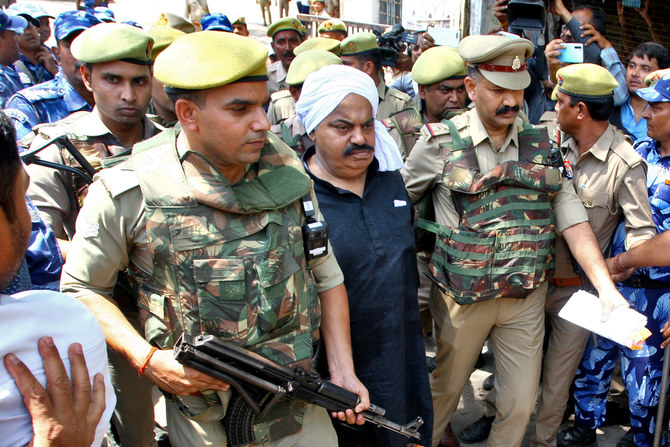
Police officers escort Atiq Ahmed, a former lawmaker in India's parliament convicted of kidnapping and accused in several criminal cases, outside a court in Prayagraj, India on April 13, 2023. (Photo courtesy: Reuters)
Short Url
Updated 17 April 2023
Follow

Former Indian politician and brother shot dead live on TV while in police custody

  • Atiq Ahmed, 60, had been state lawmaker four times, was facing murder, assault charges
  • High-level judicial probe formed to investigate killings, report expected in two months

NEW DELHI: A former Indian lawmaker convicted of kidnapping was shot dead, along with his brother, while being escorted by police in northern India on Saturday.

Atiq Ahmed and his brother, Ashraf Ahmed, were under police escort for a medical check-up at a hospital on Saturday night when three men shot them from close range as they were speaking to reporters in Prayagraj city in Uttar Pradesh state.

Multiple videos of the shooting were shared widely across social media after it was initially broadcast live on local TV channels. The footage shows the brothers in handcuffs before a man pulled a gun close to Atiq’s head, with Ashraf also shot a split second later.

“According to the initial information, three people came in the guise of media persons and they tried to take (sound) bites,” Prayagraj Police Commissioner Ramit Sharma told reporters on Saturday.

“At that time they fired, and we have arrested three people, and Atiq and Ashraf died.”

The government of Uttar Pradesh, controlled by Prime Minister Narendra Modi’s ruling Bharatiya Janata Party, formed a three-member judicial commission on Sunday to investigate the killings and submit a report in two months.

“Today there is a complete shutdown in Prayagraj and people are in a deep sense of fear,” social activist Irshad Ullah, who is based in the city, told Arab News.

Internet services and gatherings of more than four people were barred across the state after the attack.

“No one is safe now. If the state does not like you it can kill you at will — this is the message from this incident.”

Atiq Ahmed, 60, had a long stint both in politics and in the criminal world. He was a state lawmaker four times and had dozens of cases, including kidnapping, murder, and extortion, registered against him over the past two decades.

Ahmed had petitioned the Indian Supreme Court for protection two weeks earlier, saying there was a threat to his life from the police. His teenage son was shot dead by police on Thursday in what was described as a shootout.

“Crime has reached its peak in UP (Uttar Pradesh) and the morale of the criminals is high. When someone can be killed openly despite being surrounded by a security cordon, one can imagine the state of the general public. Due to this, an ambience of fear is being created among the public,” Akhilesh Yadav, chief of the opposition Samajwadi Party, said in a tweet.

Rakesh Tripathi, BJP spokesperson in Uttar Pradesh, said an investigation was underway.

“The incident in Prayagraj is unfortunate and police are investigating the matter. The accused are in police custody and we are investigating the whole affair,” Tripathi told Arab News.

Saturday’s killings have sparked concerns over India’s rule of law among human rights activists and members of civil society.

“Over a dozen bullets fired to kill gangster Atiq Ahmed and his brother in the presence of the police and camera persons without any retaliatory fire from the police personnel present points to the worrying truth that justice by the judiciary has been done away with,” Suhas Chakma, director of Delhi-based Rights & Risks Analysis Group, told Arab News.

“How the police can be so lax knowing well that he was a high-profile convict? How can some three people come and kill him despite such a huge police presence?” Prof. Roop Rekha Verma, social activist and former professor at Uttar Pradesh’s Lucknow University, told Arab News.

“My question is on the intention of the police and the government,” she added.

The killings, according to senior Supreme Court advocate Sanjay Hedge, are “a total negation of the rule of law.

“The judiciary cannot look away or be seen as complicit in a cover-up. It must take a more proactive stance, asking the right questions and eliciting answers,” Hedge told Arab News.

Delhi-based political analyst Prof. Apoorvanand Jha, said the incident was a challenge for Indian democracy.

“This is an ominous sign for Indian democracy,” Jha told Arab News. “Atiq Ahmed approached the supreme court for protection. So now we will wait to see whether the apex court takes the suo moto cognizance of these killings and makes the Uttar Pradesh government accountable.”
2025 among world’s three hottest years on record, WMO says

Updated 14 January 2026
Follow

2025 among world’s three hottest years on record, WMO says

  • All eight datasets confirmed that the last three years were the planet’s three hottest since records began, the WMO said
  • The slight differences in the datasets’ rankings reflect their different methodologies and types of measurements

BRUSSELS: Last year was among the planet’s three warmest on record, the World Meteorological Organization said on Wednesday, as EU scientists also confirmed average temperatures have now exceeded 1.5 degrees Celsius of global warming for the longest since records began.
The WMO, which consolidates eight climate datasets from around the world, said six of them — including the European Union’s European Center for Medium-Range Weather Forecasts (ECMWF) and the British national weather service — had ranked 2025 as the third warmest, while two placed it as the second warmest in the 176-year record.
All eight datasets confirmed that the last three years were the planet’s three hottest since records began, the WMO said. The warmest year on record was 2024.

THREE-YEAR PERIOD ABOVE 1.5 C AVERAGE ⁠WARMING LEVEL
The slight differences in the datasets’ rankings reflect their different methodologies and types of measurements — which include satellite data and readings from weather stations.
ECMWF said 2025 also rounded out the first three-year period in which the average global temperature was 1.5 C above the pre-industrial era — the limit beyond which scientists expect global warming will unleash severe impacts, some of them irreversible.
“1.5 C is not a cliff edge. However, we know that every fraction of a degree matters, particularly for worsening extreme weather events,” said Samantha Burgess, strategic ⁠lead for climate at ECMWF.
Burgess said she expected 2026 to be among the planet’s five warmest years.

CHOICE OF HOW TO MANAGE TEMPERATURE OVERSHOOT
Governments pledged under the 2015 Paris Agreement to try to avoid exceeding 1.5 C of global warming, measured as a decades-long average temperature compared with pre-industrial temperatures.
But their failure to reduce greenhouse gas emissions means that target could now be breached before 2030 — a decade earlier than had been predicted when the Paris accord was signed in 2015, ECMWF said. “We are bound to pass it,” said Carlo Buontempo, director of the EU’s Copernicus Climate Change Service. “The choice we now have is how to best manage the inevitable overshoot and its consequences on societies and natural systems.”
Currently, the world’s long-term warming level is about 1.4 C above the pre-industrial era, ECMWF said. Measured on a short-term ⁠basis, average annual temperatures breached 1.5 C for the first time in 2024.

EXTREME WEATHER
Exceeding the long-term 1.5 C limit would lead to more extreme and widespread impacts, including hotter and longer heatwaves, and more powerful storms and floods. Already in 2025, wildfires in Europe produced the highest total emissions on record, while scientific studies confirmed specific weather events were made worse by climate change, including Hurricane Melissa in the Caribbean and monsoon rains in Pakistan which killed more than 1,000 people in floods.
Despite these worsening impacts, climate science is facing political pushback. US President Donald Trump, who has called climate change “the greatest con job,” last week withdrew from dozens of UN entities including the scientific Intergovernmental Panel on Climate Change.
The long-established consensus among the world’s scientists is that climate change is real, mostly caused by humans, and getting worse. Its main cause is greenhouse gas emissions from burning fossil fuels like coal, oil and gas, which trap heat in the atmosphere.