Pakistani political leader tries to mediate talks between government, ex-PM Khan’s party

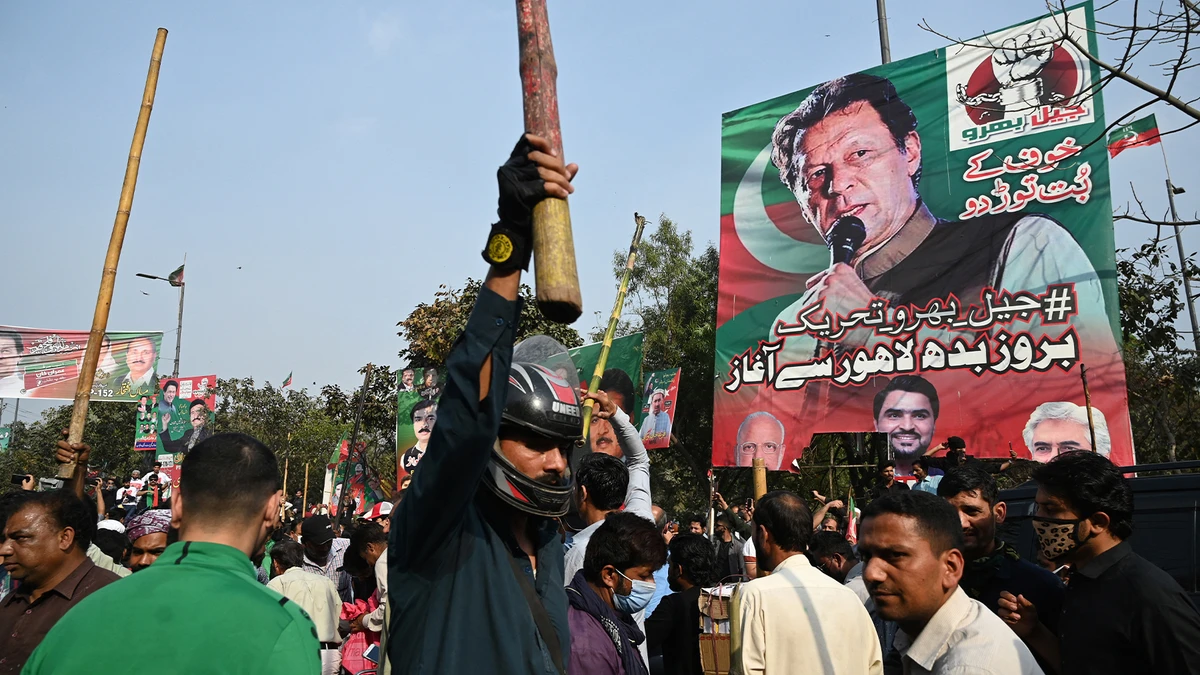
Supporters of former Pakistan's prime minister Imran Khan block a road near Khan's residence to prevent officers from arresting him, in Lahore, Pakistan, on March 15, 2023. (AFP/File)
Short Url
Updated 16 April 2023
Follow

Pakistani political leader tries to mediate talks between government, ex-PM Khan’s party

  • The JI chief holds separate talks with Shehbaz Sharif and Imran Khan to break political deadlock
  • Siraj-ul-Haq proposes national elections as a way out of the current political crisis in Pakistan

ISLAMABAD: The top leader of a Pakistani religious political party, Jamaat-e-Islami (JI), held separate meetings with Prime Minister Shehbaz Sharif and his arch-rival Imran Khan in the eastern city of Lahore on Saturday, trying to convince the two leaders to sort out their differences over the upcoming elections through constructive negotiations.

Pakistan’s ruling coalition has consistently refused to hold early elections in the country since the downfall of Khan’s Pakistan Tehreek-e-Insaf (PTI) administration in a parliamentary no-confidence vote last year in April. However, Khan has been seeking snap polls since his ouster from power and dissolved the provincial assemblies of Punjab and Khyber Pakhtunkhwa in January, where his party was in power, to mount greater political pressure on the government.

As the political crisis deepened in recent months over the issue, Pakistan’s top court took up the matter for hearing and instructed the country’s central bank to give Rs21 billion to the election commission to conduct the polls.

The JI chief, Siraj-ul-Haq, took a three-member delegation to mediate between the two sides and said he was reasonably satisfied with the outcome of the two meetings.

“The meetings with Prime Minister Mian Shehbaz Sharif and former prime minister Imran Khan were useful,” he said in a Twitter post. “It was agreed to move forward through negotiations. The political, economic, and constitutional crises that Pakistan is currently facing cannot be solved by any court or establishment. Politicians will have to solve their own problems.”

The JI leader maintained that the best way out of the current situation was to approach the people and agree on a date for national elections.

“Elections should be conducted in such an environment that the results are accepted by all, and no more chaos is spread as a result,” he continued.

The current political situation in the country has also created a rift between the government and Pakistan’s superior judiciary. The coalition administration has openly accused the Supreme Court of playing a “leading role” in politics while asking it not to “trespass” on parliament’s territory.

The JI’s initiative is not the only one to bring the top PTI leadership to the negotiating table with the government amid a highly polarized political environment. Last month, a delegation of civil society organizations also held meetings with the two sides while trying to convince them to call an all-parties conference to iron out their differences.
Pakistan flags funding strain, host state cooperation gaps in UN peacekeeping

Updated 07 February 2026
Follow

Pakistan flags funding strain, host state cooperation gaps in UN peacekeeping

  • Pakistan says blue helmets remain the most visible symbol of UN commitment to peace
  • The country urges member states to pay contributions on time to sustain UN missions

ISLAMABAD: Pakistan on Friday raised concerns over mounting financial pressures on United Nations peacekeeping operations along with a lack of cooperation from some host countries, warning that the challenges risk undermining the effectiveness and safety of missions worldwide.

Pakistan’s top diplomat at the UN flagged the issues while speaking at a UN Security Council briefing on peacekeeping police components.

Pakistan is one of the world’s top troop-contributing countries and has deployed more than 235,000 peacekeepers to 48 UN missions across four continents over the past eight decades.

A total of 182 of its peacekeepers have also lost their lives while serving under the UN flag.

“We are concerned at the current challenges faced by the United Nations peacekeeping, both financial as well as those arising from lack of host state cooperation,” Ambassador Asim Iftikhar Ahmad told the council. “Pakistan underscores the importance of full cooperation by host States to enable timely deployment of peacekeepers including police components where authorized by the Security Council.”

He noted that UN missions were operating under acute financial stress, leading to capacity reductions that directly affected mandate delivery and the safety of peacekeepers, while UN police units continued to face gaps between authorized strength and actual deployments.

Ahmad urged UN member states to pay their assessed contributions in full and on time to ensure peacekeeping missions remain operationally capable.

“Blue helmets are the most visible symbol of the United Nations commitment to peace and stability,” he said. “Peacekeeping brings relevance and legitimacy to this organization by making a tangible difference in people’s lives.”

Pakistan has contributed both military and police personnel to UN operations, deploying more than 50 formed police units to missions including Haiti, Darfur, Timor-Leste and Côte d’Ivoire, according to Pakistan’s UN mission.