

Pakistan’s FM tells interim administration in Kabul his country committed to peaceful Afghanistan

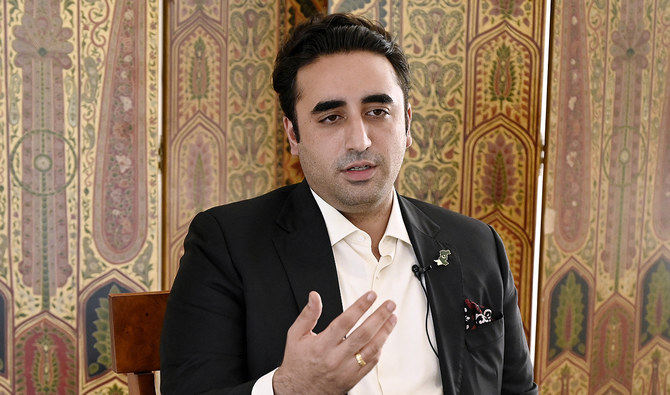
In this file photo, taken on September 27, 2022, Pakistan's Foreign Minister Bilawal Bhutto-Zardari speaks during an interview at the Embassy of Pakistan in Washington, DC. (Photo courtesy: AFP/File)
Short Url
Updated 15 April 2023
Follow

Pakistan’s FM tells interim administration in Kabul his country committed to peaceful Afghanistan

  • Bilawal Bhutto-Zardari spoke to his counterpart, Amir Khan Muttaqi, and discussed a whole spectrum of issues
  • The phone call was held after Pakistan pledged to continue intelligence-based operations against militant outfits

ISLAMABAD: Pakistan’s foreign minister Bilawal Bhutto-Zardari assured the interim Taliban administration in Kabul of his country’s commitment to the peace and stability of their country in a phone call held on Saturday.

Bhutto-Zardari spoke to his counterpart, the acting Afghan minister for foreign affairs, Amir Khan Muttaqi, and discussed a wide spectrum of issues.

Pakistan has tried to convince the international community to constructively engage the new rulers of Afghanistan while also making an effort to persuade officials in Kabul to respect the rights of Afghan citizens.

“Foreign Minister Bilawal Bhutto Zardari held a telephone conversation with Acting Afghan Minister for Foreign Affairs, Amir Khan Muttaqi, today,” said the foreign office in a brief statement. “They discussed a range of issues of mutual interest. The Foreign Minister reaffirmed Pakistan’s commitment to a stable, peaceful and prosperous Afghanistan.”

The phone call was held only days after several regional countries shared Pakistan’s concern over militant presence in Afghanistan during a ministerial conference in Samarkand.

The participants of the gathering maintained that “terrorism-related security situation in Afghanistan was still severe” and promised to enhance cooperation among themselves to “develop a united front against terrorism.”

They also named several militant entities, including the Tehreek-e-Taliban Pakistan and Baloch Liberation Army, while pointing out that their continued presence in Afghanistan posed “a serious threat to regional and global security.”

Pakistan, which has witnessed a surge in militant attacks since last November, has already taken up the issue with the Taliban administration in Afghanistan, asking its leaders not to allow their soil to be used by these groups against other countries.

Pakistan’s defense minister Khawaja Asif recently warned the Afghan Taliban that his country would even strike at militant hideouts in the neighboring state if the administration in Kabul was not able to deal with anti-Pakistan elements within its borders.

Bhutto-Zardari’s conversation with the acting Afghan foreign minister also took place when Pakistan’s military has pledged to continue with intelligence-based operations against militant groups operating in the provinces of Khyber Pakhtunkhwa and Balochistan that share a porous border with Afghanistan.


Pakistan, Afghanistan trade heavy casualty claims, battlefield losses as cross-border fighting escalates

Updated 4 sec ago
Follow

Pakistan, Afghanistan trade heavy casualty claims, battlefield losses as cross-border fighting escalates

  • Pakistan says 133 Afghan Taliban killed in counter-strikes, Kabul says 55 Pakistani soldiers dead
  • Both sides report destruction, capture of military posts as escalation deepens, signaling widening conflict

Islamabad/Karachi: Pakistan and Afghanistan traded claims of heavy battlefield losses early Friday as cross-border fighting intensified along their shared frontier, marking the most serious escalation in hostilities between the bitter neighbors in recent months.

The fighting follows Pakistani airstrikes earlier this week targeting what Islamabad said were Tehreek-e-Taliban Pakistan (TTP) and Daesh militant camps inside Afghanistan. Pakistan said those strikes killed more than 100 militants, while Kabul said women and children were killed and condemned the attacks as violations of Afghan sovereignty.

With both governments now announcing retaliatory operations and publishing sharply conflicting casualty figures, the confrontation signals a rapid deterioration in relations between the two countries.

Pakistani officials said the latest strikes were in response to what they described as unprovoked firing by Afghan forces along multiple sectors of the border late Thursday. The Pakistani prime minister’s spokesman Mosharraf Zaidi said at 0345 hours Friday counter-strikes were continuing.

“A total of 133 Afghan Taliban are confirmed killed, more than 200 wounded,” Zaidi said in an X update. “Twenty seven (27) Afghan Taliban posts have been destroyed, and nine (9) have been captured.”

He added that strikes had targeted military positions in Kabul, Paktia and Kandahar, and that corps headquarters, brigade headquarters, ammunition depots, logistics bases and other installations had been destroyed.

Pakistan’s Information Minister Attaullah Tarar described the military action as “Operation Wrath for the Sake of Truth,” saying Pakistan’s “effective counter operations are ongoing.”

Defense Minister Khawaja Asif adopted sharply escalatory language on X, declaring: “Now it is open war between us and you.”

On the Afghan side, Taliban government spokesperson Zabihullah Mujahid accused Pakistan of bombing major cities. 

“The cowardly Pakistani army has bombed some places in Kabul, Kandahar, and Paktia. Praise be to God, no one was harmed,” Mujahid said on X.

In a separate statement, Afghanistan’s Ministry of National Defense said its forces had conducted retaliatory operations along the shared border. 

The ministry claimed 55 Pakistani soldiers were killed, two garrisons and 19 posts captured and military equipment seized. It said eight Afghan fighters were killed and 11 wounded in the clashes, and alleged that 13 civilians were injured in Nangarhar.

Pakistani officials said no Pakistani posts had been damaged or captured. 

None of the casualty figures or battlefield claims from either side could be independently verified.

Cross-border violence has intensified in recent weeks, with Pakistan blaming a surge in suicide bombings and militant attacks on insurgents it says are based in Afghanistan. Kabul denies providing safe havens to anti-Pakistan militant groups.

The latest clashes mark the third major escalation between the neighbors in less than a year. Similar Pakistani strikes last year triggered weeklong fighting before Qatar, Türkiye and other regional actors mediated a ceasefire in October.

The 2,600-kilometer (1,600-mile) frontier, a key trade and transit corridor linking Pakistan to landlocked Afghanistan and onward to Central Asia, has faced repeated closures amid tensions, disrupting commerce and humanitarian movement. Trade and movement of people between the two nations has remained closed since October 2025.

The confrontation also unfolds against a backdrop of growing friction over Afghanistan’s regional alignments. Pakistan has repeatedly accused the Taliban authorities of allowing Indian influence to expand in Afghanistan, an allegation Kabul has rejected.

Pakistan’s defense minister Asif renewed that accusation on Friday, saying the Taliban government had turned Afghanistan into “a colony of India.”

Islamabad has long accused India of using Afghan territory to support anti-Pakistan militant groups, a charge New Delhi denies.