

TTP still using Afghan soil to attack Pakistan — defense minister

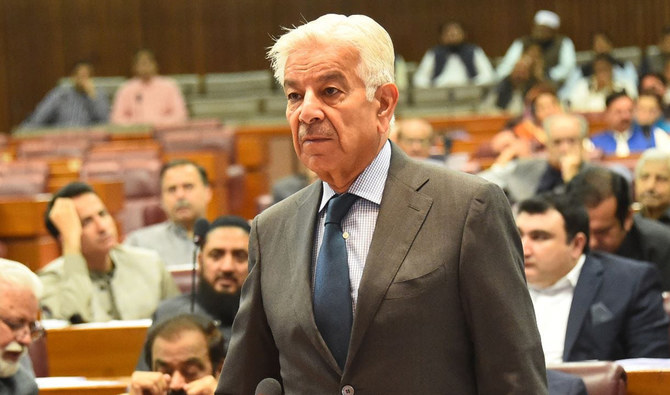
Pakistan’s Defense Minister, Khawaja Asif speaks during a session of the National Assembly on March 29, 2023, in Islamabad, Pakistan. (Photo courtesy: National Assembly of Pakistan/Facebook)
Short Url
Updated 11 April 2023
Follow

TTP still using Afghan soil to attack Pakistan — defense minister

  • Asif says during visit to Kabul, the Afghan Taliban assured Pakistan of cooperation regarding reining in the TTP 
  • He says since the Afghan Taliban and the TTP fought against NATO forces together, they have a ‘camaraderie’ 

ISLAMABAD: Pakistan’s Defense Minister, Khawaja Asif, has said that while his country enjoyed cordial relations with the interim government in Afghanistan, Islamabad was concerned about the outlawed Tehreek-e-Taliban Pakistan (TTP) still using the Afghan soil to operate in different parts of Pakistan, an international media outlet reported on Monday.

Asif’s statement comes amid an uptick in militant attacks, mostly claimed by the TTP, across the South Asian country, particularly after the group called off its fragile truce with the government in November. The TTP is a separate group but closely aligned with the Afghan Taliban. 

Relations between Pakistan and Afghanistan have also been strained lately due to skirmishes at the border, with Islamabad sharing on multiple occasions its concerns with Kabul regarding the presence of TTP in Afghanistan. 

In February, Asif visited Afghanistan along with a delegation to hold talks on security issues with the interim Taliban administration and it to rein in the outlawed group whose top leaders took an oath of allegiance to the Afghan Taliban in August 2021. 

“We have good relations with [Afghanistan] but the thing bothering us is that the TTP, to date, is using the Afghan soil to operate across Pakistan, especially in KP,” he said in an interview to Voice of America’s Urdu service. 

The minister said both sides held a detailed discussion on the matter, while the Afghan Taliban also shared their “limitations” with the Pakistani delegation. 

“We used different channels to bring this issue to Kabul’s notice, while I also visited Afghanistan to hold talks,” he said. “The [Afghan authorities] clearly demonstrated that they were willing to cooperate with Islamabad and would not allow the use of the Afghan soil for terrorism against any country as they were bound to do so under the Doha Agreement.” 


The Pakistani government, during a meeting of the National Security Committee (NSC) last week, said the previous government, led by Imran Khan, was responsible for bringing the TTP back to Pakistan, which in turn had become a reason behind the recent surge in militant violence across the South Asian country. 

“The Taliban were brought back under a program and Imran Khan has been signaling throughout his political career that he is an ideological supporter of the Taliban,” Asif said. 

The defense minister opined that the Afghan Taliban were distancing themselves from the TTP, but since they fought together against the North Atlantic Treaty Organization (NATO) forces, they shared a “camaraderie.” 

“According to my information about the TTP militants, 78,000 of them have been involved in the war with the Afghan Taliban against NATO forces,” he said. “From this point of view, there was a camaraderie between the Afghan and Pakistani Taliban which was also seen from their words in the meetings with the Taliban ‘that they are not in a position to oppose them but they also want to help Pakistan’.” 

Asif said TTP members also had advanced equipment in their possession left by the US in Afghanistan, while he also accused India of helping the TTP. 


At ECO meeting, Pakistan proposes ‘Regional Innovation Hub’ to curb natural disasters

Updated 21 January 2026
Follow

At ECO meeting, Pakistan proposes ‘Regional Innovation Hub’ to curb natural disasters

  • Pakistan hosts high-level 10th ECO Ministerial Meeting on Disaster Risk Reduction in Islamabad
  • Innovation hub to focus on early warning technologies, risk informed infrastructure planning

ISLAMABAD: Pakistan has proposed to set up a “Regional Innovation Hub on Disaster Risk Reduction” that focuses on early warning technologies and risk informed infrastructure planning, the Press Information Department (PID) said on Wednesday, as Islamabad hosts a high-level meeting of the Economic Cooperation Organization (ECO).

The ECO’s 10th Ministerial Meeting on Disaster Risk Reduction (DRR) is being held from Jan. 21-22 at the headquarters of the National Disaster Management Authority (NDMA) in Pakistan’s capital. 

The high-level regional forum brings together ministers, and senior officials from ECO member states, representatives of the ECO Secretariat and regional and international partner organizations. The event is aimed to strengthen collective efforts toward enhancing disaster resilience across the ECO region, the PID said. 

“Key agenda items include regional cooperation on early warning systems, disaster risk information management, landslide hazard zoning, inclusive disaster preparedness initiatives, and Pakistan’s proposal to establish a Regional Innovation Hub on Disaster Risk Reduction, focusing on early warning technologies, satellite data utilization, and risk-informed infrastructure planning,” the statement said. 

The meeting was attended by delegations from ECO member states including Pakistan, Türkiye, Azerbaijan, Iran, Kyrgyzstan, Tajikistan, Turkmenistan and Uzbekistan. Representatives of regional and international organizations and development partners were also in attendance.

Discussions focused on enhancing regional coordination, harmonizing disaster risk reduction frameworks, and strengthening collective preparedness against transboundary and climate-induced hazards impacting the ECO region, the PID said. 

ECO members states such as Pakistan, Türkiye, Afghanistan and others have faced natural calamities such as floods and earthquakes in recent years that have killed tens of thousands of people. 

Heavy rains triggered catastrophic floods in Pakistan in 2022 and 2025 that killed thousands of people and caused damages to critical infrastructure, inflicting losses worth billions of dollars. 

Islamabad has since then called on regional countries to join hands to cooperate to avert future climate disasters and promote early warning systems to avoid calamities in future.