

Pakistanis living abroad sent $2.5 billion home in March, Saudi Arabia and UAE top contributors

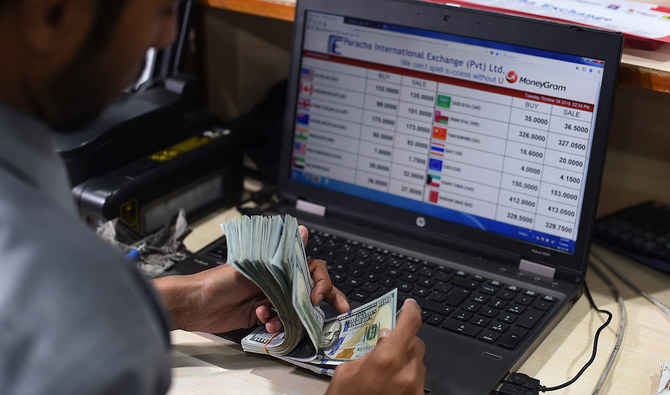
This file photo, taken on October 9, 2018, shows a Pakistani dealer counting US dollars at a currency exchange shop in Karachi. (Photo courtesy: AFP/File)
Short Url
Updated 10 April 2023
Follow

Pakistanis living abroad sent $2.5 billion home in March, Saudi Arabia and UAE top contributors

  • The sum represents a 27.4% increase compared to Feb and is the highest in last seven months
  • The announcement offered some hope for improving Pakistan's ailing economy, officials said

ISLAMABAD: Pakistanis living abroad have sent $2.5 billion home in March, responding to the cash-strapped government's appeal for more hard currency remittances, the country's central bank said Monday.

The sum represents a 27.4% increase compared to February and is the highest in seven past months, according to a tweet by the State Bank of Pakistan. The announcement offered some hope for improving Pakistan's ailing economy, officials said. The remittances came mainly from Pakistanis living in the United States, Britain and the Middle East.

Pakistan is grappling with one of its worst economic crises, exacerbated by last summer’s devastating floods that killed 1,739 people, destroyed 2 million homes and caused $30 billion in damages.

The impoverished country also has been hit by a wave of violence, which last week prompted top political and military leaders to order new operations against the Pakistani Taliban, a militant group that is separate but allied with the Afghan Taliban. The Pakistani Taliban have stepped up attacks on security forces since unilaterally ending a cease-fire with the government last November.

Pakistan is in the final phase of talks with the International Monetary Fund to secure a crucial instalment of $1.1 billion loan from a $6 billion bailout package. The tranche has been on hold since December over Pakistan’s failure to meet the terms of a previous deal, signed in 2019 by then-Prime Minister Imran Khan.

Economists fear a failure to get the IMF loan would spark a surge in inflation. About 21% of Pakistan’s 220 million people live in poverty.

Prime Minister Shahbaz Sharif has blamed Khan, now opposition leader, for much of the economic demise, saying the former cricket star turned Islamist politician violated the terms of the 2019 agreement with the IMF.

Sharif has also asked his finance minister, Ishaq Dar, to sit out a trip to Washington on Monday for the annual meeting of the Word Bank and the IMF because of the country's dire economic crisis. Dar will instead join the gathering virtually.

Khan was ousted in a no-confidence vote in Parliament in April 2022 and has campaigned demanding Sharif schedule early elections. In a speech to lawmakers Monday, Dar accused Khan of intentionally deepening the crisis to harm the country.

“We will put Pakistan back on the path of progress,” Dar said in Parliament, claiming that Pakistan managed to avoid default “by the grace of God” and “because of the timely measures” taken by Sharif's administration.

Foreign exchange reserves, which last month fell to below $3 billion, have also witnessed an improvement and now stand at $9 billion, Dar said. 


Pakistan to begin first phase of Hajj 2026 trainings from today

Updated 31 December 2025
Follow

Pakistan to begin first phase of Hajj 2026 trainings from today

  • Training programs to be held in phases across Pakistan till February, says religion ministry
  • Saudi Arabia allocated Pakistan a total quota of 179,210 pilgrims for Hajj 2026

ISLAMABAD: Pakistan’s religious affairs ministry has said that it will begin the first phase of mandatory Hajj 2026 training for pilgrims intending to perform the pilgrimage from today, Thursday.

The one-day Hajj training programs will be held in phases across the country at the tehsil level until February. The ministry directed intending pilgrims to bring their original identity cards and the computerized receipt of their Hajj application to attend the training sessions.

“Pilgrims should attend the one-day training program according to their scheduled date,” Pakistan’s Ministry of Religious Affairs (MoRA) said in a statement.

The ministry said training schedules are being shared through the government’s Pak Hajj 2026 mobile application as well as via SMS. It added that details of the schedule are also available on its website.

According to the ministry, training programs will be held in Abbottabad on Jan. 2; Ghotki, Thatta and Kotli on Jan. 3; and Tando Muhammad Khan and Khairpur on Jan. 4.

Hajj training sessions will be held in Rawalakot, Badin and Naushahro Feroze on Jan. 5, while pilgrims in Fateh Jang, Dadu and Tharparkar will receive the training on Jan. 6.

The ministry said training programs will be conducted in Umerkot and Larkana on Jan. 7, followed by sessions in Mirpurkhas, Shahdadkot and Mansehra on Jan. 8.

Pakistan’s religious affairs ministry has previously said these trainings will be conducted by experienced trainers and scholars using multimedia.

It said the training has been made mandatory to ensure that intending pilgrims are fully aware of Hajj rituals and administrative procedures.

Saudi Arabia has allocated Pakistan a quota of 179,210 pilgrims for Hajj 2026, of which around 118,000 seats have been reserved under the government scheme, while the remainder will be allocated to private tour operators.

Under Pakistan’s Hajj scheme, the estimated cost of the government package ranges from Rs1,150,000 to Rs1,250,000 ($4,049.93 to $4,236), subject to final agreements with service providers.