Israeli forces kill Palestinian child, 15, in West Bank raid

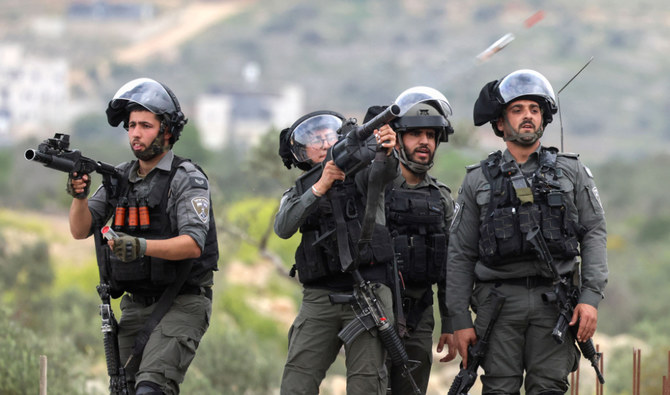
Israeli security forces fire tear gas at Palestinians. (AFP)
Short Url
Updated 11 April 2023
Follow

Israeli forces kill Palestinian child, 15, in West Bank raid

  • Scores of Palestinians injured as Israeli settlers march on abandoned West Bank outpost 
  • 1,500 settlers flanked by Israeli police breach grounds of Al-Aqsa Mosque

RAMALLAH: Israeli forces killed a 15-year-old Palestinian boy on Monday in a raid on a West Bank camp, amid wider clashes during a settler march and a mass intrusion into the grounds of Al-Aqsa Mosque.

Palestinian medical sources said Mohammed Balhan was killed as Israeli forces stormed the Aqabat Jaber near Jericho in the West Bank. Balhan was hit with three bullets to the head, abdomen and pelvis during clashes.

Two other civilians suffered bullet wounds to their lower bodies and five other civilians were arrested.

The Israeli army has killed 96 Palestinians in the West Bank this year, seven of whom were from Jericho. More than 100 Palestinians have been arrested in that time.

His death came amid reports that 191 Palestinians were injured during clashes with Israeli forces around Mount Abu Sbeih near Beita, south of Nablus, as residents staged a counter-protest against a march by thousands of Israeli settlers attempting to reclaim the nearby abandoned hilltop outpost known as “Avitar.” 

The march, from the Za’tara checkpoint, was protected by a battalion-sized Israeli force and led by seven government ministers including National Security Minister Itamar Ben Gvir and Finance Minister Bezalel Smotrich. More than a dozen other members of the Knesset took part.

The settlers demanded the legalization of Avitar, which was initially established in 2013 and finally evacuated by Supreme Court order last year following repeated bouts of violence in which 12 Palestinians were killed and thousands injured. 

Israeli media reported that some marchers have vowed to take and remain on the site to “impose a reality on the ground.”

Mahmoud Barham, mayor of Beita, told Arab News that hundreds of residents confronted the Israeli army.

Barham, whose brother was killed in previous clashes over Avitar, said that the presence of Israeli ministers, MPs and settlement leaders was designed to send a message that Israel was determined to control the area.

“We are ready to confront and resist and to start a new round of popular resistance against them,” he told Arab News. “We were and will remain guards of Mount Abu Sbeih, even if the number of martyrs, wounded and prisoners among us doubles.”

Ghassan Daghlas, responsible for the settlement file in the northern West Bank of the Palestinian Presidency, told Arab News that the march aimed to legitimize the theft of Palestinian lands.

“We are facing a new settlement battle with this extreme right-wing Israeli government,” he said. “If their policies are not met with a strong Palestinian and international popular response, they will reactivate settlements in the northern West Bank and rebuild the settlements that were evacuated in 2005.”

Meanwhile, more than 1,500 settlers guarded by Israeli police stormed Al-Aqsa Mosque on the fifth day of the Jewish Passover holiday.

The Islamic Awqaf Department said the numbers were higher than the incursions before Passover. Hundreds of Palestinians and Turks were present in Al-Aqsa’s squares during the incursion, it added.

Hamas spokesman Abdel Latif Al-Qanou said that both incidents showed Israel’s aggression and push to Judaize Palestinian land and sanctities. He called on Palestinians to resist what he described as a fascist occupation government.

Palestinian Prime Minister Mohammed Shtayyeh said that the Israeli government must be held accountable for its daily crimes, the aggression at Al-Aqsa, the pro-settlement march of ministers and Knesset members, and the invasions that have led to the deaths of many Palestinians such as Mohammed Balhan in Jericho on Monday.

In Hebron, Israeli forces closed the Bab Al-Zawiya area and Beersheba Street in the city center in preparation for a settler march, forcing store owners to shut their businesses and preventing shoppers preparing for Eid in Al-Shuhada Street and the Tal Rumeida area.

The Israeli authorities still prevent citizens and visitors from reaching the Ibrahimi Mosque to perform prayers there under the pretext of the settlers’ celebration of their Jewish holiday.


Trump: US carrying out ‘major combat operations’ in Iran

Updated 5 min 41 sec ago
Follow

Trump: US carrying out ‘major combat operations’ in Iran

  • An Israeli defense official said the operation had been planned for months in coordination with Washington

WASHINGTON/DUBAI/CAIRO: US President Donald Trump said ​on Saturday that the United States had begun “major combat operations” in Iran, warning that there may be US casualties.

The strikes, which Trump said were aimed at destroying Iranian missiles and annihilating its navy, follow repeated US-Israeli warnings that ‌they would ‌strike Iran again ​if ‌it pressed ⁠ahead ​with its ⁠nuclear and ballistic missile programs.

“I do not make this statement lightly. The Iranian regime seeks to kill,” Trump said in a video shared on Truth Social.

“The lives of courageous American ⁠heroes may be lost and ‌we may have casualties ‌that often happens in ​war, but we’re ‌doing this, not for now. We’re ‌doing this for the future, and it is a noble mission.”


Trump told the members of the Islamic Revolutionary Guard, Iran’s armed forces, ‌to lay down their weapons, promising that they would be granted ⁠immunity.

The ⁠other option, according to Trump, is “certain death.”

Washington and Tehran held a series of talks in recent weeks about Iran’s nuclear ambition. The most recent one was held on Thursday with no deal.

“Iran refused, just as it has for decades and decades. They rejected every opportunity to renounce their ​nuclear ambitions, and we ​can’t take it anymore,” Trump said.Israel launched a pre-emptive attack against Iran on Saturday, and ​a United States attack is underway, plunging the Middle East into a renewed military confrontation and further dimming hopes for a diplomatic solution to Tehran’s nuclear dispute with the West.

The latest updates:

• Israeli military reports missiles have been launched from Iran toward Israel, authorities call on people to head to shelters

• Iranian President Masoud Pezeshkian is “safe and sound”, state media reported.

• The Jerusalem municipality ordered schools and workplaces to close on Saturday after Israel launched strikes on arch-foe Iran

• US embassies in Qatar, Bahrain issue shelter-in-place orders for personnel

• Tasnim reports Iran is preparing for strong response to Israel

• Israeli media: We are awaiting confirmation of the assassination of a number of prominent Iranian leaders

• Iranian television has declared a state of alert in all hospitals across the country

• Israeli media said that Israel was targeting rocket launch sites to prevent Iran from responding

• The head of Iran’s National Security Committee said that Israel has embarked on a path whose outcome is not in its hands

• Explosions heard in the cities of Qom, Karaj and Kermanshah

• Explosions heard in Isfahan, central Iran

• Israeli Army Radio said air force launches second wave of strikes on Iran

The scope of the air and sea operations was not immediately clear. Iran was preparing a crushing retaliation, an Iranian official said.

An apparent strike in Iran’s capital Saturday happened near the offices of Khamenei. State television acknowledged an explosion in the area of the offices.

Israeli media reported attempts to assassinate Iranian President Masoud Pezeshkian during the attacks, and have not ruled out Khamenei being targeted.

Several missiles have struck University Street and the Jomhouri area in Tehran, while explosion likely occurred in the northern Seyyed Khandan area of Tehran, state media reported. Thick smoke was also rising from the vicinity of Pasteur Street in downtown Tehran, ISNA said.

The attack, coming after Israel and Iran engaged in a 12-day air war in June, follows repeated US-Israeli warnings that they would strike again if ‌Iran pressed ‌ahead with its nuclear and ballistic missile programs.

“The State ​of ‌Israel ⁠launched ​a pre-emptive ⁠attack against Iran to remove threats to the State of Israel,” Defense Minister Israel Katz said.

People watch as smoke rises on the skyline after an explosion in Tehran on Feb. 28, 2026. (AP)

An Israeli defense official said the operation had been planned for months in coordination with Washington, and that the launch date was decided weeks ago.

The US military declined to immediately comment on the attack.

Explosions were heard in Tehran on Saturday, Iranian media reported, and sirens sounded across Israel around 08:15 local time in what the military said was a proactive ⁠alert to prepare the public for the possibility of an ‌incoming missile strike.

The Israeli military announced ‌the closure of schools and workplaces, with exceptions for ​essential sectors, and a ban on public ‌airspace.

Israel closed its airspace to civilian flights, and the airports authority ‌asked the public not to go to any of the country’s airports.

The country’s airspace will reopen and flights to and from Israel to resume ‘as soon as the security situation allows,’ the airport authority said.

Iran’s airspace has been closed, Tasnim news agency reported.

People run for cover following an explosion in Tehran on Feb. 28, 2026. (WANA via Reuters)

The US and Iran renewed negotiations in February in a bid to resolve the decades-long dispute through diplomacy and avert the threat of a military confrontation that could destabilize the region.

Israel, however, ‌insisted that any US deal with Iran must include the dismantling of Tehran’s nuclear infrastructure, not just stopping the ⁠enrichment process, and ⁠lobbied Washington to include restrictions on Iran’s missile program in the talks.

Iran said it was prepared to discuss curbs on its nuclear program in exchange for lifting sanctions but ruled out linking the issue to missiles.

Tehran also said it would defend itself against any attack.

It warned neighboring countries hosting US troops that it would retaliate against American bases if Washington struck Iran.

In June, the US joined an Israeli military campaign against Iranian nuclear installations, in the most direct American military action ever against the Islamic Republic.

Tehran retaliated then by launching missiles toward the US Al Udeid air base in Qatar, ​the largest in the Middle ​East.

Western powers have warned that Iran’s ballistic missile project threatens regional stability and could deliver nuclear weapons if developed. Tehran denies seeking atomic bombs.