

Israel rapped over Al-Aqsa crackdown

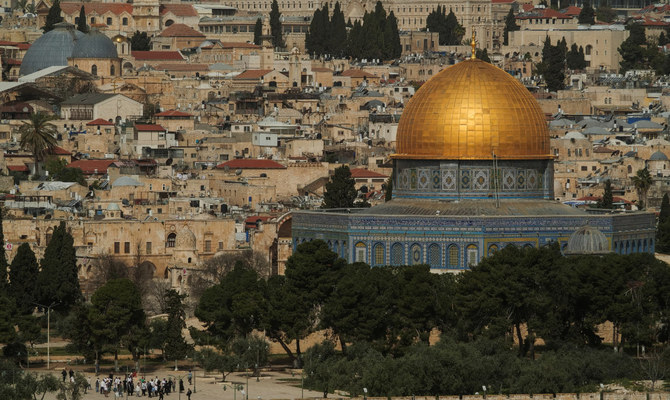
A view taken from the Mount of Olives shows a group of Jewish visitors on the Al-Aqsa compound, also known to Jews as Temple Mount, in Jerusalem's Old City, April 9, 2023. (Reuters)
Short Url
Updated 09 April 2023
Follow

Israel rapped over Al-Aqsa crackdown

  • Authorities attacked worshipers stationed in Al-Aqsa Mosque for prayers on Saturday night in an attempt to remove them by force

RAMALLAH: Israel came under fresh criticism on Sunday for its continued crackdown on Al-Aqsa Mosque and East Jerusalem.

Israel’s measures and US support for them will not lead to security and stability, warned Nabil Abu Rudeineh, the Palestinian Presidency spokesperson.

His remarks came as tension mounted on Sunday at Al-Aqsa and in East Jerusalem following aggressive actions carried out by Israel’s security forces.

Authorities attacked worshipers stationed in Al-Aqsa Mosque for prayers on Saturday night in an attempt to remove them by force.

The move aimed to allow hundreds of Israeli settlers to storm the mosque under the protection of Israeli police the following morning.

The Islamic Awqaf Department said that 912 settlers stormed Al-Aqsa on Sunday.

The Israeli armed forces and intelligence officers deployed in Al-Aqsa were distributed in squares across the site, especially the Al-Qibli prayer square.

Forces escorted settlers who stormed the mosque.

At the same time, Israeli police deployed at Al-Silseleh gate checked the identities of those arriving at Al-Aqsa to worship and prevented young men from entering the site.

The continuous Israeli provocations against the Al-Aqsa Mosque are “unacceptable” and will “turn its courtyards into a battlefield,” leading to a severe deterioration of the situation, warned the Palestinian Presidency spokesperson.

Lamenting the daily attacks against holy sites during Ramadan, Abu Rudeineh added: “The worshipers there have condemned measures and unacceptable actions that work to ignite the region and drag it toward the abyss.”

The presidential spokesman held the Israeli occupation government responsible for the deteriorating situation over its continued torment of worshipers.

At the same time, Israeli authorities extended the closure of West Bank and Gaza Strip crossings until midnight on April 12.

The Israeli facilities for Ramadan remain canceled due to the security escalation.

Palestinians say that the closures are part of a policy to collectively punish the West Bank and Gaza Strip.

Israeli forces also announced the closure of the Ibrahimi Mosque in Hebron’s southern West Bank for two days starting Sunday, under the pretext of Jewish holidays.

Nidal Al-Ja’bari, director general of the Hebron Islamic Awqaf, denounced the closure of the mosque, describing it as a “blatant violation” and a “provocative attack” on the right of Muslims to worship.

The Israeli armed forces also tightened security measures.

Authorities closed all military checkpoints and electronic gates leading to the Ibrahimi Mosque to secure settler celebrations of the Jewish Passover in the mosque and its yards.

Hefzy Abu Sneineh, the imam and preacher of the Ibrahimi Mosque in Hebron — the second most crucial mosque for Muslims after Al-Aqsa in the Palestinian territories — told Arab News that the Ibrahimi Mosque is wholly closed to Muslims, including its outer squares.

Abu Sneina said that 1,000 worshipers perform Tarawih prayers daily in the Ibrahimi Mosque, and about 2,500 perform Asr prayers each day.

Those worshipers will be forced to move to other mosques far away in the city during the two-day lockdown period, he added.

The Israeli army reinforced its deployed forces in the West Bank with three additional brigades and additional Border Police in Jerusalem.

Israeli opposition leader Yair Lapid commented on the tense situation in Jerusalem.

Lapid said that Israeli National Security Minister Itamar Ben-Gvir only wants to ignite the Middle East, warning: “This is what happens when the place (Al-Aqsa Mosque) is entrusted to the most extremist man in Israel.”


Editorial: The threat of Yemen’s fragmentation is far reaching

President of Yemen’s Presidential Leadership Council Rashad Mohammed Al-Alimi. (SABA Net)
Updated 25 December 2025
Follow

Editorial: The threat of Yemen’s fragmentation is far reaching

  • The southern issue is a just cause — one that must be addressed in any future political settlement and not reduced to the ambitions of any single individual, including the likes of Aidarous Al-Zubaidi

RIYADH: As Yemen’s political landscape continues to shift at a dizzying pace, it is worth pausing to reflect on the official Saudi position — and the commentary of some of our leading Saudi columnists — regarding the recent unilateral moves by the Southern Transitional Council (STC) in the governorates of Hadramout and Al-Mahrah. These actions, taken without the consent of the Presidential Leadership Council (PLC) or coordination with the Arab Coalition, represent a dangerous gamble with the future of a fragile nation — one that Saudi Arabia, like its Arab neighbors, wishes only peace, stability, and prosperity.
There is no ambiguity in the Kingdom’s stance: it has worked tirelessly to preserve calm in Hadramout and Al-Mahrah, steering both regions away from military escalation and toward peaceful solutions. In a bid to contain the situation, Saudi Arabia, in coordination with its brothers and partners in the United Arab Emirates and the PLC, dispatched a joint team to negotiate with the STC. The goal was clear — facilitate the withdrawal of STC forces and hand over military sites to the National Shield Forces.
Yet despite Riyadh’s call for de-escalation and its appeal to the STC to prioritize national interest and social cohesion, the Council has persisted in its confrontational posture, seemingly indifferent to the grave consequences of its actions.
Observers in Riyadh will note that the Kingdom remains steadfast in its support for the PLC and Yemen’s internationally recognized government. Its commitment to Yemen’s stability is not rhetorical — it is political, economic, and developmental. Saudi Arabia’s vision is to shepherd Yemen from the shadows of conflict into an era of peace, prosperity, and regional integration. This is not merely a function of geography or shared borders; it is a reflection of the Kingdom’s religious, political, and economic responsibilities in the Arab and Islamic world.
From this vantage point, the newspaper firmly believes that the STC’s unilateral actions in Hadramout constitute a blatant violation of Yemen’s transitional framework. They undermine the legitimacy of the recognized government, threaten the fragile peace, and jeopardize the political process. Worse still, they echo the very tactics employed by the Houthi militias — an alarming parallel that should not be ignored.
It is therefore essential to reiterate the Kingdom’s position: the STC must withdraw its forces from Hadramout and Al-Mahrah, restoring the status quo ante. This is not a punitive demand, but a necessary step to safeguard national security and prevent further military flare-ups.
At the same time, Saudi Arabia has consistently affirmed that the southern issue is a just cause — one that must be addressed in any future political settlement. It is enshrined in the outcomes of Yemen’s National Dialogue and must be resolved inclusively, reflecting the aspirations of all southern Yemenis — not reduced to the ambitions of any single individual, including the likes of Aidarous Al-Zubaidi or other STC figures.
Ultimately, we urge the separatists to choose reason over recklessness. Partitioning Yemen will not bring peace — it will sow the seeds of future wars, embolden extremist actors, and pose a threat not only to Yemen’s internal cohesion but to regional and international stability. As Western and American policymakers know all too well: what happens in Yemen never stays in Yemen.