
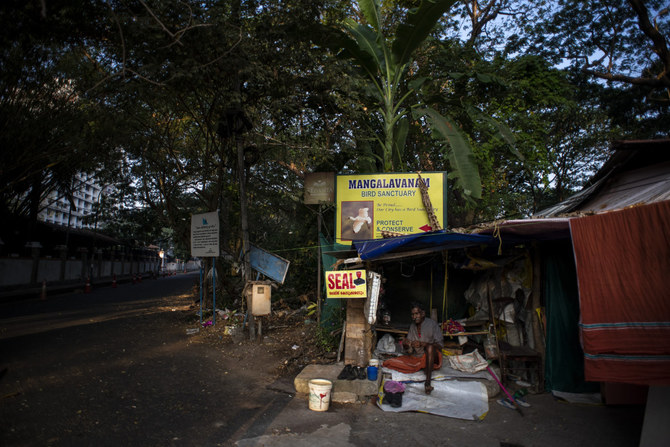


KOCHI, India: Burrowed between mangroves and a bustling skyline, 70-year-old Rajan, who only uses one name, reminisces about his old home.
For nearly sixty years, Rajan has lived comfortably among the trees in Mangalavanam forest in India’s southern Kerala state. In the last two decades, the surrounding city of Kochi has boomed as the state’s financial capital and swallowed up once-protected green areas, including Rajan’s former home.
He was forced to sell his land to a local private realtor when the area was bought up for construction about 15 years ago. He moved into a makeshift dwelling on the edge of a protected bird sanctuary.
“Now there are buildings all around and no wind,” said Rajan, adding that the towering concrete has made the city and forest stifling hot.
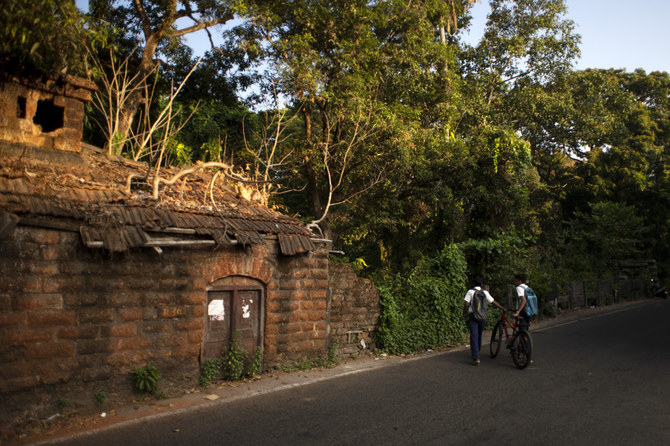
Government buildings, private offices and homes have sprung up at pace, cutting deep into the forest known as the “green lung of Kochi.” The trees are now squeezed on all sides by buildings, construction and smog.
Environmentalists are concerned over the loss and declining health of mangrove cover, which is particularly effective at sucking planet-warming carbon dioxide out of the air, can fend off scorching heat for nearby residents and sustains populations of local wildlife.
Officials and developers alike defend the need to house the state’s dense population and harness economic growth in the world’s soon-to-be most populous nation, but experts say this cannot come at the cost of green spaces.
Kerala has lost nearly 98 percent of its mangrove forests, shrinking from 700 square kilometers (270 square miles) to just 17 square kilometers (6.5 square miles) since 1975, according to figures from the Kerala Forest Research Institute. Mangrove cover across the country creeped up slightly between 2017 to 2019 at a rate of 0.5 percent per year thanks to concerted efforts by the government with restoration and maintenance projects springing up in Kerala and beyond.
“I had literally fought with the government to come out with plans to protect the mangrove forests,” said Kathireshan Kandasamy, who studies India’s mangrove forests and is a former member of the National Mangrove Committee, a body set up by the government to advise on conservation.
In 2022 the Indian government, following Kandasamy and the committee’s advice, identified 44 critical mangrove ecosystems in the country, including two in Kerala. It launched a management action plan to protect and maintain the areas. State governments also started sanctioning funds for conservation projects.
The shrunken Mangalavanam is now listed as a protected area, but there are concerns about the impact of nearby development.
“I found out that some city drainage is passing through this mangrove ecosystem,” said Rani Varghese, a research scholar at the Kerala University of Fisheries and Ocean Studies. Varghese said the runoff “is changing its whole ecosystem.”
While the trees themselves are still sucking planet-warming carbon dioxide out of the air, Varghese explained, effluents and pollutants in the soil hamper how good of a sink for carbon the soil can be.
With record amounts of carbon dioxide being pumped into the air by human activity, maintaining ecosystems like mangrove forests can counteract some of the harms of warming.
The potential of the forest to store carbon “is actually in the state of deterioration,” said Varghese.
A. Anil Kumar, who’s mayor of the city’s administrative body, the Kochi Corporation, said while they cannot do anything about wastewater runoff immediately the area will continue to be studied.
In the meantime, property companies use what’s left of the squeezed forests as a selling point for extravagant homes and office buildings in the area.
Signs outside new developments boast about their luxury apartments’ untouched green views from properties’ multiple balconies. Long, plastic advertising boards line nearby roads with images of thick forests.
The apartments give residents spectacular sights of backwaters merging with the Arabian Sea and, for a premium, Mangalavanam’s last green stronghold in the form of the bird sanctuary, which is surrounded by construction and scaffolding.
K. Krishnankutty, a nearby resident, comes for a morning walk every day on the surrounding road, where mangrove branches hang overhead, lining wide pavements. He said he loves the shade and chirping birds but laments how much the lush space has slimmed in recent years.
“All around this Mangalavanam used to be open with no tall buildings,” Krishnankutty said. “So many migratory birds used to come here. Now we cannot see any as the buildings cover up this area.”
Experts fear the loss of Kerala’s forests could worsen in the coming years.
Some 75 percent of the remaining mangroves across Kerala are in the hands of private individuals and could be cleared for more lucrative intensive shrimp farming, said M. Ramit, a program officer for the Wildlife Trust of India, who is working on a project to restore mangroves in Kannur, a coastal district in northern Kerala.
“The Kerala government had earlier devised a plan to acquire the mangrove land from private individuals in order to conserve them,” Ramit said, but “somehow, the plan was later dropped.”
But Kerala’s state department of environment and climate change contested the claims and said there is no threat to the existing mangrove forests, regardless of ownership, as the forests are protected by state laws.
Varghese, the Kerala University researcher, said there’s still hope that the trend of mangrove loss can be reversed and the forest ecosystem can function normally in the near future.
“If we stop the adverse human interventions in the sanctuary and divert the drainage from Mangalavanam, in another 10 years we could regain all the potential benefits of the mangrove ecosystem,” Varghese said.
With the right measures, she said, communities can “turn it around as a good carbon sink.”