CAPE TOWN: A pilot in South Africa made a hasty emergency landing after discovering a highly venomous cobra hiding under his seat.
Rudolf Erasmus had four passengers on board the light aircraft during Monday’s flight when he felt “something cold” slide across his lower back. He glanced down to see the head of a fairly large Cape Cobra “receding back under the seat,” he said.
“It was as if my brain didn’t know what was going on,” he told The Associated Press.
After taking a moment to compose himself, he informed his passengers of the slippery stowaway.
“There was a moment of stunned silence,” he said. Everyone stayed cool, especially the pilot.
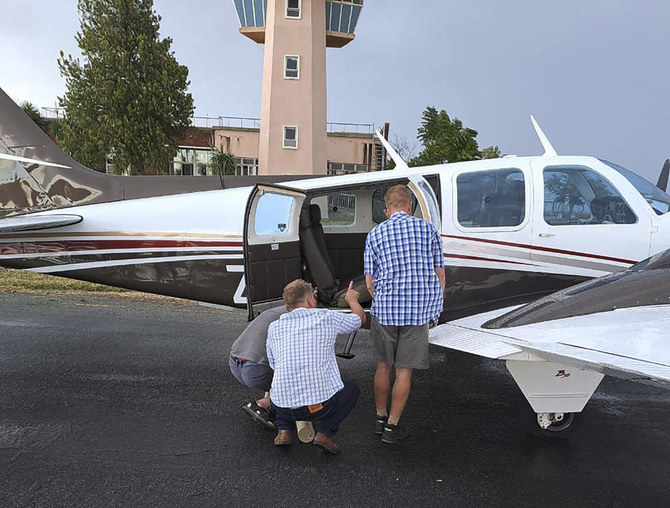
Erasmus called air traffic control for permission to make an emergency landing in the town of Welkom in central South Africa. He still had to fly for another 10 to 15 minutes and land the plane with the snake by his feet.
“I kept looking down to see where it was. It was happy under the seat,” Erasmus said. “I don’t have a big fear of snakes but I normally don’t go near them.”
Brian Emmenis, who works at Welkom radio station Gold FM and is also an aviation expert, received a phone call to see if he could help. He called the fire and rescue department, which sent emergency responders and a snake handler to meet the plane at the airport. Emmenis was first at the scene and saw everyone disembark, “visibly shaken,” Emmenis said, but all safe thanks to Erasmus.
“He stayed calm and landed that aircraft with a deadly venomous Cape Cobra curled up underneath his seat,” Emmenis said.
Cape Cobras are one of Africa’s most dangerous cobra species because of the potency of their venom.
The drama wasn’t over for the poor pilot.
Welkom snake handler Johan de Klerk and a team of aviation engineers searched the plane for the best part of two days but still hadn’t found the cobra by Wednesday and were uncertain if it had sneaked out unnoticed.
The engineering company Erasmus works for wanted its plane back in the city of Mbombela in northern South Africa. So, he had to fly it back home, a 90-minute voyage with the possibility that the cobra was still onboard.
Unsurprisingly, his passengers decided to look for another way to get home.
This time Erasmus took some precautions: He wore a thick winter jacket, he said, wrapped a blanket round his seat, and had a fire extinguisher, a can of insect repellent and a golf club within arm’s reach in the cockpit.
“I would say I was on high alert,” Erasmus said.
The cobra didn’t reappear on that flight and the plane has now been completely stripped, but still no sign of the snake, Erasmus said.
The theory is it found its way on board before Erasmus and his passengers took off at the start of their trip from the town of Worcester in the Western Cape province, where Cape Cobras are usually found in South Africa. It might have got out in Welkom or might still be hiding somewhere deep in the plane.
“I hope it finds somewhere to go,” Erasmus said. “Just not my aircraft.”


![]()

Snake on a plane! South African pilot finds cobra under seat
Short Url
https://arab.news/4uqvq
Snake on a plane! South African pilot finds cobra under seat
- Rudolf Erasmus had four passengers on board the light aircraft during Monday's flight when he felt “something cold” slide across his lower back
- He glanced down to see the head of a fairly large Cape Cobra “receding back under the seat”


Latest updates


Recommended


© 2026 SAUDI RESEARCH & PUBLISHING COMPANY, All Rights Reserved And subject to Terms of Use Agreement.