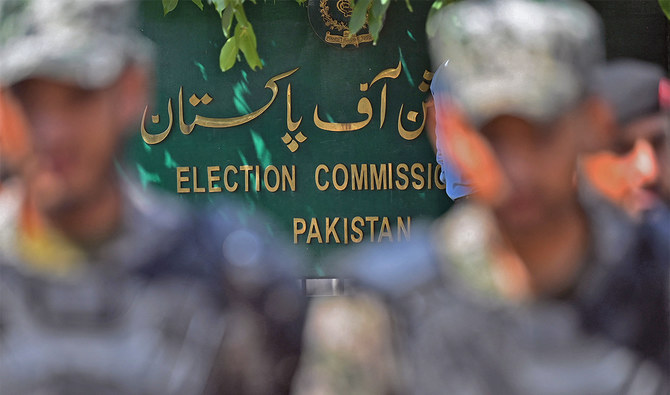

ISLAMABAD: The Election Commission of Pakistan (ECP) will meet today, Wednesday, to discuss a ruling by the Supreme Court that the regulator’s decision last month to delay provincial elections was unconstitutional and ordering that the vote be held next month.
Provincial assemblies in the Punjab and Khyber Pakhtunkhwa provinces were dissolved in January by ex-Prime Minister Imran Khan and his allies in a bid to force early general elections, since Pakistan historically holds the provincial and national elections together. According to Pakistan’s constitution, elections must be held within 90 days of the dissolution of a legislative assembly.
But as the acting governments in the two provinces and the ECP failed to announce dates, the Supreme Court took suo motu notice of the case and in a 3:2 verdict on March 1 ordered the ECP to fulfil its constitutional obligation and announce an election schedule for the two provinces. The ECP subsequently said the vote in Punjab would be held on April 30 but later said it was impossible to hold the vote in April due to security and financial concerns, announcing October 8 as the new poll date in Punjab.
Khan’s PTI party then approached the Supreme Court, which ruled yesterday, Tuesday, that the delay was illegal and voting in the provincial assembly election in Punjab, Pakistan’s most prosperous and politically important province, should be on May 14. The date of the vote in the northwestern province of Khyber Pakhtunkhwa would be decided later, pending technical issues, the court said.
All eyes are now on the Election Commission’s next move, while Khan has called on his supporters to come out into the streets to show they stand with the Supreme Court.
“After Isha [evening prayers], the entire nation should come out to express gratitude for the decision of the Supreme Court and say that we stand with them,” Khan said in an address to followers on Tuesday night, after the verdict.
The top court ruling is a blow to the coalition government of Prime Minister Shehbaz Sharif that wants national elections and the voting for regional assemblies held on the same day.
Following Tuesday’s verdict, Law Minister Azam Nazeer Tarar said it would deepen the constitutional crisis and more judges should have heard the landmark case to avoid any doubts amid reports of divisions within the higher judiciary. The government has been asking for the formation of a full court but the chief justice rejected the request.
The verdict in the election delay case also comes as, separately, Pakistan’s parliament has passed a new law to curtail the powers of the Supreme Court’s chief justice amid the row between the higher judiciary and the government on the holding of snap polls in Punjab and Khyber Pakhtunkhwa.
The government says it is economically not viable to hold the snap elections in Punjab and Khyber Pakhtunkhwa first and then have another general election this year in October while the Supreme Court has repeatedly ordered that polls to be held in the two provinces within 90 days of the dissolution of the two local governments, which falls by April 30.
The new draft law, which has been approved by the upper and lower houses of parliament and sent to Pakistan’s president for assent, has cut down the chief justice’s powers to constitute panels, hear appeals or assign cases to judges in his team, according to a copy of the bill.
These tasks will now be done by a three-member committee headed by the chief justice with his two most senior judges as members.