- Court says election regulator not authorized to extend election date beyond 90 days period stipulated by constitution
- Directs federal government to provide Rs21 billion funds to ECP by April 10, make security arrangements for elections
ISLAMABAD: The Supreme Court on Tuesday ruled that a decision by the election regulator to postpone polls in Pakistan’s most populous Punjab province to October 8 was unconstitutional and announced elections on May 14, a verdict likely to worsen a row between the higher judiciary and the federal government which wants provincial elections held on the same time as national polls.
The landmark ruling comes after days of hearings in the Supreme Court on a petition filed by ex-premier Imran Khan’s Pakistan Tehreek-e-Insaf (PTI) party over the Election Commission of Pakistan (ECP)’s decision last month to postpone elections in Punjab from April 30 to October 8.
“Neither the Constitution nor the law empowers the Commission to extend the date of elections beyond the 90 days period as provided in Article 224(2) of the Constitution,” the six-page judgment said, declaring the election regulator’s decision to postpone the election date “unconstitutional.”
“The polling day perforce must be shifted, and moved forward from 30.04.2023 to 14.05.2023.”
Speaking to reporters, Law Minister Azam Nazeer Tarar said he felt “pain and regret” at the decision by the three-judge bench.
“This will make the political crisis that we see today deeper and more serious,” he added.
The law minister said there was a perception of division within the country’s judiciary:
“To eliminate this perception, as the head of the institution, the chief justice should have taken this important constitutional and legal issue to a larger bench,” Tarar said, urging the chief justice to call a full court meeting to discuss the issue to avoid Pakistan descending into “chaos.”
Provincial assemblies in the Punjab and Khyber Pakhtunkhwa provinces were dissolved in January by Khan and his allies in a bid to force early general elections, since Pakista historically holds the provincial and national elections together. According to Pakistan’s constitution, elections must be held within 90 days of the dissolution of a legislative assembly.
After weeks of delays and political wrangling on the issue, the Supreme Court in a 3:2 verdict on March 1 ordered the ECP to fulfil its constitutional obligation and announce an election schedule for Punjab and Khyber Pakhtunkhwa. The ECP subsequently said the vote in Punjab would be held on April 30 but later said it was impossible to hold the vote in April due to security and financial concerns. It announced October 8 as the new poll date in Punjab.
Khan’s PTI party then approached the Supreme Court, which has since been debating whether the ECP’s postponement decision was legal.
At Tuesday’s hearing, the court ruled that the election commission’s order to postpone polls had wasted 13 days, directing the federal government to release the required election funds of Rs21 billion to the ECP by April 10 and make security arrangements for election duty.
“Without prejudice to the generality of the foregoing, the Federal Government must make available all necessary personnel, whether from the Armed Forces, Rangers, Frontier Constabulary and all other forces under the direct, indirect or ultimate command and control of the said Government, as are required by the Commission for security and other purposes related to the general elections,” the judgment said.
“In this regard, the Federal Government must forthwith, and not later than 17.04.2023, provide a plan acceptable to the Commission.”
As per the court order, the election commission is bound to issue a final list of candidates on April 19 and allot election symbols to all candidates on April 20.
During previous hearings in the case, the election commission had assured the court it would hold the elections if it was provided with the required funds and security for election duty.
Khan’s party has welcomed the judgment, calling it ‘historic and constitutional’ and urging all other political parties to create a “conducive environment” for peaceful polls in Punjab.
“It is a clear, historic and constitutional judgment,” PTI lawyer Ali Zafar told reporters after the court released its judgment. “The constitutional supremacy stands proven today through this verdict.”
Senior PTI leader Shah Mahmood Qureshi called the verdict a “watershed moment” in Pakistan’s political history.
“A clear line has been drawn [to differentiate] between democratic powers, constitutional powers and unconstitutional powers,” Qureshi told reporters outside the court, commenting on the verdict.
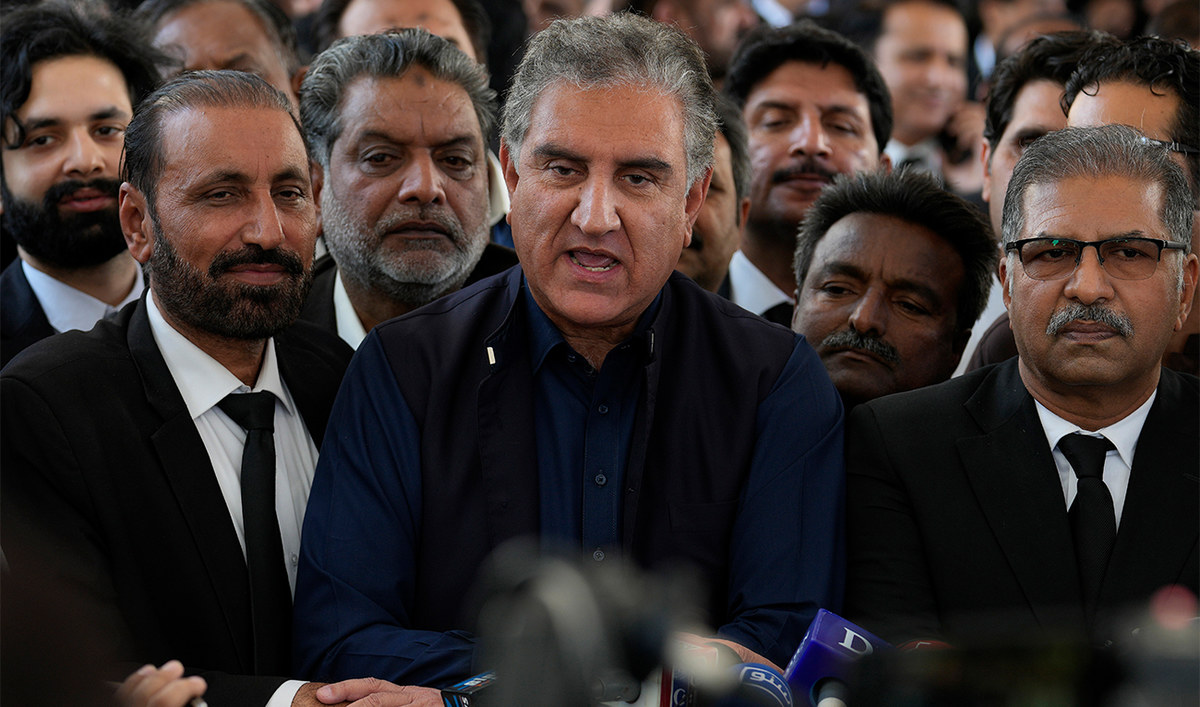
The PTI leader urged the party’s followers and leaders to start preparing for elections: “Prepare yourself to be the next government of Pakistan and the next government of Punjab, god willing.”
The verdict in the election delay case comes as, separately, Pakistan’s parliament has passed a new law to curtail the powers of the Supreme Court’s chief justice amid a row between the higher judiciary and the government on the holding of snap polls in Punjab and Khyber Pakhtunkhwa.
The government says it is economically not viable to hold the snap elections in Punjab and Khyber Pakhtunkhwa first and then have another general election this year in October.
The Supreme Court last month ordered the snap polls to be held in the two provinces within 90 days of the dissolution of the two local governments, which falls by April 30.