After over three years, Pakistan, China reopen key border crossing to bolster trade

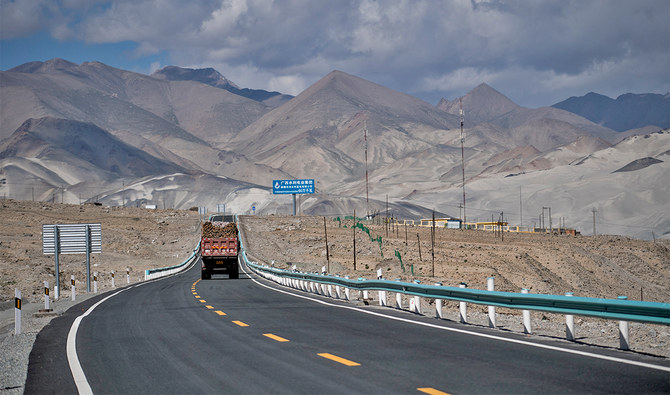
This picture taken on June 27, 2017 shows a truck driving along the China-Pakistan Friendship Highway before the Karakorum mountain range near Tashkurgan in China's western Xinjiang province. (AFP/File)
Short Url
Updated 03 April 2023
Follow

After over three years, Pakistan, China reopen key border crossing to bolster trade

  • The border trade through Khunjerab Pass was suspended in 2019 to stem coronavirus spread
  • The key route was occasionally opened in the last four years for emergency cargo from China

KHAPLU: Pakistan and China will be resuming travel and trade activities through a key border point in Pakistan’s northern Gilgit-Baltistan region that connects with China’s Xinjiang after a gap of more than three years, Pakistani officials said, hoping to accelerate trade between the two nations. 

At 5,000 meters above sea level, the Khunjerab Pass is the highest paved international crossing in the world, a major trade route between China and Pakistan, and an important gateway to South Asia and Europe for Chinese imports and exports. 

Under an agreement, trade activities between the two countries through the Khunjerab Pass continue from April till November. The first trade activity between China and Pakistan under the China-Pakistan Economic Corridor (CPEC) began via the Karakoram Highway, which passes through Khunjerab, in November 2016. 

The key border point was closed in 2019 to contain the spread of coronavirus, but authorities on both sides of the border last week decided to reopen it for all kinds of traffic on April 3, according to Gilgit-Baltistan Home Secretary Rana Muhammad Saleem Afzal. 

“Reopening of Khunjrab Pass is critical to accelerating trade between Pakistan and China,” Pakistan Prime Minister Shehbaz Sharif said on Twitter late Sunday. 

“The government is determined to unpack the full potential of CPEC (China-Pakistan Economic Corridor) by making it the centerpiece of our economic diplomacy for the region. Trade & connectivity are the building blocks of prosperity.” 

China and Pakistan are historic allies that enjoy cooperation in several sectors, including defense, military and trade, in part due to their border disputes with India. Beijing has also invested heavily in the $65 billion CPEC project that seeks to connect China to Pakistani ports through a vast network of roads, railways and pipelines. 

The prolonged closure of Khunjerab Pass caused immense financial losses to the local business community and triggered layoffs. The key border point was occasionally opened during the last three years for emergency cargo transportation from China to Pakistan. 

Pakistan, a country of 220 million, has been embroiled in an economic crisis, with its currency at a historic low level, forex reserves barely enough to cover a month of imports and inflation at a 50-year high. 

The resumption of trade with China is expected to bring some respite to the cash-strapped South Asian nation. 


Education spending surges 251% as students return from autumn break: SAMA

Updated 12 December 2025
Follow

Education spending surges 251% as students return from autumn break: SAMA

RIYADH: Education spending in Saudi Arabia surged 251.3 percent in the week ending Dec. 6, reflecting the sharp uptick in purchases as students returned from the autumn break.

According to the latest data from the Saudi Central Bank, expenditure in the sector reached SR218.73 million ($58.2 million), with the number of transactions increasing by 61 percent to 233,000.

Despite this surge, overall point-of-sale spending fell 4.3 percent to SR14.45 billion, while the number of transactions dipped 1.7 percent to 236.18 million week on week.

The week saw mixed changes between the sectors. Spending on freight transport, postal and courier services saw the second-biggest uptick at 33.3 percent to SR60.93 million, followed by medical services, which saw an 8.1 percent increase to SR505.35 million.

Expenditure on apparel and clothing saw a decrease of 16.3 percent, followed by a 2 percent reduction in spending on telecommunication.

Jewelry outlays witnessed an 8.1 percent decline to reach SR325.90 million. Data revealed decreases across many other sectors, led by hotels, which saw the largest dip at 24.5 percent to reach SR335.98 million. 

Spending on car rentals in the Kingdom fell by 12.6 percent, while airlines saw a 3.7 percent increase to SR46.28 million.

Expenditure on food and beverages saw a 1.7 percent increase to SR2.35 billion, claiming the largest share of the POS. Restaurants and cafes retained the second position despite a 12.6 percent dip to SR1.66 billion.

Saudi Arabia’s key urban centers mirrored the national decline. Riyadh, which accounted for the largest share of total POS spending, saw a 3.9 percent dip to SR4.89 billion, down from SR5.08 billion the previous week.

The number of transactions in the capital settled at 74.16 million, down 1.4 percent week on week.

In Jeddah, transaction values decreased by 5.9 percent to SR1.91 billion, while Dammam reported a 0.8 percent surge to SR713.71 million.

POS data, tracked weekly by SAMA, provides an indicator of consumer spending trends and the ongoing growth of digital payments in Saudi Arabia. 

The data also highlights the expanding reach of POS infrastructure, extending beyond major retail hubs to smaller cities and service sectors, supporting broader digital inclusion initiatives. 

The growth of digital payment technologies aligns with the Kingdom’s Vision 2030 objectives, promoting electronic transactions and contributing to the nation’s broader digital economy.