After over three years, Pakistan, China reopen key border crossing to bolster trade

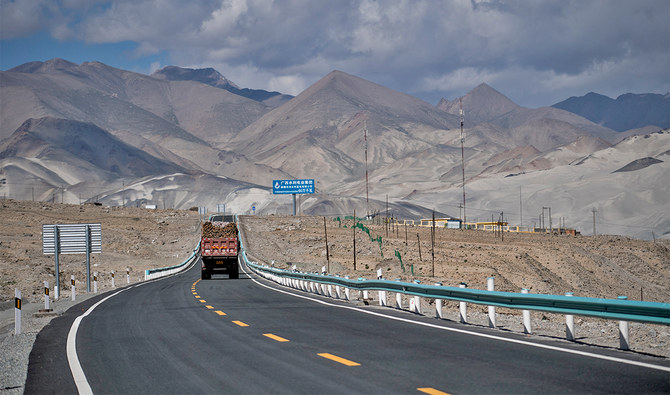
This picture taken on June 27, 2017 shows a truck driving along the China-Pakistan Friendship Highway before the Karakorum mountain range near Tashkurgan in China's western Xinjiang province. (AFP/File)
Short Url
Updated 03 April 2023
Follow

After over three years, Pakistan, China reopen key border crossing to bolster trade

  • The border trade through Khunjerab Pass was suspended in 2019 to stem coronavirus spread
  • The key route was occasionally opened in the last four years for emergency cargo from China

KHAPLU: Pakistan and China will be resuming travel and trade activities through a key border point in Pakistan’s northern Gilgit-Baltistan region that connects with China’s Xinjiang after a gap of more than three years, Pakistani officials said, hoping to accelerate trade between the two nations. 

At 5,000 meters above sea level, the Khunjerab Pass is the highest paved international crossing in the world, a major trade route between China and Pakistan, and an important gateway to South Asia and Europe for Chinese imports and exports. 

Under an agreement, trade activities between the two countries through the Khunjerab Pass continue from April till November. The first trade activity between China and Pakistan under the China-Pakistan Economic Corridor (CPEC) began via the Karakoram Highway, which passes through Khunjerab, in November 2016. 

The key border point was closed in 2019 to contain the spread of coronavirus, but authorities on both sides of the border last week decided to reopen it for all kinds of traffic on April 3, according to Gilgit-Baltistan Home Secretary Rana Muhammad Saleem Afzal. 

“Reopening of Khunjrab Pass is critical to accelerating trade between Pakistan and China,” Pakistan Prime Minister Shehbaz Sharif said on Twitter late Sunday. 

“The government is determined to unpack the full potential of CPEC (China-Pakistan Economic Corridor) by making it the centerpiece of our economic diplomacy for the region. Trade & connectivity are the building blocks of prosperity.” 

China and Pakistan are historic allies that enjoy cooperation in several sectors, including defense, military and trade, in part due to their border disputes with India. Beijing has also invested heavily in the $65 billion CPEC project that seeks to connect China to Pakistani ports through a vast network of roads, railways and pipelines. 

The prolonged closure of Khunjerab Pass caused immense financial losses to the local business community and triggered layoffs. The key border point was occasionally opened during the last three years for emergency cargo transportation from China to Pakistan. 

Pakistan, a country of 220 million, has been embroiled in an economic crisis, with its currency at a historic low level, forex reserves barely enough to cover a month of imports and inflation at a 50-year high. 

The resumption of trade with China is expected to bring some respite to the cash-strapped South Asian nation. 


PIF’s Humain invests $3bn in Elon Musk’s xAI prior to SpaceX acquisition

Updated 18 February 2026
Follow

PIF’s Humain invests $3bn in Elon Musk’s xAI prior to SpaceX acquisition

JEDDAH: Humain, an artificial intelligence company owned by Saudi Arabia’s Public Investment Fund, invested $3 billion in Elon Musk’s xAI shortly before the startup was acquired by SpaceX.

As part of xAI’s Series E round, Humain acquired a significant minority stake in the company, which was subsequently converted into shares of SpaceX, according to a press release.

The transaction reflects PIF’s broader push to position Saudi Arabia as a central hub in the global AI ecosystem, as part of its Vision 2030 diversification strategy.

Through Humain, the fund is seeking to combine capital deployment with infrastructure buildout, partnerships with leading technology firms, and domestic capacity development to reduce reliance on oil revenues and expand into advanced industries.

The $3 billion commitment offers potential for long-term capital gains while reinforcing the company’s role as a strategic, scaled investor in transformative technologies.

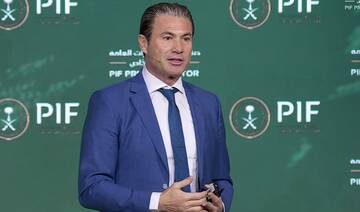
CEO Tareq Amin said: “This investment reflects Humain’s conviction in transformational AI and our ability to deploy meaningful capital behind exceptional opportunities where long-term vision, technical excellence, and execution converge, xAI’s trajectory, further strengthened by its acquisition by SpaceX, one of the largest technology mergers on record, represents the kind of high-impact platform we seek to support with significant capital.” 

The deal builds on a large-scale collaboration announced in November at the US-Saudi Investment Forum, where Humain and xAI committed to developing over 500 megawatts of next-generation AI data center and computing infrastructure, alongside deploying xAI’s “Grok” models in the Kingdom.

In a post on his X handle, Amin said: “I’m proud to share that Humain has invested $3 billion into xAI’s Series E round, just prior to its historic acquisition by SpaceX. Through this transaction, Humain became a significant minority shareholder in xAI.”

He added: “The investment builds on our previously announced 500MW AI infrastructure partnership with xAI in Saudi Arabia, reinforcing Humain’s role as both a strategic development partner and a scaled global investor in frontier AI.”

He noted that xAI’s trajectory, further strengthened by SpaceX’s acquisition, exemplifies the high-impact platforms Humain aims to support through strategic investments.

Earlier in February, SpaceX completed the acquisition of xAI, reflecting Elon Musk’s strategy to integrate AI with space exploration.

The combined entity, valued at $1.25 trillion, aims to build a vertically integrated innovation ecosystem spanning AI, space launch technology, and satellite internet, as well as direct-to-device communications and real-time information platforms, according to Bloomberg.

Humain, founded in August, consolidates Saudi Arabia’s AI initiatives under a single entity. From the outset, its vision has extended beyond domestic markets, participating across the global AI value chain from infrastructure to applications.

The company represents a strategic initiative by PIF to diversify the Kingdom’s economy and reduce oil dependence by investing in knowledge-based and advanced technologies.