

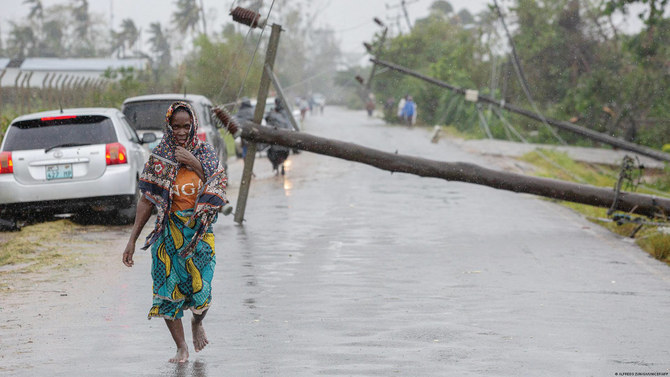

QUELIMANE: Weeks after massive Cyclone Freddy hit Mozambique for a second time, the still-flooded country is facing a spiraling cholera outbreak that threatens to add to the devastation.
There were over 19,000 confirmed cases of cholera across eight of Mozambique’s provinces as of March 27, according to UN Office for the Coordination of Humanitarian Affairs, a figure which had almost doubled in a week.
Freddy was likely the longest-lived cyclone ever, lasting over five weeks and hitting Mozambique twice. The tropical storm killed 165 people in Mozambique, 17 in Madagascar and 676 in Malawi. More than 530 people are still missing in Malawi two weeks later so that country’s death toll could well exceed 1,200.
Freddy made its second landfall in Mozambique’s Zambezia province, where scores of villages remain flooded and water supplies are still contaminated.
At a hospital in Quelimane, Zambezia’s provincial capital, National Institute of Health director-general Eduardo Sam Gudo Jr. reported there were 600 new confirmed cases a day in Quelimane district alone, but said that the real number may be as high as 1,000.
At least 31 died of cholera in Zambezia and over 3,200 were hospitalized between March 15 and 29, according to data from the Ministry of Health.
Cases are highest in the neighborhood of Icidua on the city outskirts, where most residents live in bamboo or adobe mud huts and fetch water in buckets from communal wells. Flooding brought by the cyclone has exposed many of these wells to water contaminated with sewage overflow and other sources of bacteria. Cholera spreads through feces, often when it gets into drinking water.
But until water pipelines ruptured in the floods are repaired, these wells are the only source of water for those in Icidua and communities like it. For now, temporary solutions offer the only hope of stemming the outbreak.
Volunteers go from house to house distributing bottles of Certeza, a local chlorine-based water purifier. Each bottle should last a family for a week, but supplies are running low as local production struggles to keep pace with demand. There are also not enough people to distribute the Certeza, even if greater supplies could be procured, Gudo said.
In the meantime, health workers are struggling to treat the infected with many clinics and hospitals badly damaged. “The cyclone destroyed the infrastructure here,” said Jose da Costa Silva, the clinical director of the Icidua health center. “We are working in parts of the hospital that were not destroyed. Some colleagues are working outside in the open because there’s not enough space available for everyone.”
Eighty health centers in total were affected by Freddy’s two landfalls in Mozambique, according to INGD, the country’s disaster management agency.
Although cyclones do occur in southern Africa from December to May, human-caused climate change has made tropical cyclones wetter, more intense and more frequent. The now-dissipated natural La Nina event also worsened cyclone activity in the region. While Cyclone Freddy itself hasn’t yet been attributed to climate change, researchers say it has all the right hallmarks of a warming-fueled weather event.
Formed in early February off Australia, the cyclone with exceptional longevity made an unprecedented crossing of more than 8,000 kilometers from east to west across the Indian Ocean.
It followed a looping path rarely recorded by meteorologists, hitting Madagascar and Mozambique for the first time at the end of February, and then again in March before barrelling into Malawi.
Restoring normal water supplies in Mozambique will take time, as many damaged pipelines run through areas that are still inaccessible two weeks after the cyclone’s last impact.
“A cholera outbreak in a flooded flatland with a very high water table is ‘mission impossible’ to address,” Myrta
Kaulard, the UN resident coordinator in Mozambique, said.
“Sanitation is a huge problem and the flooding has affected key infrastructure, such as the water pipelines and the electricity supply … Repairing that infrastructure in flooded areas is another ‘mission impossible.’”
Meanwhile, rural areas around Quelimane are facing other threats. Many villages and fields are still underwater, and the humidity has bred swarms of mosquitoes carrying malaria. In a makeshift displacement camp on the bank of a flooded rice paddy near the village of Nicoadala, 20 out of 290 residents are sick with malaria, according to Hilario Milisto Irawe, a local chief.
There were 444 reported cases of malaria in Quelimane district on 24 March alone, but the number is likely much higher as many, such as those in the camp outside Nicoadala, lack access to health facilities.
Compounding the public health crisis, the material livelihoods of hundreds of thousands are at risk as Freddy hit just before the main harvest. It also carried seawater inland, threatening the long-term fertility of the soil in an area where malnutrition is already chronic.
“All our farms are flooded. Our rice farms are destroyed. All we can do is start over again, but we don’t know how we will do that,” said Irawe.


