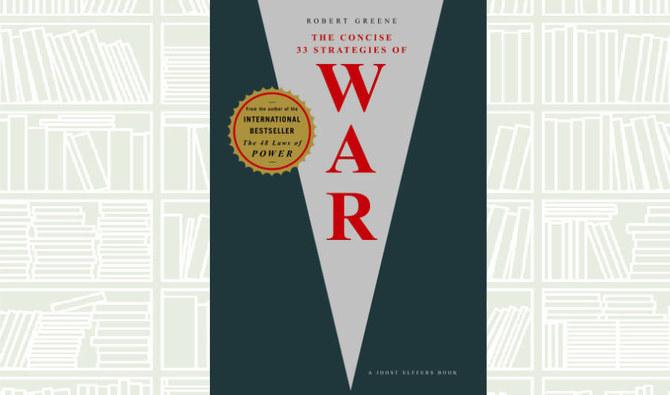

“The Concise 33 Strategies of War” was written by Robert Greene and produced by Joost Ellferson in 2006.
It contains timeless lessons based on centuries of religious, political and philosophical views on warfare.
Greene’s third book draws upon military history, business management and psychology.
The 33 strategies of the title are divided into five parts. Part one, “Self-directed Warfare,” talks of the necessity of cutting ties with past fears and temporary emotions in the face of conflict.
It says that to become a “true strategist,” one must understand that emotional subjectivity can cloud strategies, that waging war on oneself is crucial to leave that comfortable space and that one must win the battle against themselves first.
Greene argues that impartiality does not exist. “A sharply worded question, an opinion designed to offend, will make them react and take sides.”
Part two delves into organizational or team warfare, command-and-control, “controlled-chaos” and morale.
Parts three and four, defensive and offensive war respectively, tackle deterrence strategies or how to create a threatening presence and how to pick your battles and win the war.
In part five, “Unconventional (Dirty) War,” Greene says that “to try to stay clean out of a sense of morality is to risk defeat.”
Greene is a best-selling author of numerous other books that combine and connect rich and dense texts into one guide. He wrote his famous texts “The 48 Laws of Power,” “The Art of Seduction,” and “Mastery.”