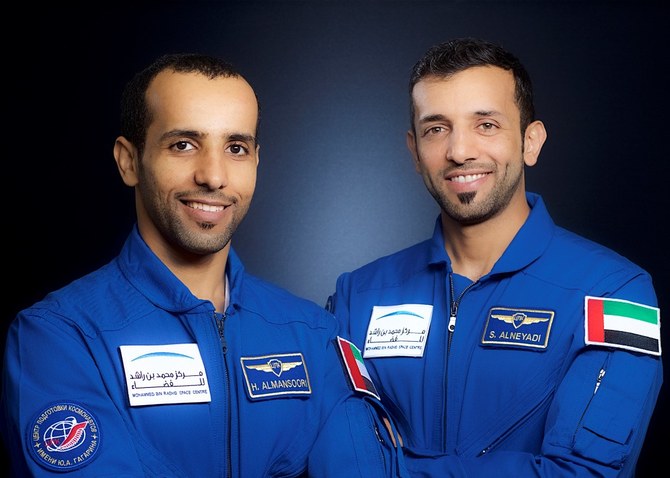
DUBAI: Emirati astronaut Hazzaa Al-Mansoori has become the first Arab to be appointed to the key role of increment lead for an International Space Station expedition, reported Emirates News Agency on Saturday.
Since the Soyuz MS-22 spacecraft undocked on March 28, the historic Expedition 69 has marked a milestone for the Arab region and the UAE.
In addition to Al-Mansoori, the ground-breaking mission includes Sultan Al-Neyadi, the first Arab astronaut to embark on a long-duration spaceflight.
As part of his duty as a lead, the Emirati astronaut will guide the ISS crew through every aspect of the mission, underscoring the UAE’s expanding contribution to the field of space exploration.
Expedition 69 crew members are set to conduct multiple experiments during their mission, including investigating the effects of microgravity on material combustion to enhance spacecraft safety, testing a novel tool for deep-space immune monitoring, and advancing research on 3D-cultured cardiac muscle tissue to evaluate human cardiac function in microgravity.
Al-Neyadi will also test samples for microorganisms from outside the space station.
Salem Humaid Al-Marri, director-general of Mohammed Bin Rashid Space Center, said: “Expedition 69 represents the longest Arab space mission to date and marks the first time an Arab astronaut has been appointed as increment lead. Al-Mansoori’s appointment to this position is a testament to his exceptional skills and knowledge.”
It sets the stage for more Arab astronauts to participate in space exploration., according to Al-Marri, who added: “We are excited to witness Sultan and Hazzaa collaborate to conduct ground-breaking experiments that will broaden our knowledge of space and understanding of life in microgravity.”
Al-Mansoori shoulders a critical responsibility for the seamless integration and execution of ISS crew activities throughout Expedition 69.
This involves an array of duties, such as developing, managing, implementing, and communicating mission integration procedures.
Al-Mansoori will ensure the mission’s efficiency and effectiveness by serving as the primary point of contact between the ground team and the ISS crew during operations.
He said: “I am honored to facilitate seamless information exchange between the Astronauts Office and the ISS Expedition team. However, my role entails more than just transmitting data. It includes understanding and appreciating our crew’s challenges and triumphs in space. We aim to advance human space exploration through our collective efforts to support Expedition 69.”
Al-Neyadi has begun conducting experiments with the BioFabrication Facility, evaluating its capacity to produce knee cartilage tissue for treating injuries in space and remote locations on Earth.
He underwent neck, shoulder, and leg vein scans using the Ultrasound 2 medical device.
Expedition 69 crew aboard the ISS comprises astronauts Al-Neyadi, Stephen Bowen, Woody Hoburg, Frank Rubio, Dmitri Petelin, Sergey Prokopyev and Andrey Fedyaev.


![]()


Emirati astronaut Hazzaa Al-Mansoori marks another milestone on Arab space mission
Short Url
https://arab.news/jdsta
Emirati astronaut Hazzaa Al-Mansoori marks another milestone on Arab space mission
- Ground-breaking mission also includes Sultan Al-Neyadi, the first Arab astronaut to embark on a long-duration spaceflight
- Salem Humaid Al-Marri, MBRSC director-general said: ‘Expedition 69 represents the longest Arab space mission to date and marks the first time an Arab astronaut has been appointed as increment lead’


WHO says Dubai global emergency logistics hub ‘resuming operations’
- Hanan Balkhy, WHO’s Eastern Mediterranean regional chief, says more than 50 emergency supply requests across 25 countries are affected by the pause
- The hub stopped work this week after Iran launched waves of missile and drone attacks across the Gulf
GENEVA: The World Health Organization said its global health emergencies logistics hub in Dubai was resuming operations on Friday after a pause caused by the war in the Middle East.
“One of our most immediate concerns is the disruption of humanitarian health supply chains,” Hanan Balkhy, the UN health agency’s Eastern Mediterranean regional chief, told a press conference in Geneva.
“After a temporary pause, WHO’s Hub for Global Health Emergencies Logistics is today resuming operations,” she said, speaking from Cairo.
She said the UAE, in coordination with the UN’s World Food Programme, had confirmed that it stood ready to facilitate urgent humanitarian shipments.
“More than 50 emergency supply requests across 25 countries are currently affected,” said Balkhy.
“These pending requests — which will benefit more than 1.5 million people — include WHO supplies for Lebanon, Gaza, Yemen, and Somalia, as well as polio laboratory supplies for global detection and eradication activities across a number of countries.”
She said the WHO would be working in the coming days to process urgent new shipments and clear priority backlogs.
Balkhy noted that even before the escalation of hostilities in the Middle East, health systems in many countries were already operating at full capacity.
“WHO has pre-positioned trauma supplies and essential medicines at our warehouse in Tehran and is closely monitoring the situation — including potential mass casualty needs, disruptions to essential health services, and possible displacement,” she said.
“One of our most immediate concerns is the disruption of humanitarian health supply chains,” Hanan Balkhy, the UN health agency’s Eastern Mediterranean regional chief, told a press conference in Geneva.
“After a temporary pause, WHO’s Hub for Global Health Emergencies Logistics is today resuming operations,” she said, speaking from Cairo.
She said the UAE, in coordination with the UN’s World Food Programme, had confirmed that it stood ready to facilitate urgent humanitarian shipments.
“More than 50 emergency supply requests across 25 countries are currently affected,” said Balkhy.
“These pending requests — which will benefit more than 1.5 million people — include WHO supplies for Lebanon, Gaza, Yemen, and Somalia, as well as polio laboratory supplies for global detection and eradication activities across a number of countries.”
She said the WHO would be working in the coming days to process urgent new shipments and clear priority backlogs.
Balkhy noted that even before the escalation of hostilities in the Middle East, health systems in many countries were already operating at full capacity.
“WHO has pre-positioned trauma supplies and essential medicines at our warehouse in Tehran and is closely monitoring the situation — including potential mass casualty needs, disruptions to essential health services, and possible displacement,” she said.
Latest updates


© 2026 SAUDI RESEARCH & PUBLISHING COMPANY, All Rights Reserved And subject to Terms of Use Agreement.