Saudi Women’s U-17 national team captain aims to inspire Saudi girls

1 / 6
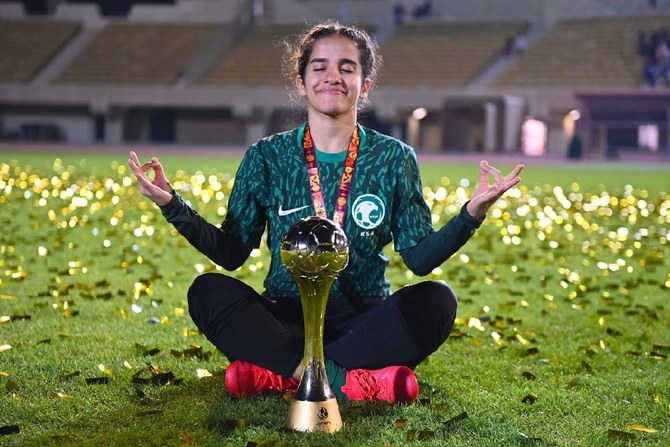
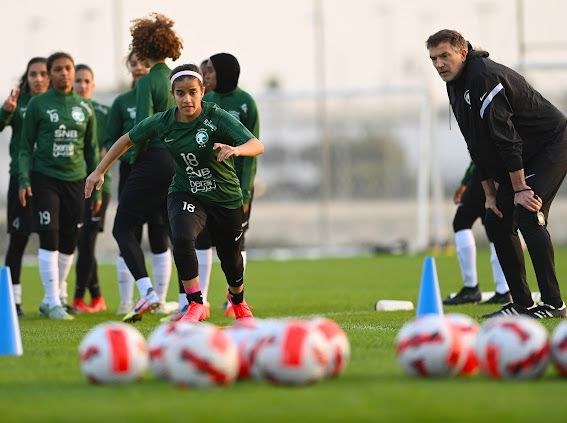
Majd Alotaibi striking one of her signature poses after the women's national team won the international friendly match. (Supplied)
2 / 6
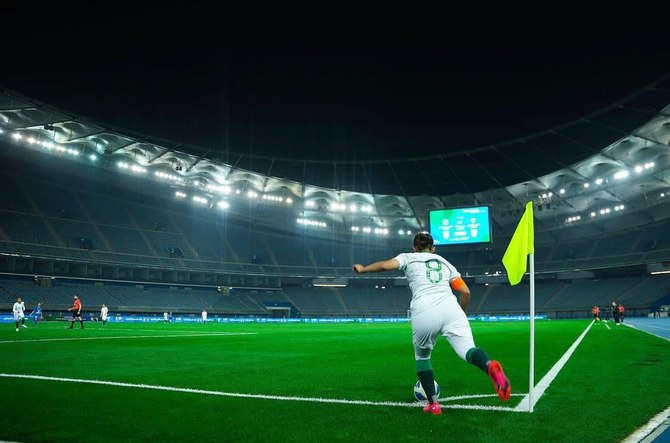
At 16, Majd Alotaibi is one of the youngest players in the women’s First Division. (Supplied)
3 / 6
At 16, Majd Alotaibi is one of the youngest players in the women’s First Division. (AN Photo/Huda Bashatah)
4 / 6
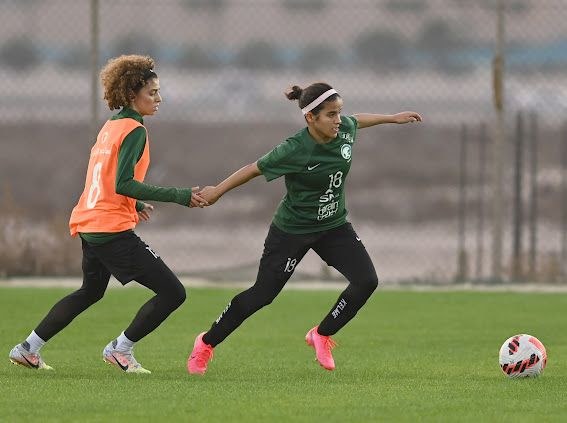
At 16, Majd Alotaibi is one of the youngest players in the women’s First Division. (Supplied)
5 / 6
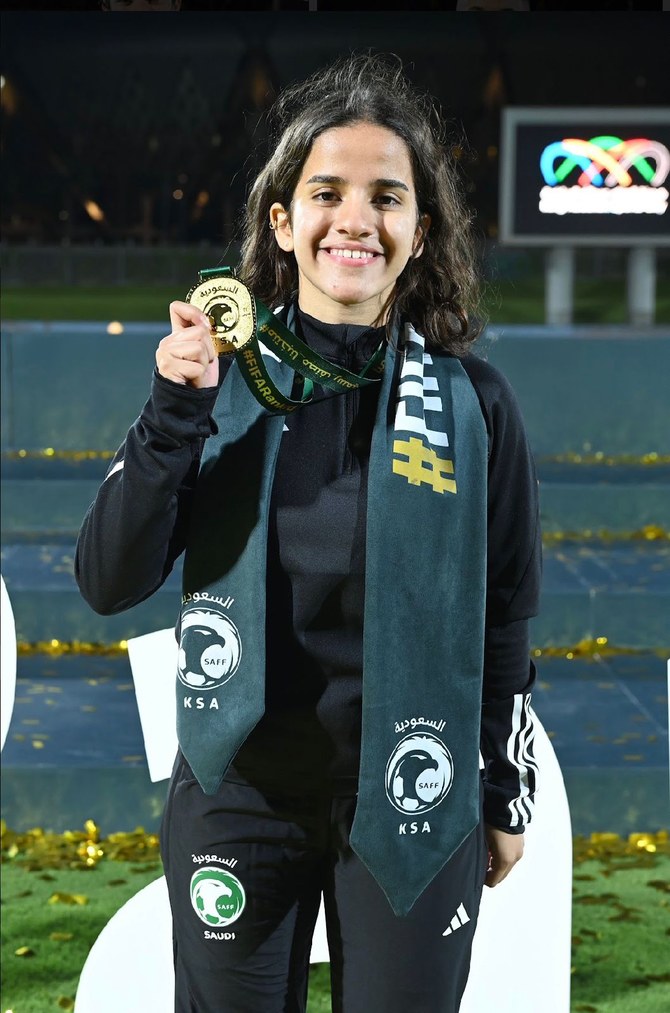
At 16, Majd Alotaibi is one of the youngest players in the women’s First Division. (Supplied)
6 / 6
At 16, Majd Alotaibi is one of the youngest players in the women’s First Division. (Supplied)
Short Url
Updated 02 April 2023
Follow

Saudi Women’s U-17 national team captain aims to inspire Saudi girls

  • At 16, Majd Alotaibi is one of the youngest players in the women’s First Division

RIYADH: Majd Alotaibi is dreaming big.

The captain of the U-17 Saudi Women’s National Football Team — established in February —hopes to inspire other girls across the Kingdom and dreams of winning the FIFA World Cup with the Green Falcons.  

The U-17 team, led by Croatian coach Stella Gutal, consists of 28 players and is captained by Alotaibi, who is one of the youngest players in the Saudi women’s First Division, in which she represents Al-Yamamah FC.

Alotaibi started playing football in 2013, aged six, in a team coached by her father, who was a professional football player himself.   

“My dad used to be a player so I felt like football was in my blood,” Alotaibi told Arab News. “It’s been a big part of my life since I was young.” Her family and friends “and everyone cheering me on” are her main motivation, she added. And she hopes to be a source of motivation for others too. “Being one of the youngest players in the (league and national team) means that I have to inspire younger girls,” she added. 

She is quick to credit her teammates at the Saudi national team, saying: “I would like to thank my teammates first of all, because they helped make it easier for me; because I’m one of the youngest, they take care of me.”  

Alotaibi stressed that discipline and dedication are crucial for anyone hoping to become a professional.

“If you love the game and you want to do amazing things and achieve a lot, you need to be 100 percent in what you’re doing,” she explained. “Always being there on time, always the first person on the field, last person off the field. If you have passion for something, you’re going to achieve a lot of great things.” 

On March 24, Saudi Arabia’s Women’s National Team entered the FIFA world rankings after nine international matches over the previous year.  

“Currently the Saudi national team is ranked 171 out of 188 national teams. That just proves how hard we have been working in such a short time so, inshallah, in the future you will see how far we come,” Alotaibi said.  

After a recent victory in an international friendly match, the team gathered for official pictures, and Alotaibi mimicked Manchester City star Erling Haaland’s ‘yoga meditation’ goal celebration.  

 “I know it’s Haaland’s move, but I was happy and wanted to celebrate and that was the first thing that came to mind,” she said. “Now it’s become a thing.”

She has another signature pose where she brings her hands together to create the letter “M.”

“It’s M for Majd,” she said. “Inshallah, for upcoming matches when I score, I will do it.” 

For now, Alotaibi is focusing on her career with Al-Yamamah and the Saudi national team, but would she consider a move in the future?

“What’s next for me is I want to become the best player in the league,” she said. “Regarding (other) clubs… to be continued.”

Alotaibi is still very young and aims to continue pushing herself to new limits while inspiring other young girls to pursue their passions and achieve their goals. 

Her own ambitions remain very lofty. She told Arab News that in 10 years, with the help of her teammates, she hopes to win the World Cup.

“It’s not something I want to accomplish by myself, it’s something I want to accomplish with the Saudi national team. I want to win the World Cup, Women’s World Cup,” the young star said.


Pakistan bowler Tariq and his unusual delivery courts controversy at the T20 World Cup

Updated 4 sec ago
Follow

Pakistan bowler Tariq and his unusual delivery courts controversy at the T20 World Cup

  • Offspinner’s unconventional bowling action has already mesmerized some of the big names
  • As is often the case in cricket, the reasons for Usman Tariq’s potential illegal delivery are complicated
ISLAMABAD: With a momentary pause in his delivery and his statue-like pose at the crease, Pakistan spin bowler Usman Tariq has created plenty of attention at cricket’s Twenty20 World Cup.
Just enough, it seems, to throw off opposing batters.
With it has come a fair share of controversy — that his pause-and sling style of bowling is an illegal delivery, or in cricket parlance, chucking. He’s already been reported twice, but cleared, by Pakistani cricket authorities.
The 28-year-old offspinner’s unconventional bowling action has already mesmerized some of the big names in shortest format of the game and has seen him taking three wickets against an inexperienced United States in Sri Lanka this week in what was his first T20 World Cup game.
As is often the case in cricket, the reasons for Tariq’s potential illegal delivery are complicated.
First there is the so-called “15-degree debate” — that bowlers cannot exceed the ICC’s 15-degree elbow flex limit, which is nearly impossible for on-field umpires to judge accurately in real time.
Another talking point has been the pause in Tariq’s delivery stride. Some critics, including former India cricketer Shreevats Goswami, compare it to a football penalty run-up that would be ruled illegal if the shooter stops midway.
Baffling the batters
Batters like Cameron Green of Australia and South African Dewald Brevis are a few notable players that were flummoxed by Tariq’s bowling action.
Power-hitter Brevis fell to Tariq’s only second ball in T20 international cricket in November. Green shook his head in disbelief and mocked Tariq’s bowling action close to the boundary line — but later apologized — when he walked back after slicing a wide delivery straight to the cover fielder during Pakistan’s 3-0 sweep of Australia at Lahore.
Tariq’s rise in T20 cricket has also seen him taking a hat-trick at Rawalpindi when he took 4-18 against Zimbabwe during the tri-series in November. He has taken 11 wickets off his 88 balls in only four T20 internationals.
It was no surprise when selectors included Tariq in the 15-man T20 World Cup squad, knowing that pitches in Sri Lanka would suit slow bowlers more than pacemen.
Tariq’s journey to top-level cricket wasn’t a smooth one. He was twice reported for suspect bowling action during country’s premier domestic T20 tournament — the Pakistan Super League — over the last two seasons, but on both occasions he was cleared after testing at the National Cricket Academy in Lahore.
“I have two elbows in my arm,” Tariq said. “My arm bends naturally. I have got this tested and cleared. Everyone feels I bend my arm and all that. My bent arm is a biological issue.”
Tariq has also featured in the Caribbean Premier League and with his deceptive bowling action he was the tournament’s second-highest wicket taker for champions Trinbago Knight Riders.
Long pause a problem
“The batters are struggling to read Tariq because of the long pause the moment he steps on the bowling crease,” former Pakistan captain Sarfaraz Ahmed, who has played with Tariq in the PSL’s Quetta Gladiators, said.
“The long pause disturbs all the concentration of batters and when he bowls a fastish (delivery, after a long pause), or even a slow ball, it leaves the batters clueless.”
Less than three months ago, Tariq said he had dreamed about playing against archrival India. And after Pakistan withdrew its boycott of Sunday’s game in the T20 World Cup, Tariq’s dream could come true if Pakistan uses five spinners against India.
“I wish there’s a match against India and I can win the game for Pakistan single-handedly,” Tariq said then. “My coaches have injected this thing in me that ‘you have to win matches single-handedly’.”
On Sunday against India, Tariq could do just that.