


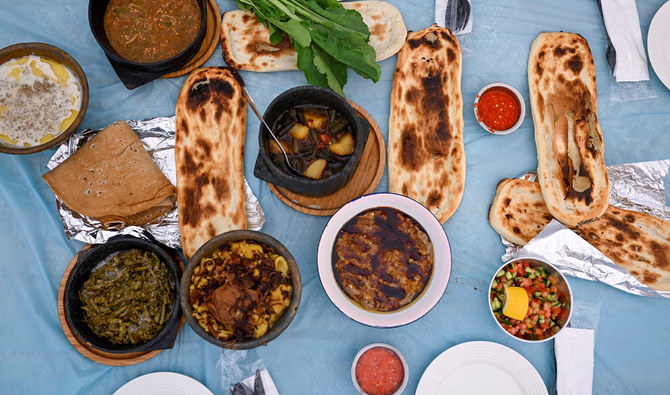

JEDDAH: During the holy month of Ramadan, once the call for Maghrib prayer is heard, people across the Kingdom break their fast with a rich array of traditional dishes particular to their region, many of which have a long and distinguished history.
For iftar, there is a well-known custom of gathering in the home of the head of the family. Often families would have iftar in two stages, which is to first break their fast with gahwa (Arabic coffee) and dates, followed with the main courses and praying Maghrib prayer.
In the western region comprising Makkah, Jeddah and Madinah, the iftar spread features dishes from Hijazi cuisine such as shouraik bread, duggah (Madini mixture of condiments), different types of dates such as rutab and sukkary, Zamzam water, sambosa, gahwa, balila and foul.
A Jeddah-based heritage researcher, Etidal Atiwi, said that the Ramadan table in the Hijaz region is very rich. “Ramadan has a special flavor because dishes made during the month contain special items and require preparations that are made in the last week of Shaban (the month preceding Ramadan in the Islamic calendar), where all the ingredients needed forthese foods are prepared beforehand,” she told Arab News.
The two most important dishes that must be present on the Hijazi Ramadan table are barley soup known as hab, which is famous for its special aroma and distinctive taste, as well as the sambosa, which is a deep-fried, triangle-shaped savory pastry stuffed with different kinds of fillings such as ground beef or chicken.
“Foul is the undisputed master of the Hijazi iftar, served especially with ghee and suhaira, which is a special type of bread prepared from chickpeas and spices. People are keen to prepare this bread, especially for Ramadan,” Atiwi explained.
Foul is a staple on iftar and sahoor tables across the Middle East during Ramadan. While each region and country has its own style, in Hijaz it has a special smoky flavor, Atiwi said.
For desserts, they enjoy “banana, almonds, cheese and cream kunafa … as well as jubniya, which is made from pastry dough, stuffed with sweet cheese, then deep fried and dipped in sugar syrup. It is a very old dessert that is usually served (for) iftar,” Atiwi said. Another sweet dish that is popular in the region is sagdana, which is made of sago, milk and sugar.
A refreshing drink widely served in the region is sobia, which is believed to have found its way to the Kingdom through Egyptian pilgrims hundreds of years ago. Made of barley, flour, dry bread and sugar, sobia is usually sold by street vendors. Another popular beverage is Qamr Al-Din, which is a thick and sweet apricot drink.
Atiwi also pointed out a special habit of Hijazi households related to water cups. “We fumigate water utensils with incense after washing and drying, which gives a distinctive aroma to the cup once it is used for drinking water. In addition, we add drops of rose water, or kadi water, for a refreshing flavor and many health benefits.”
Some of the famous Hijazi families who offer the best sobia are the Al-Khosha in Madinah, Al-Khodari and Al-Hussaini in Makkah, and the Hanbazaza family in Jeddah.
In the central region, people break their fast with aseedah, margoog, mafrouk, and matazeez, which are prepared with brown grains, beef, vegetables, honey, onions or ghee.
Riyadh-based Samirah Al-Anizi said that “hnini marks our iftar table.” It is a traditional Najdi dessert made from dates, brown bread and butter, and seasoned with cardamom and saffron. The dish is served warm or at room temperature during the winter season as it provides energy and warmth.
From Riyadh to Qassim, tawa is another dish that is served specially for iftar, which is made of whole wheat flour, black seeds and sugar.
In Hail, one of the most popular dishes is maqshush, made of buckwheat bites garnished with a combination of ghee, honey, dates, molasses and sugar. It was also selected as the national dessert by the Saudi Ministry of Culture’s Culinary Arts Commission earlier last month.
In the southern region of the Kingdom, such as Jazan, the iftar spread comprises traditional sweet and savory dishes, such as moghsh and marsa, and mashghoutha, which are primarily made of flour mixed with fresh milk and served hot with dates. Most families use traditional cooking methods to prepare food.
Nahla Zamim, a kindergarten teacher from Jazan, said: “Grain soup with meat, sambosa, fish, Qamar Al-Din juice, shafut in some families, and makhloota (sour dumpling) is among the most important dishes that are found (on the) Ramadan table.”
Another popular staple in the region is mogsh soup in a mifa, a traditional oven with a stone bowl in which pieces of meat are placed with different types of vegetables. “The preparation of mogsh soup is the most prominent feature of the month of Ramadan, as households get up at dawn and light the mifa to prepare the soup with meat,” she said.
In the Eastern Region, there is a unique diversity of dishes related to Ramadan iftar tables. Sara Al-Dossari from Alkhobar said that “thareed and fried dumplings drizzled with date molasses are among the most popular in Ramadan.” Thareed is a mix of vegetables including zucchini, carrots and potatoes, with small pieces of lamb, that are assembled on thin bread.


