

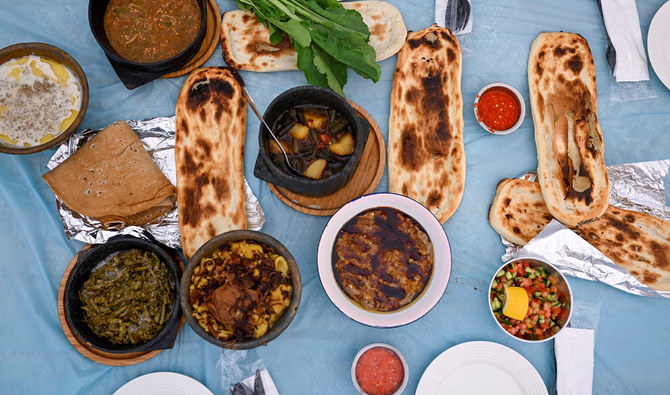
Saudi Arabia’s rich array of regional Ramadan dishes

1 / 2
Mogsh soup being cooked in a traditional oven called mifa. (SPA)
2 / 2
A traditional iftar spread from Jazan, located in the southern region of the Kingdom. (SPA)
Short Url
Updated 31 March 2023
Follow

Saudi Arabia’s rich array of regional Ramadan dishes

  • Hijaz, Najd, southern and eastern regions have own specialities
  • Various types of dates, breads, soups and desserts on iftar tables

JEDDAH: During the holy month of Ramadan, once the call for Maghrib prayer is heard, people across the Kingdom break their fast with a rich array of traditional dishes particular to their region, many of which have a long and distinguished history.

For iftar, there is a well-known custom of gathering in the home of the head of the family. Often families would have iftar in two stages, which is to first break their fast with gahwa (Arabic coffee) and dates, followed with the main courses and praying Maghrib prayer.

In the western region comprising Makkah, Jeddah and Madinah, the iftar spread features dishes from Hijazi cuisine such as shouraik bread, duggah (Madini mixture of condiments), different types of dates such as rutab and sukkary, Zamzam water, sambosa, gahwa, balila and foul.

A Jeddah-based heritage researcher, Etidal Atiwi, said that the Ramadan table in the Hijaz region is very rich. “Ramadan has a special flavor because dishes made during the month contain special items and require preparations that are made in the last week of Shaban (the month preceding Ramadan in the Islamic calendar), where all the ingredients needed forthese foods are prepared beforehand,” she told Arab News.

The two most important dishes that must be present on the Hijazi Ramadan table are barley soup known as hab, which is famous for its special aroma and distinctive taste, as well as the sambosa, which is a deep-fried, triangle-shaped savory pastry stuffed with different kinds of fillings such as ground beef or chicken.

“Foul is the undisputed master of the Hijazi iftar, served especially with ghee and suhaira, which is a special type of bread prepared from chickpeas and spices. People are keen to prepare this bread, especially for Ramadan,” Atiwi explained.

Foul is a staple on iftar and sahoor tables across the Middle East during Ramadan. While each region and country has its own style, in Hijaz it has a special smoky flavor, Atiwi said.

For desserts, they enjoy “banana, almonds, cheese and cream kunafa … as well as jubniya, which is made from pastry dough, stuffed with sweet cheese, then deep fried and dipped in sugar syrup. It is a very old dessert that is usually served (for) iftar,” Atiwi said. Another sweet dish that is popular in the region is sagdana, which is made of sago, milk and sugar.

A refreshing drink widely served in the region is sobia, which is believed to have found its way to the Kingdom through Egyptian pilgrims hundreds of years ago. Made of barley, flour, dry bread and sugar, sobia is usually sold by street vendors. Another popular beverage is Qamr Al-Din, which is a thick and sweet apricot drink.

Atiwi also pointed out a special habit of Hijazi households related to water cups. “We fumigate water utensils with incense after washing and drying, which gives a distinctive aroma to the cup once it is used for drinking water. In addition, we add drops of rose water, or kadi water, for a refreshing flavor and many health benefits.”

Some of the famous Hijazi families who offer the best sobia are the Al-Khosha in Madinah, Al-Khodari and Al-Hussaini in Makkah, and the Hanbazaza family in Jeddah.

In the central region, people break their fast with aseedah, margoog, mafrouk, and matazeez, which are prepared with brown grains, beef, vegetables, honey, onions or ghee.

Riyadh-based Samirah Al-Anizi said that “hnini marks our iftar table.” It is a traditional Najdi dessert made from dates, brown bread and butter, and seasoned with cardamom and saffron. The dish is served warm or at room temperature during the winter season as it provides energy and warmth.

From Riyadh to Qassim, tawa is another dish that is served specially for iftar, which is made of whole wheat flour, black seeds and sugar.

In Hail, one of the most popular dishes is maqshush, made of buckwheat bites garnished with a combination of ghee, honey, dates, molasses and sugar. It was also selected as the national dessert by the Saudi Ministry of Culture’s Culinary Arts Commission earlier last month.

In the southern region of the Kingdom, such as Jazan, the iftar spread comprises traditional sweet and savory dishes, such as moghsh and marsa, and mashghoutha, which are primarily made of flour mixed with fresh milk and served hot with dates. Most families use traditional cooking methods to prepare food.

Nahla Zamim, a kindergarten teacher from Jazan, said: “Grain soup with meat, sambosa, fish, Qamar Al-Din juice, shafut in some families, and makhloota (sour dumpling) is among the most important dishes that are found (on the) Ramadan table.”

Another popular staple in the region is mogsh soup in a mifa, a traditional oven with a stone bowl in which pieces of meat are placed with different types of vegetables. “The preparation of mogsh soup is the most prominent feature of the month of Ramadan, as households get up at dawn and light the mifa to prepare the soup with meat,” she said.

In the Eastern Region, there is a unique diversity of dishes related to Ramadan iftar tables. Sara Al-Dossari from Alkhobar said that “thareed and fried dumplings drizzled with date molasses are among the most popular in Ramadan.” Thareed is a mix of vegetables including zucchini, carrots and potatoes, with small pieces of lamb, that are assembled on thin bread.


Saudi House kicks off Davos with push on Vision 2030, AI platform and ‘humanizing’ tourism

At Saudi House, ministers and executives set out how the Kingdom sees the next phase of its transformation. (Supplied)
Updated 20 January 2026
Follow

Saudi House kicks off Davos with push on Vision 2030, AI platform and ‘humanizing’ tourism

  • Saudi ministers dominate pre-summit spotlight at Saudi pavilion, touting Vision 2030’s next phase and human capital as key to global edge
  • Ministry of Economy and Planning announced the SUSTAIN Platform which aims to accelerate AI-enabled, cross-sector collaboration for sustainable development

DAVOS: For regulars at the World Economic Forum, Monday in Davos is usually a chance to ease into the week, a time to reconnect, plan meetings and prepare for the intense schedule ahead.

This year, Saudi Arabia moved quickly to fill that lull, taking center stage with a packed program of panels ahead of Tuesday’s official opening.

At the Saudi House — the Kingdom’s official pavilion on the Promenade, returning after its debut as a standalone venue at the 2025 WEF Annual Meeting — Saudi ministers and global executives set out how the Kingdom sees the next phase of its transformation.

Monday’s speakers at the Saudi House included Minister of Finance Mohammed Al-Jadaan, Minister of Investment Khalid Al-Falih, Minister of Tourism Ahmed Al-Khateeb, and President and Vice Chairman of Meta Dina Powell McCormick. (Supplied)

Established by the Ministry of Economy and Planning, the venue is pitched as a platform for international thought leaders to tackle the challenges, opportunities and solutions shaping the global economy.

Opening a session on the Kingdom’s role at this year’s Forum and the next phase of Vision 2030 — now in its 10th year and roughly two-thirds complete — Princess Reema bint Bandar, Saudi Arabia’s ambassador to the US, said human capital “is the actual driver if you want a competitive, modern economy.”

She described one of the biggest achievements of the past decade as the emergence of a highly qualified cohort of young Saudis who could work anywhere in the world but “choose to come home, choose to build at home and choose to deliver at home,” calling this “the biggest symbol of the success of Vision 2030.”

Who can give you optimum access to opportunities while addressing risks? I contend that Saudi Arabia has been able to provide that formula.

Khalid Al-Falih, Saudi minister of investment

On the same panel, Minister of Finance Mohammed Aljadaan said this success is rooted in a “behavioral change” that has strengthened the Kingdom’s credibility with both international partners and its own citizens.

“Credibility comes from being very pragmatic, making sure that you maintain your fiscal policy discipline, but at the same time refocus your resources where it matters,” he said, warning that “markets will call your bluff if you’re not serious.”

The Saudi House, a cross-ministerial initiative led by the Ministry of Economy and Planning, is intended to underscore the Kingdom’s “commitment to global cooperation” by offering “a platform where visionary ideas are shared and shaped,” while showcasing opportunities and lessons from its “unprecedented national transformation.”

Lubna Olayan, Chair of the Corporate Board, Olayan Group

Echoing earlier comments to Arab News, Economy and Planning Minister Faisal Alibrahim said the Kingdom’s role as an anchor of stability has helped unlock its potential, stressing that while the objective is to decouple from reliance on a single commodity, “2030 is not the finishing line.”

Khalid Al-Falih, Saudi minister of investment, said Saudi Arabia has been able to enable access to opportunities while addressing major risks, arguing that few countries can match the Kingdom’s overall mix.

“No country has all of those to 100 percent,” he said. “But who can give you the mix that gives you optimum access to opportunities while addressing all of those risks?

Dr. Bedour Alrayes, Deputy CEO, Human Capability Development Program, Saudi Arabia

“I contend that Saudi Arabia has been able to provide that formula and the proof is in the pudding,” noting that local investment has doubled in recent years to reach levels comparable with India and China.

While societal transformation dominated the morning discussions, the afternoon turned to technology, tourism, sport and culture, four strategic sectors expected to spearhead Vision 2030’s next phase.

The Ministry of Economy and Planning used the day to announce the SUSTAIN Platform, due to launch in 2026, which aims to accelerate AI-enabled, cross-sector collaboration for sustainable development.

The ministry said SUSTAIN will translate the Kingdom’s public and private-sector coordination mandate into a practical national tool to help government entities, businesses, investors, academia and civil society identify credible partners, form trusted coalitions and move initiatives “from planning to implementation more efficiently,” addressing a global challenge where fragmented partnerships often slow delivery and blunt impact.

“We are in a moment in time where technology may well impact the face of humanity,” said Dina Powell McCormick, recently appointed president and vice chairman of Meta, welcoming the Kingdom’s “desire” to partner with technology companies and its embrace of innovation.

Minister of Tourism Ahmed Alkhateeb, discussing how technology is being deployed in his sector, underlined that “in travel and tourism, people are very important. We learn about other people’s culture through interacting with people. We digitalize the unnecessary and humanize the necessary.”

He added that while technological transformation is a priority, “we don’t want to replace this big workforce with technology. I think we need to protect them in Saudi Arabia, where we’re being a model. I’m an advocate of keeping the people.”

Throughout the week, Saudi House will host more than 20 sessions, including over 10 accredited by the WEF, across six themes: Bold Vision, Insights for Impact, People and Human Capability, Quality of Life, Investment and Collaboration, and Welcoming the World.

The pavilion will also launch “NextOn,” a new series of influential and educational talks featuring leading global voices.