



KARACHI: Pakistan's ongoing economic crisis, caused by a major dollar liquidity crunch, has doubled the cost of Saudi dates, said local traders on Tuesday, after the country lost much of its own crops in the wake of the monsoon floods that destroyed farmlands in the southern region of Sindh and Balochistan last year.
Saudi dates are a much-loved culinary treasure for Pakistani elites in the Muslim fasting month of Ramadan. Traditionally, the prices of these dates remain high in the local market due to their quality. They are also the top choice of affluent classes in Pakistan.
Ajwa, Ambar, Safwai, Sukkari, Barhi, Saghai, Kalmi, Khudri, Kholas and Medjoul are the most famous Saudi dates sold in Pakistan. However, local traders say the prices of Saudi dates had doubled while the sales had reduced this year.
“Last year, the rate of Sukkari dates was Rs1,100 per kilogram,” Sher Zaman Khan, a local dealer, told Arab News on Tuesday. “This year, it rate has increased to Rs2,200. The rate of Kalmi dates stood at Rs900 but it has gone up between Rs1,700 and Rs1,800. Last year, the cost of Ambar date were Rs1,400 but they are sold for Rs2,800 this year.”
With an annual production of around 1.1 million tons, Saudi Arabia is one of the top producers and exporters of dates. Pakistan, which is also among the world's top 10 date producers with about 500,000 tons of annual yield, meets half of its demand through imports, mainly in the holy month of Ramadan.
Dealers said the quantity of Saudi dates had substantially declined in Pakistani market due to restrictions on imports, coupled with the widespread devastation caused by last year's floods in the dates growing areas of Sindh and Balochistan.
“The demand for Saudi dates has declined because of the diminishing purchasing power of people,” Hanif Baloch, an importer and dealer of the fruit, told Arab News. “Even those belonging to high income classes have started thinking before buying.”
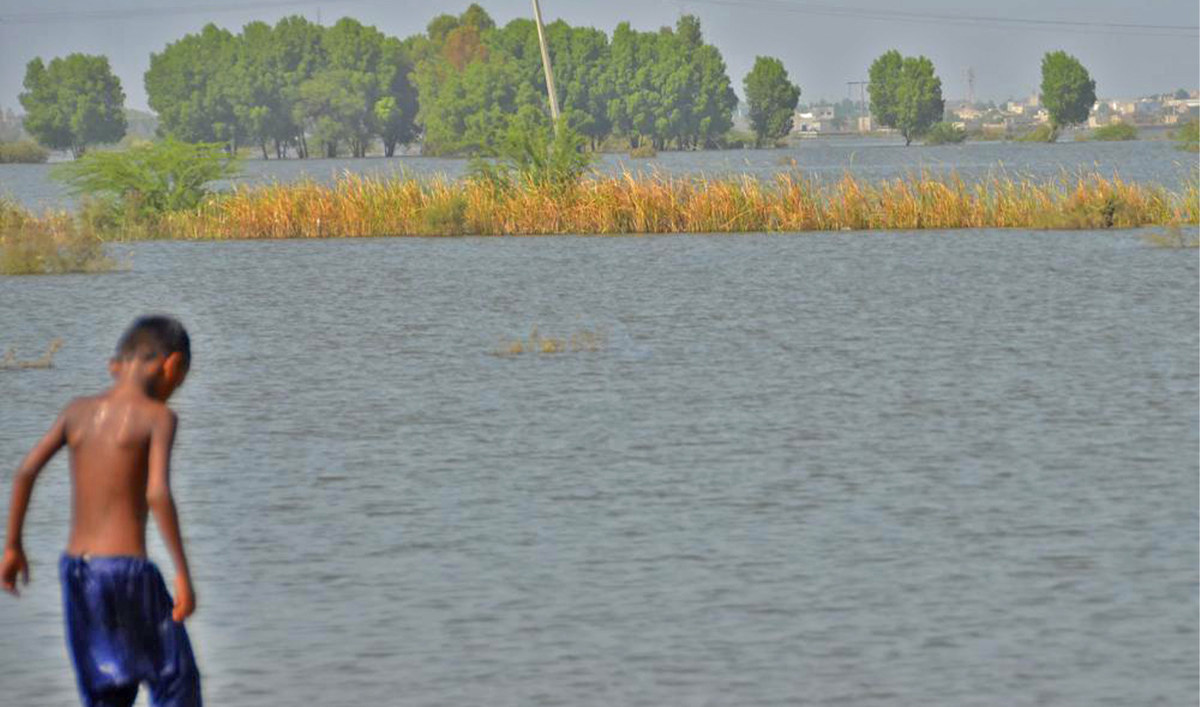
A boy stands beside a sugarcane field, which is submerged by floodwaters due to heavy monsoon rains, in Dera Allahyar area of Jaffarabad, a district of southwestern Balochistan province, Pakistan, Saturday, Sept. 17, 2022. (AFP/File)
Another importer, Haji Abubaker, who used to travel to Saudi Arabia to personally pick up Arabian dates right from the farms in the kingdom, said he could not import dates this year due to government-imposed restrictions.
Pakistan decided to restrict its imports in recent months to prevent the outflow of dollars by slowing down cargo clearance from ports. The banks operating in the country also started delaying or denying opening letters of credit (LCs).
“We were expecting that there would be a shortage of dates during Ramadan after the domestic crop loss and lack of LCs, but this was compensated by the high prices which subdued the demand,” Muhammad Sabir, chairman of Khajoor Market Association, said.
Pakistani farmers said last year's devastating rains had left nothing of the domestically produced dates for Ramadan consumption.
“In Sindh, dates are cultivated on 105,000 acres of land, of which the fruit was ready at 98,000 acres,” Nabi Bux Sathio, senior vice president of the Sindh Chamber of Agriculture, told Arab News. “The fruit was manually picked up and placed on the ground to dry, but rains ruined it, leaving nothing for this Ramadan.”
Despite the reduced sales and production cuts, Pakistanis will still be able to taste Saudi dates after the kingdom presented 100 tons of its produce to the South Asian country.
The Saudi envoy to Pakistan, Nawaf bin Said Al-Malki, and the director of King Salman Humanitarian Aid and Relief Center, Dr Khalid M. Al-Othmani, handed over the fruit to Pakistan for distribution in the country.


