

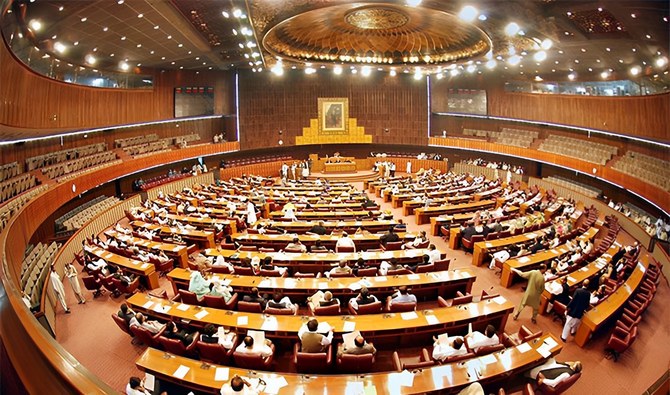

ISLAMABAD: The Pakistani government on Tuesday tabled a bill in parliament to curtail powers of the country's top judge to take suo motu notices, constitute benches and to provide the right to appeal to the aggrieved party in suo motu cases.
The development comes hours after two Supreme Court judges, Justice Mansoor Ali Shah and Justice Jamal Khan Mandokhail, called for revisiting the power of “one-man show” enjoyed by the chief justice. In a dissenting note released on Monday, the two judges called for a collegial system in the top court to ensure transparency and accountability in dispensation of justice.
Law Minister Azam Nazeer Tarar tabled the bill, titled Supreme Court (Practice and Procedure) Bill 2023, in the National Assembly, suggesting amendments to the existing law. The bill, a copy of which is available with Arab News, says a cause, matter or appeal before the apex court would be heard and disposed of by a bench constituted by a three-member committee, comprising chief justice and two senior most judges. The decisions of the committee shall be made by majority.
Regarding the apex court’s original jurisdiction, the bill says any matter invoking the use of Article 184 (3) (suo motu) would first be placed before the above-mentioned committee. In suo-motu case, the court itself takes cognizance of a matter and commences proceedings instead of parties bringing a case or controversy to it.
“If the committee is of the view that a question of public importance with reference to enforcement of any of the fundamental rights... is involved, it shall constitute a bench comprising not less than three judges of the Supreme Court of Pakistan which may also include the members of the committee, for adjudication of the matter,” the bill reads.
The bill grants the right to appeal in suo motu cases with the appeal's fixation before the court within a period not exceeding 14 days.
Speaking on the floor of parliament, the law minister said the legal fraternity and the general public had been demanding an amendment to the existing law as suo motu notices had been taken on "petty issues" in the past, with no right to appeal to the aggrieved party.
“In the past, questions were raised on integrity of the Supreme Court due to its suo motu notices as the existing rules allow the chief justice to exercise all these powers,” he said.
“This bill is allowing intra-court appeal now which was limited to review petition only in the past and its scope was very limited.”
The law minister said concerns were raised due to the dissenting note of the two judges and the federal cabinet unanimously approved the bill to protect integrity and dignity of the institution.
Meanwhile, the National Assembly, the lower house of Pakistan parliament, adopted a resolution presented by Information Minister Marriyum Aurangzeb, urging the Supreme Court not to interfere in "political matters" and with authority of the country's election regulator.
The resolution demanded the top court avoid interference as the Election Commission of Pakistan (ECP) was an independent institution and mandated under the constitution to hold elections in the country. Elections of all assemblies in the country should be held together for political stability, it added.
The Supreme Court is presently hearing a petition filed by ex-premier Imran Khan’s Pakistan Tehreek-e-Insaf (PTI) party regarding delay in elections in Punjab and Khyber Pakhtunkhwa (KP) assemblies, which were dissolved in January.
Speaker National Assembly Raja Pervaiz Ashraf has referred the bill to the law and justice committee of the house for debate and discussion. The National Assembly will take up the bill for a vote after the committee presents its report.


