

Pakistan rights commission rebukes feuding political parties

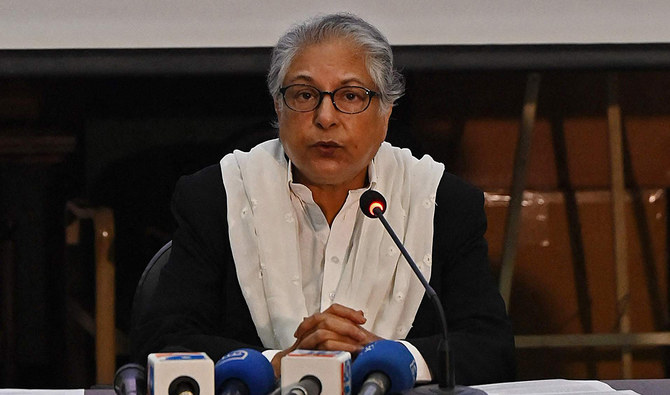
Chairperson of the Human Rights Commission of Pakistan, Hina Jilani speaks during a press conference in Lahore on March 28, 2023. (AFP)
Short Url
Updated 28 March 2023
Follow

Pakistan rights commission rebukes feuding political parties

  • The fragile coalition government of Shehbaz Sharif is currently facing increasing pressure from ex-PM Imran Khan
  • There have been multiple clashes between police, Khan supporters over legal cases the ex-PM has decried as spurious

LAHORE: Pakistan's human rights commission rebuked feuding political parties on Tuesday for undermining democracy as the world's fifth-most populous country battles an economic crisis. 

The fragile coalition government led by Shehbaz Sharif has been facing increasing pressure from opposition leader Imran Khan, Pakistan's most popular politician, ahead of elections due by October. 

There have been multiple clashes between police and Khan supporters this month over legal cases the former cricket star has decried as spurious. 

"We are aware that there is a very menacing and irresponsible opposition here which has made use of violence, humiliated police and destroyed the law and order," commission chairperson Hina Jilani told a news conference in Lahore. 

"Despite that, we are forced to say that we do not expect such behaviour by the state and government which includes retaliatory measures, vindictive and vengeful measures." 

Khan dissolved the two local parliaments he controlled at the start of the year in a bid to disrupt Sharif's government. 

Under the constitution elections must be held within 90 days, a deadline just a few weeks away. However, the election commission refused to set a date after the military said it was unable to ensure security. 

The date of the elections are now tied up in legal wrangling. 

"The dissolution of the assemblies were a very dangerous and incorrect political strategy in my view, and there was an agenda behind it," Jilani said of Khan's move. 

"Despite that, we believe regular elections in Pakistan are extremely important." 

Khan sent his MPs back to the upper house on Tuesday, a year after he was ousted in a no-confidence vote and ordered his allies to abandon parliament. 

He has since been snarled in dozens of legal cases, including for sedition and under Pakistan's anti-terrorism act. 

Khan's supporters clashed with police outside his Lahore home this month when officers arrived with an arrest warrant that was later suspended. 

"Ultimately, the crux of the ongoing crisis is political and not legal," Jilani, a supreme court lawyer, said in a statement. 

"There is no other option for the political opposition and the government but to hold serious and meaningful dialogue in parliament to resolve this in the larger interests of Pakistan's people." 

Pakistan is also in the grip of a dire balance-of-payments crisis that has forced the government to implement strict financial measures in a bid to revive a stalled International Monetary Foundation bailout programme. 

The measures have seen the rupee plummet and inflation soar and the crisis has left families struggling to afford basic food items and fuel. In some extreme cases, parents have pulled children out of school and sent them to work. 

Caretaker governments, which are severely limited in their day-to-day operations, are in place in the two dissolved parliaments of Khyber Pakhtunkhwa and Punjab.


Islamabad, Tehran to extend electricity supply agreement for Pakistan’s southwest

Updated 09 December 2025
Follow

Islamabad, Tehran to extend electricity supply agreement for Pakistan’s southwest

  • Tariffs to remain between 7.7–11.45 cents/kWh as Islamabad seeks stability for energy-short border regions
  • Iran currently powers Gwadar and other border towns where Pakistan’s national grid remains limited

ISLAMABAD: Pakistan and Iran have agreed to extend their cross-border electricity supply pact for the southwestern province of Balochistan, maintaining tariffs between 7.7 and 11.45 cents per kilowatt-hour, Pakistan’s energy ministry said on Tuesday.

The deal, first signed in 2002, underpins energy security for parts of southwestern Pakistan where the national grid remains underdeveloped and erratic supply has hampered both industry and residential consumption. Coastal towns like Gwadar and nearby Mand Town in Balochistan have for years relied on imported Iranian power as connectivity with Pakistan’s main transmission network is incomplete and local generation insufficient.

Iran currently exports 100 megawatts of electricity to Gwadar under a March 2023 agreement and could scale up deliveries once additional infrastructure is operational. In May 2023, Prime Minister Shehbaz Sharif and Iranian President Ebrahim Raisi jointly inaugurated the Polan–Gabd transmission line to enable another 100 MW of supply.

Energy ministry spokesperson Zafar Yab Khan confirmed the extension of the deal, saying it had been moved forward between the two governments.

“Yes, it is correct,” he told Arab News, adding that the revised agreement was expected to be placed before Pakistan’s Economic Coordination Committee (ECC).

However, the ECC, Pakistan’s top economic decision-making forum, did not take up the extension in its meeting on Tuesday.

Power trade between Iran and Pakistan has expanded gradually over two decades, with tariffs negotiated periodically to reflect fuel costs and cross-border infrastructure upgrades. In August 2023, the ECC approved amendments to a separate contract extending a 104-MW supply from Iran’s Jakigur district into Pakistan’s Mand town through December 2024.

Gwadar, a key node in the China-Pakistan Economic Corridor (CPEC), is expected to remain dependent on imported electricity until new domestic lines are completed, making continued Iranian supply critical for industries, port operations and basic household demand.