

All eyes on Pakistan Supreme Court in case on delay in elections in Punjab, KP provinces

A tribesman ballot casts his vote in a polling station for the first provincial elections in Jamrud, a town of Pakistan's Khyber Pakhtunkhwa province on July 20, 2019. (AFP/File)
Short Url
Updated 28 March 2023
Follow

All eyes on Pakistan Supreme Court in case on delay in elections in Punjab, KP provinces

  • The crisis has pitted ex-PM Imran Khan against the federal government and election regulator
  • Pakistan in midst of deep political turmoil at a time of intense and growing economic problems

ISLAMABAD: The Supreme Court will resumed hearing a petition today, Tuesday, on a delay in holding of elections in Punjab and Khyber Pakhtunkhwa provinces, an issue that has pitted ex-Prime Minister Imran Khan against the election regulator and the federal government and deepened political crisis at a time of intense economic turmoil.

Khan and his allies dissolved the legislative assemblies in the two provinces in January, hoping the move would force the federal government to call snap national polls. Under Pakistani law, fresh polls for the two provincial assemblies should be held within 90 days, and Khan’s PTI is gambling on the national government being unable to afford to hold the provincial elections separately from a national election, which is otherwise due by October.
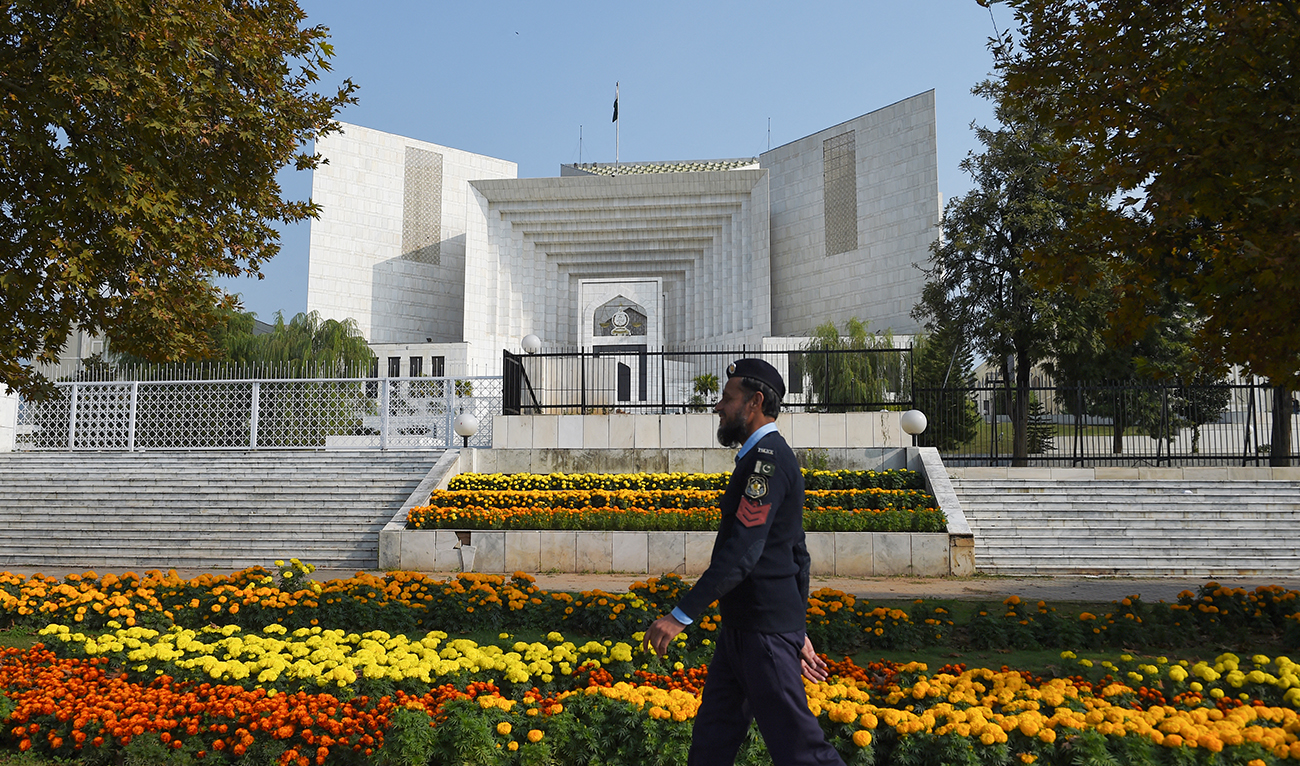


A policeman walks past in front of the Supreme Court building during a case hearing suspending the notification of the tenure extension of Chief of Army Staff (COAS) General Qamar Javed Bajwa, in Islamabad on November 28, 2019. (AFP/File)

Earlier this month, the Supreme Court ordered that polls must be held within 90 days, after which dates were announced for elections in both provinces. However, last week, the Election Commission (ECP) announced postponing provincial polls in Punjab from April 30 to October 8, citing lack of funds and the country’s precarious security situation as reasons for the decision. The governor of KP has also since proposed elections in the northwestern province also on October 8.

Khan’s PTI party has petitioned the top court on the delay and a five-member bench, headed by Chief Justice Umar Ata Bandial, started hearing the case yesterday, Monday.

“Our [PTI] standpoint is the same as the people of Pakistan,” senior PTI leader Chaudhry Fawad Chaudhry said on Tuesday outside the Supreme Court where he had come to represent his party at the hearing.

“Pakistan’s people want to see an independent and strong Supreme Court.”


On Tuesday, the ruling alliance also decided to become a party to the case. The Pakistan Muslim League Nawaz (PML-N) of PM Shehbaz Sharif as well as the Pakistan Peoples Party and Jamiat Ulema-e-Islam-Fazl (JUI-F) have filed pleas in the SC to become a party in the case and will present their stance when the hearing resumes.

On Monday, Pakistani media widely reported the chief justice questioning the ECP’s authority under the constitution to postpone elections.

Bandial observed that timely general elections held “honestly, justly, fairly and in accordance with law” were crucial under a democratic system of government mandated by the constitution.

“Any flaw, deficiency or failing in the holding of general elections is, prima facie, a matter of public importance that affects the fundamental rights of the voting public,” he was widely quoted by Pakistani media as saying.


Pakistan urges equal application of international law, flags Indus treaty at UN debate

Updated 4 sec ago
Follow

Pakistan urges equal application of international law, flags Indus treaty at UN debate

  • Pakistani envoy says silence over violations of international law are fueling conflicts from South Asia to Gaza
  • He urges the UN secretary-general to use the Charter’s preventive tools more proactively to help avert conflicts

ISLAMABAD: Pakistan’s UN ambassador on Monday called for equal application of international law in resolving global conflicts, warning that India’s decision to hold the 1960 Indus Waters Treaty in abeyance and the unresolved dispute over Kashmir continued to threaten stability in South Asia.

Speaking at an open debate of the UN Security Council on “Leadership for Peace,” Ambassador Asim Iftikhar Ahmad said selective enforcement of international law and silence in the face of violations were fueling conflicts worldwide, undermining confidence in multilateral institutions.

His remarks come months after a brief but intense military escalation between India and Pakistan in May, following a gun attack on tourists in Indian-administered Kashmir. India blamed the attack on Pakistan, a charge Islamabad denied while calling for a transparent international probe.

The attack triggered a military standoff between the two South Asian nuclear neighbors and prompted New Delhi to suspend the World Bank-brokered Indus Waters Treaty, a move Pakistan says has no basis in international law and has described as “an act of war.”

“India’s unilateral suspension of the Indus Waters Treaty — a rare and enduring example of successful diplomacy — is yet another blatant breach of international obligations that undermines regional stability and endangers the lives and livelihoods of millions,” Ahmad told the council.

He said Jammu and Kashmir remained one of the oldest unresolved disputes on the Security Council’s agenda and required a just settlement in line with UN resolutions and the wishes of the Kashmiri people, a position India has long rejected.

Ahmad broadened his remarks to global conflicts, citing Gaza, Ukraine, Sudan and other crises, and said peace could not be sustained through “selective application of international law” or by sidelining the United Nations when violations occur.

The Pakistani envoy also referred to the Pact for the Future, a political declaration adopted by UN member states this year aimed at strengthening multilateral cooperation, accelerating progress toward the 2030 development goals and reforming global governance institutions.

While welcoming the pact, Ahmad warned that words alone would not deliver peace, pointing to widening development financing gaps, rising debt distress and climate shocks that he said were reversing development gains across much of the Global South.

He called for a stronger and more proactive role for the UN Secretary-General, including earlier use of preventive tools under the UN Charter, and urged the Security Council to demonstrate credibility through consistency, conflict prevention and greater respect for international court rulings.

“No nation can secure peace alone,” Ahmad said. “It is a collective endeavor, requiring leadership, cooperation and genuine multilateralism.”