

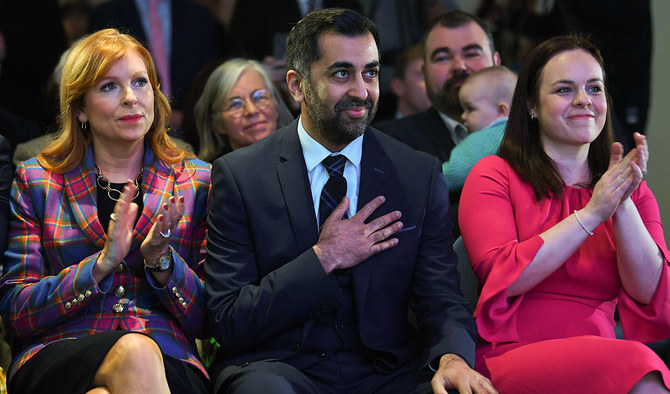

LONDON: Scottish nationalists picked Humza Yousaf to be the country's next leader on Monday after a bitterly fought contest that exposed deep divisions in his party over policy and a stalled independence campaign.
The 37-year-old practicing Muslim succeeds Nicola Sturgeon as leader of the governing Scottish National Party (SNP) and will take over as head of the semi-autonomous government once he wins an approval vote in the Scottish parliament.
Yousaf, who will be the first Muslim to lead a country in Western Europe, said he would concentrate on tackling the cost of living crisis, ending the divisions in the party, and making a renewed push for independence.
"The people of Scotland need independence now, more than ever before and we will be the generation that delivers independence," he said in a speech in Edinburgh after the results were announced.
Yousaf's victory was confirmed at the national rugby ground after a six-week campaign where the three candidates spent much of the contest criticizing each other's record in a series of personal attacks.
The SNP's unity, which had been one of its strengths, broke down over arguments about how to achieve a second independence referendum and the best way to introduce social reforms such as transgender rights.
Yousaf takes over a party with an overriding objective to end Scotland's three-centuries-long union with England. His predecessor stepped down after the British government repeatedly blocked a route to a new vote on independence.
While about four in 10 Scots support independence, according to a poll this month, the departure of Sturgeon - a charismatic and commanding leader - may initially slow some of the momentum behind a break up of the United Kingdom.
FRONTRUNNER
Yousaf won 52% of the vote of SNP members in the second round of counting, beating Kate Forbes, the finance secretary, who got 48%. Ash Regan, who had quit the government because of her opposition to proposed changes to gender recognition, was eliminated in the first round.
Coree Brown Swan, a lecturer in politics at Queen's University Belfast, said it would be difficult for the party to unite after a divisive leadership contest.
"It's a broad church of a party, which incorporates lots of different ideologies and opinions on things beyond independence," she said.
The frontrunner to replace Sturgeon, Yousaf has stressed continuity with her record, including her push to make it easier for transgender people to gain official recognition to change their gender.
Yousaf has spoken of the need to focus on building the case for independence and achieving consistent support for the movement, adding that he was open minded on which process to pursue once that level of support was achieved.
He pointed to his own background - born in Glasgow, with a father from Pakistan and mother from Kenya - and views as examples of the inclusive, socially liberal and multi-ethnic Scotland that the SNP has promoted.
During the campaign, Yousaf appeared more relaxed than Forbes, a member of the Free Church of Scotland, in balancing his religious views with the party's socially progressive policies.
While Forbes faced criticism when she announced her opposition to same-sex marriage, Yousaf said he supports it. In 2016, Yousaf took his oath of allegiance in the Scottish parliament in Urdu while wearing a kilt, and he has referred to himself as coming from a "bhangra and bagpipes" heritage.
Scotland voted against independence by 55% to 45% in 2014. Britain's vote to leave the EU two years later when most Scots wanted to stay, and Scotland's handling of the coronavirus pandemic, brought new support for independence.
However, an opinion poll this month showed the backing for independence dropped to 39%, or 46% when 'don't knows' are excluded. That compares with a record 58% in 2020.
Asked if the British government would grant permission for Yousaf to hold an independence referendum, Prime Minister Rishi Sunak's spokesperson said its position had not changed, and people's priorities were healthcare and the economy rather than a new vote on secession.


