KYIV: Ukraine’s government on Sunday called for an emergency meeting of the UN Security Council to “counter the Kremlin’s nuclear blackmail” after Russian President Vladimir Putin revealed plans to station tactical atomic weapons in Belarus.
One Ukrainian official said Russia “took Belarus as a nuclear hostage.”
Further heightening tensions, an explosion deep inside Russia wounded three people Sunday. Russian authorities blamed a Ukrainian drone for the blast, which damaged residential buildings in a town just 175 kilometers (110 miles) south of Moscow.
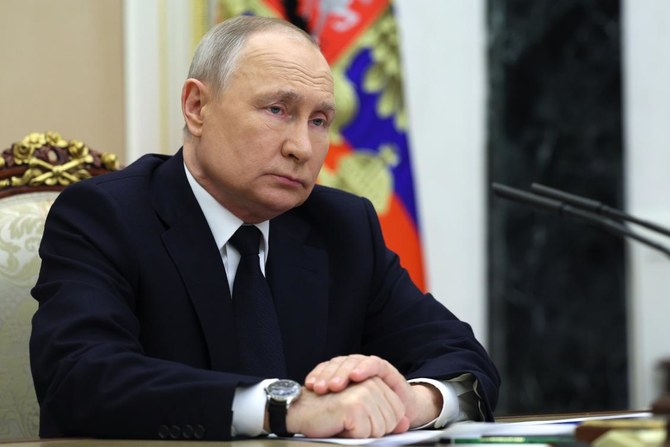
Russia has said the plan to station tactical nuclear weapons in Belarus comes in response to the West’s increasing military support for Ukraine. Putin announced the plan in a TV interview that aired Saturday, saying it was triggered by a UK decision this past week to provide Ukraine with armor-piercing rounds containing depleted uranium.
Putin argued that by deploying its tactical nuclear weapons in Belarus, Russia was following the lead of the United States. He noted that Washington has nuclear weapons based in Belgium, Germany, Italy, the Netherlands and Turkiye.
“We are doing what they have been doing for decades, stationing them in certain allied countries, preparing the launch platforms and training their crews,” he said.
Ukraine’s Foreign Ministry condemned the move in a statement Sunday and demanded an emergency meeting of the UN Security Council.
“Ukraine expects effective action to counter the Kremlin’s nuclear blackmail by the UK, China, the US and France,” the statement read, saying these countries “have a special responsibility” regarding nuclear aggression.
“The world must be united against someone who endangers the future of human civilization,” the statement said.
Ukraine has not commented on Sunday’s explosion inside Russia. It left a crater about 15 meters (50 feet) in diameter and five meters deep (16 feet), according to media reports.
Russian state-run news agency Tass reported authorities identified the drone as a Ukrainian Tu-141. The Soviet-era drone was reintroduced in Ukraine in 2014, and has a range of about 1,000 kilometers (620 miles).
The explosion took place in the town of Kireyevsk in the Tula region, about 300 kilometers (180 miles) from the border with Ukraine. Russia’s Defense Ministry said the drone crashed after an electronic jamming system disabled its navigation.
Similar drone attacks have been common during the war, although Ukraine hardly ever acknowledges responsibility. On Monday, Russia said Ukrainian drones attacked civilian facilities in the town of Dzhankoi in Russia-annexed Crimea. Ukraine’s military said several Russian cruise missiles were destroyed, but did not specifically claim responsibility.
In December, the Russian military reported several Ukrainian drone attacks on long-range bomber bases deep inside Russia. The Russian Defense Ministry said the drones were shot down, but acknowledged that their debris damaged some aircraft and killed several servicemen.
Also, Russian authorities have reported attacks by small drones in the Bryansk and Belgorod regions on the border with Ukraine.
On Saturday, Putin argued that Belarusian President Alexander Lukashenko has long asked to have nuclear weapons in his country again to counter NATO. Belarus shares borders with three NATO members — Latvia, Lithuania and Poland — and Russia used Belarusian territory as a staging ground to send troops into neighboring Ukraine on Feb. 24, 2022.
Both Lukashenko’s support of the war and Putin’s plans to station tactical nuclear weapons in Belarus has been denounced by the Belarusian opposition.
Oleksiy Danilov, the secretary of Ukraine’s National Security and Defense Council, tweeted Sunday that Putin’s announcement was “a step toward internal destabilization” of Belarus that maximized “the level of negative perception and public rejection” of Russia and Putin in Belarusian society. The Kremlin, Danilov added, “took Belarus as a nuclear hostage.”
Tactical nuclear weapons are intended for use on the battlefield and have a short range and a low yield compared with much more powerful nuclear warheads fitted to long-range missiles. Russia plans to maintain control over the ones it sends to Belarus, and construction of storage facilities for them will be completed by July 1, Putin said.
Russia has stored its tactical nuclear weapons at dedicated depots on its territory, and moving part of the arsenal to a storage facility in Belarus would up the ante in the Ukrainian conflict by placing them closer to Russian aircraft and missiles already stationed there.
The US said it would “monitor the implications” of Putin’s announcement. So far, Washington hasn’t seen “any indications Russia is preparing to use a nuclear weapon,” National Security Council spokesperson Adrienne Watson said.
In Germany, the foreign ministry called it a “further attempt at nuclear intimidation,” German news agency dpa reported late Saturday. The ministry went on to say that “the comparison drawn by President Putin to NATO’s nuclear participation is misleading and cannot be used to justify the step announced by Russia.”


![]()

Ukraine demands emergency UN meeting over Putin nuclear plan
Short Url
https://arab.news/9e6tq
Ukraine demands emergency UN meeting over Putin nuclear plan
- Putin said his plan was triggered by a UK decision this past week to provide Ukraine with armor-piercing rounds containing depleted uranium


Latest updates





© 2026 SAUDI RESEARCH & PUBLISHING COMPANY, All Rights Reserved And subject to Terms of Use Agreement.