

Inflation, flood destruction hike date prices in Pakistan as Ramadan begins

1 / 3
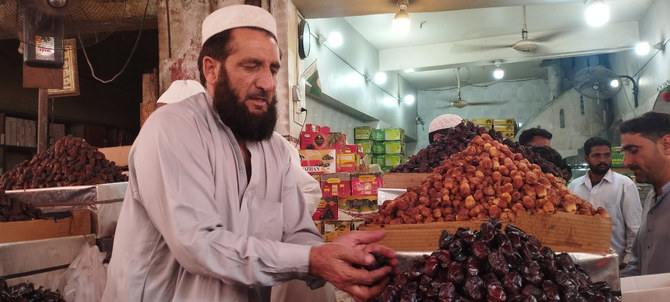
A dates seller in his stall at Pakistan's biggest date market in Karachi. (AN Photo)
2 / 3
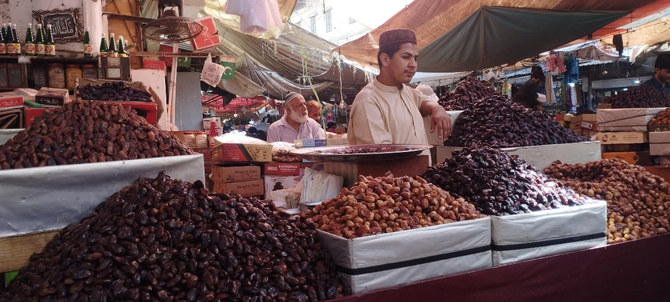
A dates seller sits in his stall at Pakistan's biggest date market in Karachi. (AN Photo)
3 / 3
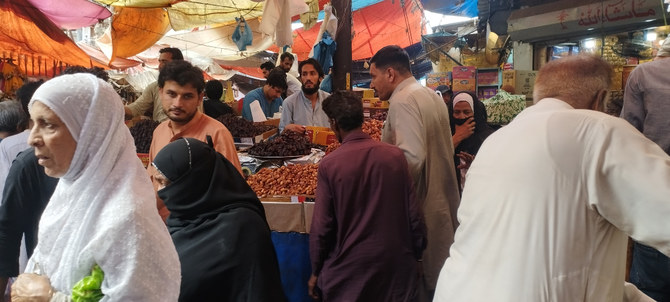
People buys dates to break their fast at Pakistan's biggest date market in Karachi. (AN Photo)
Short Url
Updated 23 March 2023
Follow

Inflation, flood destruction hike date prices in Pakistan as Ramadan begins

  • Pakistan’s inflation jumped to 50-year high of 31.5% in February
  • Over 80% of the fruit’s crops were destroyed by last year’s floods

KARACHI: As Ramadan began on Thursday, Pakistanis bore the brunt of soaring inflation as business activities in the country’s biggest date market picked up pace, with prices of some varieties surging by 50 percent compared to last year.

Hidden behind skyscrapers in Karachi’s historic Lyari area, the century-old market comes to life during the holy fasting month, when dates are consumed before the fast starts in the morning and to break it when the sun sets.

But date prices are significantly higher this year as the inflation rate in Pakistan jumped to a 50-year high, or 31.5 percent, last month.

“Everything has become expensive, and date prices have also increased,” businessman Muhammad Ishaq told Arab News, as he was shopping at the market.

“What I bought for Rs350 ($1.24) last year is now being sold for Rs500 ($1.77) per kilogram.”

Sales of the fruit have declined compared to 2022 because of the price surge, sellers said, blaming the hike also on import restrictions and the destruction of local crops when devastating floods hit Pakistan from June to October.

“Due to high rates, the buying trend has decreased,” Muhammad Sabir, chairman of the Khajoor Market Association, told Arab News.
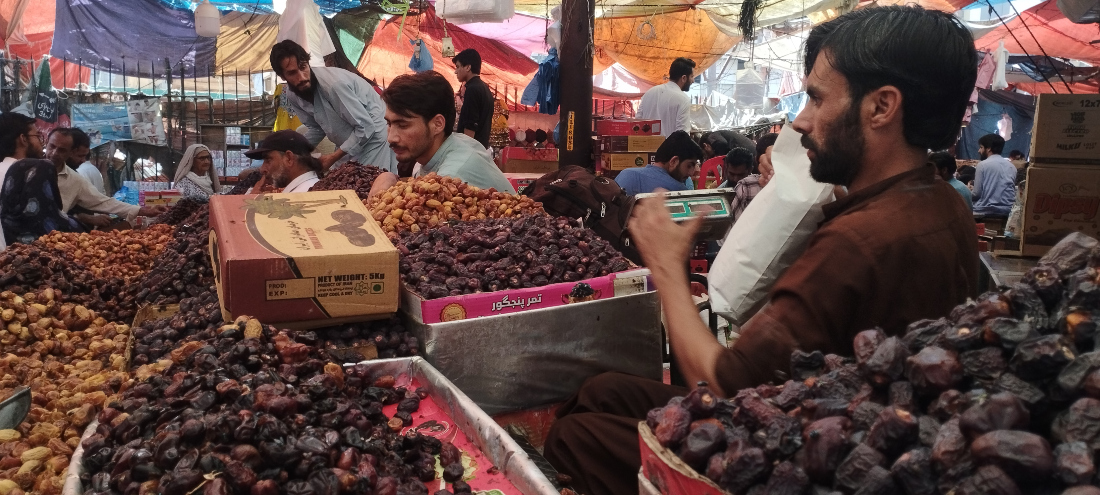
“Now premium quality dates per maund (40 kg) is being sold for Rs20,000-Rs22,000 (about $70-$77).”

As Pakistan has been struggling with depleting foreign reserves, the government slapped import restrictions on certain goods last May, including on dry and fresh fruits.

While the measures were lifted a few months later, sellers said they had contributed to the date price surge as imports from some of the main source markets did not materialize on time.

“Government had no dollars, due to which imports from Iraq were not made in time,” Hanif Baloch, who imports and sells dates, told Arab News.

Pakistan is a major producer of the fruit, with annual production estimated at around 500,000 metric tons. But more than 80 percent of date crops in the South Asian country were destroyed in the floods that submerged a third of the country. “Local date crops were ruined in floods that affected Balochistan and Sindh,” Baloch said.

“The Pakistani variety of Aseel and Mazafati dates have not been coming to the market.”

Pakistan cultivates most of its dates in Balochistan and Sindh provinces, which were the most affected by last year’s deluge. “The date crop was the first to suffer and in parts of Sindh’s growing belt it was entirely wiped out as it was the fruiting season,” Mahmood Nawaz Shah, senior vice president of Sindh Abadgar Board, told Arab News.

“The lack of post-harvest storage and drying facilities also compounded the situation and added to the crop loss.”


Afghanistan says it thwarted Pakistani airstrike on Bagram Air Base as fighting enters fourth day

Updated 5 sec ago
Follow

Afghanistan says it thwarted Pakistani airstrike on Bagram Air Base as fighting enters fourth day

  • The fighting has been the most severe between the neighbors for years
  • Pakistan accuses Taliban government of harboring militant groups that stage attacks against it
KABUL: Afghanistan thwarted attempted airstrikes on Bagram Air Base, the former US military base north of Kabul, authorities said Sunday, while cross-border fighting between Pakistan and Afghanistan stretched into a fourth day.
The fighting has been the most severe between the neighbors for years, with Pakistan declaring that it’s in “open war” with Afghanistan.
The conflict has alarmed the international community, particularly as the area is one where other militant organizations, including Al-Qaeda and the Daesh group, still have a presence and have been trying to resurface.
Pakistan accuses Afghanistan’s Taliban government of harboring militant groups that stage attacks against it and also of allying with its archrival India.
Border clashes in October killed dozens of soldiers, civilians and suspected militants until a Qatari-mediated ceasefire ended the intense fighting. But several rounds of peace talks in Turkiye in November failed to produce a lasting agreement, and the two sides have occasionally traded fire since then.
On Sunday, the police headquarters of Parwan province, where Bagram is located, said in a statement that several Pakistani military jets had entered Afghan airspace “and attempted to bomb Bagram Air Base” at around 5 a.m.
The statement said Afghan forces responded with “anti-aircraft and missile defense systems” and had managed to thwart the attack.
There was no immediate response from Pakistan’s military or government regarding Kabul’s claim of attempted airstrikes on Bagram or the ongoing fighting.
Bagram was the United States’ largest military base in Afghanistan. It was taken over by the Taliban as they swept across the country and took control in the wake of the chaotic US withdrawal from the country in 2021. Last year, US President Donald Trump suggested he wanted to reestablish a US presence at the base.
The current fighting began when Afghanistan launched a broad cross-border attack on Thursday night, saying it was in retaliation for Pakistani airstrikes the previous Sunday.
Pakistan had said its airstrike had targeted the outlawed Pakistani Taliban, also known as Tehreek-e-Taliban Pakistan, or TTP. Afghanistan had said only civilians were killed.
The TTP militant group, which is separate but closely allied with Afghanistan’s ruling Taliban, operates inside Pakistan, where it has been blamed for hundreds of deaths in bombings and other attacks over the years.
Pakistan accuses Afghanistan’s Taliban government of providing a safe haven within Afghanistan for the TTP, an accusation that Afghanistan denies.
After Thursday’s Afghan attack, Pakistani Defense Minister Khawaja Mohammad Asif declared that “our patience has now run out. Now it is open war between us.”
In the ongoing fighting, each side claims to have killed hundreds of the other side’s forces — and both governments put their own casualties at drastically lower numbers.
Two Pakistani security officials said that Pakistani ground forces were still in control on Sunday of a key Afghan post and a 32-square-kilometer area in the southern Zhob sector near Kandahar province, after having seized it during fighting Friday. The captured post and surrounding area remain under Pakistani control, they added. The officials spoke on condition of anonymity, because they weren’t authorized to speak publicly.
In Kabul, the Afghan government rejected Pakistan’s claims. Deputy government spokesman Hamdullah Fitrat called the reports “baseless.”
Afghan officials said that fighting had continued overnight and into Sunday in the border areas.
The police command spokesman for Nangarhar province, Said Tayyeb Hammad, said that anti-aircraft missiles were used from the provincial capital, Jalalabad, and surrounding areas on Pakistani fighter jets flying overhead Sunday morning.
Defense Ministry spokesman Enayatulah Khowarazmi said that Afghan forces had launched counterattacks with snipers across the border from Nangarhar, Paktia, Khost and Kandahar provinces overnight. He said that two Pakistani drones had been shot down and dozens of Pakistani soldiers had been killed.
Fitrat said that Pakistani drone attacks hit civilian homes in Nangarhar province late Saturday, killing a woman and a child, while mortar fire killed another civilian when it hit a home in Paktia province.
There was no immediate response to the claims from Pakistani officials.