

Cool weather expected to offer fasting Muslims some respite this Ramadan

1 / 2
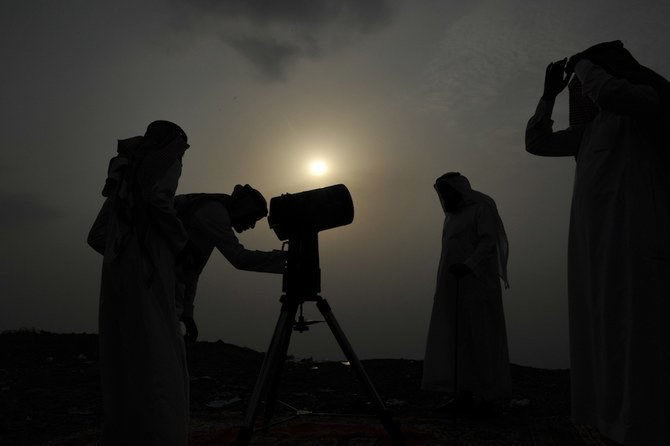
The early-spring weather during the holy month will be a relief after more than a decade of fasting during long, hot days. (AFP)
2 / 2
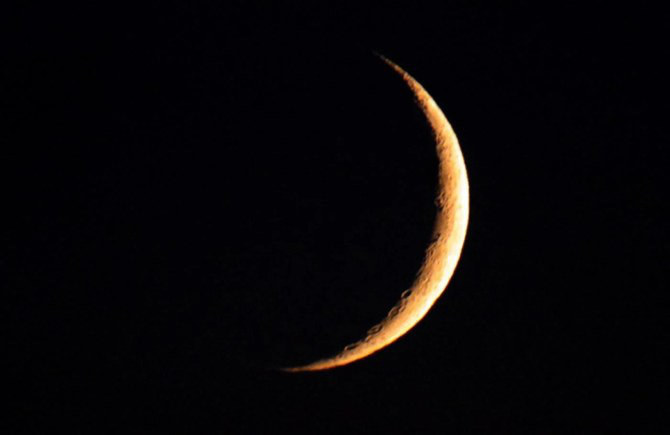
The early-spring weather during the holy month will be a relief after more than a decade of fasting during long, hot days. (Reuters)
Short Url
Updated 22 March 2023
Follow

Cool weather expected to offer fasting Muslims some respite this Ramadan

  • The early-spring weather during the holy month will be a relief after more than a decade of fasting during long, hot days 

RIYADH: Residents of the Kingdom can look forward to a more comfortable, cooler Ramadan this year, compared with the long hours of fasting in the hot and humid weather of the past decade.

The Islamic calendar is based on the lunar cycle, with the start of each month determined by the sighting of the new moon. The effect of this is that Ramadan arrives about a week-and-a-half earlier in the Gregorian calendar each year compared with the year before.

“The month of Ramadan moves between the four seasons every 33 years because the Hijri calendar is 11 days shorter than the Gregorian calendar,” said Abdulaziz Al-Hussaini, a Saudi weather and climate researcher.

“Ramadan this year is expected to have a higher rate of precipitation than normal in most regions, particularly during the first half of Ramadan. In the event of rainfall, the weather typically changes: The weather becomes cold, even during the day, with a cold breeze at night and in the early-morning hours.

“Since Ramadan falls in the spring season this year, some of the winter characteristics will be dominating the weather of Ramadan this year.”

After several years of marking Ramadan, and fasting, during the long, hot summer days, Saudis are looking forward to the more pleasant weather that is forecast for this year, and they reminisced about the years in which Ramadan fell during the winter.

“I always recall fasting during Ramadan in winter; the hours of fasting were short and we barely felt thirsty or hungry as the weather back then made fasting easier,” said Shamma Abdul Aziz, a retired history teacher from Riyadh.

Hadi Saud, a chemical engineer from Al Qassim, said: “I was 15 in 1997 and I remember breaking our fast outside, in the backyard, for the whole month. We rarely had our breakfast inside because of how good the weather was — we didn’t want to miss it.”

Al-Hussaini pointed out that Ramadan will once again be observed during the winter season “in about seven years from now.”

In fact, in 2030 Ramadan will take place twice, according to Khaled Al-Zaaq, a Saudi astronomer. This is a phenomenon that happens every 33 years, and the last time was in 1997.

In a message posted on Twitter, Al-Zaaq wrote: “In 2030, Ramadan is expected to begin on Jan. 5, 2030, and the second Ramadan of 2030 is expected to begin on Dec. 26, meaning we will fast 36 days in 2030.”

He added: “With Ramadan going around the four seasons every 33 years, in 2028 Ramadan is expected to occur at the height of winter, and in 2044 Ramadan is expected to occur at the height of summer.”


Saudi wildlife center records rare sighting of critically endangered leatherback turtle in Red Sea

Updated 05 February 2026
Follow

Saudi wildlife center records rare sighting of critically endangered leatherback turtle in Red Sea

  • NCW says the leatherback traveled thousands of kilometers to reach the Red Sea
  • The closest known nesting grounds are located in India’s Andaman Islands, some 6,500 km distant

RIYADH: Saudi Arabia's National Center for Wildlife (NCW) has documented a rare sighting of a leatherback sea turtle in the Red Sea, marking a significant biological record for one of the planet's most critically endangered marine species.

The sighting occurred approximately 30 kilometers off the coast of Al-Qunfudhah within the Blue Holes Protected Area, a newly established marine reserve, according to the Saudi Press Agency.

The NCW confirmed that the presence of a leatherback in these waters is an exceptional event. Recognized as the largest turtle species on Earth, the leatherback can weigh up to 900 kilograms. It is easily identified by its unique leathery, black carapace—distinguished by five longitudinal ridges rather than a hard bony shell—and its ability to dive to depths exceeding 1,000 meters.

Shutterstock image

Noting the species' migratory nature, the center explained that leatherbacks travel thousands of kilometers foraging for jellyfish. The specimen likely navigated through the Bab el-Mandeb Strait in search of food. 

This is considered a remarkable journey, the NCW said, noting that the nearest known populations reside in the Indian Ocean, spanning waters from South Africa to Sri Lanka (roughly 7,000 to 8,000 kilometers away). The closest known nesting grounds are located in India’s Andaman Islands, approximately 6,500 kilometers distant. No nesting activity has been recorded in the Red Sea.

According to the IUCN Red List, the leatherback is Critically Endangered in the Indian Ocean. While data for the Red Sea and Arabian Gulf is scarce, recent isolated sightings include a juvenile recorded in Jordan in December 2025 and another off Djibouti in 2019.

The NCW emphasized that these rare appearances highlight the ecological importance of the Kingdom's marine conservation efforts in the Red Sea. The center pointed to the Farasan Islands Marine Protected Area, along with the new Blue Holes and Ras Hatiba reserves, as critical sanctuaries that could support the potential expansion of such endangered species' ranges.