

Pakistan political crisis deepens as election body postpones Punjab elections to Oct. 8

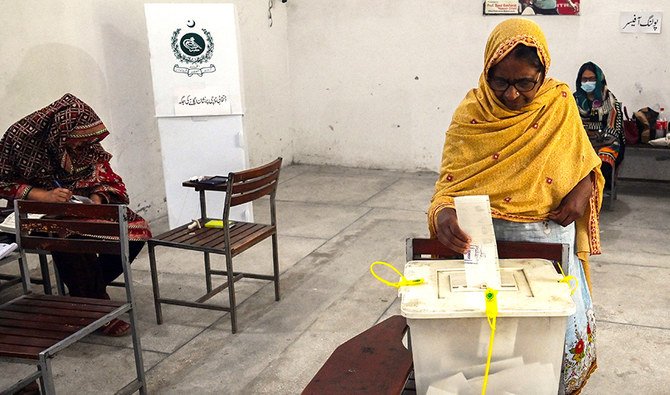
Voters cast their ballot at a polling station during the by-election in Punjab province assembly seat in Lahore on July 17, 2022. (AFP)
Short Url
Updated 22 March 2023
Follow

Pakistan political crisis deepens as election body postpones Punjab elections to Oct. 8

  • Not possible to hold and organize elections fairly and peacefully on April 30, says Pakistan's election regulator
  • Fresh schedule will be issued in due course of time with poll date on October 8, says Election Commission of Pakistan

ISLAMABAD: Pakistan's political crisis deepened on Wednesday as the election regulator announced polls in the country's most populous Punjab province would be postponed from April 30 to October 8.

The move is likely to irk former Prime Minister Imran Khan who, since his ouster from office last April, has been calling for early elections and holding mass demonstrations and sit-ins to pile pressure on the government. In recent days, Khan's party has said it would launch countrywide street protests if general elections in Punjab and Khyber Pakhtunkhwa, where provincial assemblies were dissolved in January, are not held within a constitutionally mandated 90-day limit.

After much political and legal debate, Pakistan’s President Arif Alvi announced April 30 as the date for Punjab provincial assembly elections earlier this month. 

The president announced the date after Pakistan's top court ruled that elections in Punjab and Khyber Pakhtunkhwa (KP) provinces should be held within 90 days of the dissolution of the provincial legislatures.

The controversy was triggered when former prime minister Imran Khan’s Pakistan Tehreek-e-Insaf (PTI) party and allies dissolved the Punjab and KP  provincial assemblies in January, in a bid to force the government of PM Shehbaz Sharif to announce nationwide polls.

The Election Commission of Pakistan (ECP) said in a notification that it held meetings on March 20, 21, and 22 to "deliberate extensively" on the matter of Punjab elections after receiving briefings from law enforcement agencies, ministries of finance, defence, interior and the secretary of Punjab, 

"The Commission after considering the reports, briefing and material brought before it, has arrived at the just conclusion that it is not possible to hold and organize the elections honestly, justly, fairly, in a peaceful manner and in accordance with the Constitution and law," it said. 

"The Commission hereby withdraws the election program issued vide Notification No. F. 2(3)/2023/Cord dated 8th March, 2023 and fresh schedule will be issued in due course of time with poll date on 08th October, 2023," it added. 

"The constitution and the Supreme Court have been practically abolished," Chaudhry Fawad Hussain, a close aide of Khan, wrote on Twitter. "Pakistan is now without a constitution."


Ousted via a parliamentary vote in April 2022, Khan has been pressurizing the government to hold early elections, a demand repeatedly rejected by PM Shehbaz Sharif. Khan has alleged that the ruling coalition government is "running away" from elections out of fear of his surging popularity. 


Dozens killed as security forces repulse separatist attacks in Pakistan’s Balochistan

Updated 4 sec ago
Follow

Dozens killed as security forces repulse separatist attacks in Pakistan’s Balochistan

  • The attacks unfolded early Saturday when outlawed Baloch Liberation Army members attacked several cities in the restive region
  • Security official says 37 militants, 10 security personnel killed in skirmishes that revived memories of similar attack in 2024

QUETTA/ISLAMABAD: Dozens of militants and security personnel and policemen were killed as Pakistani security forces repulsed coordinated attacks by separatist militants in the southwestern Balochistan province, officials said on Saturday, in the latest incident of violence in the insurgency-hit region.

Separatist militants, affiliated with the Balochistan Liberation Army (BLA), launched “coordinated” attacks in several cities of Balochistan early Saturday, according to a senior police official, who requested anonymity.

The attacks in the provincial capital of Quetta began at around 6am with a powerful explosion, followed by intense gunfire that lasted for two hours along with multiple explosions. Residents of Dalbandin and Nuhski said they heard explosions and gunfire, while similar attacks were launched in Mastung, Gwadar, Pasni and Turbat.

A security official said Pakistani forces had repulsed the attacks and killed 37 “Indian-backed militants,” who were in continuous contact with “their handlers in Afghanistan.” Islamabad has frequently blamed such attacks on India and Afghanistan, an allegation consistently denied by Kabul and New Delhi.

“The terrorists of Fitna Al-Hindustan (Indian-backed Baloch separatist groups) launched coordinated attacks this morning at more than 12 locations, including Quetta, Noshki, Dalbandin, Pasni, and Gwadar,” the security official said.

“In these attacks, 37 terrorists have been eliminated. Throughout the operation, the terrorists were reportedly in continuous contact with their handlers in Afghanistan. Ten security personnel were martyred while few others were injured.”

Security personnel shift an injured man at a hospital in Quetta on January 31, 2026, following an attack by Baloch separatists. Ethnic Baloch separatists launched "coordinated" attacks across Pakistan's Balochistan province on January 31, killing at least four policemen, officials said, the latest violence in insurgency-hit southwest region. (AFP)

A senior official at the Civil Hospital in Quetta told Arab News they had received 15 bodies, including nine policemen.

“Eight injured with bullet wounds were brought to the hospital,” said the official, who spoke on condition of anonymity. “Five of them were later shifted to the Combined Military Hospital (CMH) Quetta.”

Balochistan, which borders Iran and Afghanistan, is the site of a decades-long insurgency waged by Baloch separatist groups who often attack security forces and foreigners, and kidnap government officials.

Shahid Rind, the Balochistan chief minister’s aide for media and political affairs, said police and paramilitary Frontier Corps (FC) had foiled the attacks and were chasing the assailants.

“After the killing of more than 70 terrorists at different places in Balochistan in the last two days, terrorists have attempted to attack at a few places in Balochistan, which have been foiled by timely action by the police and FC,” he said on X.

“At present, the pursuit of the fleeing terrorists is underway. More details will be revealed very soon.”

Family members mourn the death of a relative killed in an attack by Baloch separatists, at a hospital in Quetta on January 31, 2026. Ethnic Baloch separatists launched "coordinated" attacks across Pakistan's Balochistan province on January 31, killing at least four policemen, officials said, the latest violence in insurgency-hit southwest region. (AFP)

In a statement issued on Saturday, BLA said the group had launched ‘Operation Herof 2.0,’ which included a series of attacks in multiple cities of Balochistan.

Saturday’s attacks follow coordinated attacks carried out by the group in Aug. 2024 in various districts of Balochistan which killed dozens of people.

The separatists accuse the central government of stealing the region’s resources to fund development elsewhere in the country. The Pakistani government denies the allegations and says it is working for the uplift of local communities in Balochistan.

Pakistan Railways suspended train service from Balochistan to other parts of the country for a day, following Saturday’s attacks.

“Quetta-Peshawar bound Jaffar Express, and Quetta-Chaman passenger trains have been canceled due to the prevailing security situation in Balochistan,” Muhammad Kashif, the railways controller in Quetta division, told Arab News.