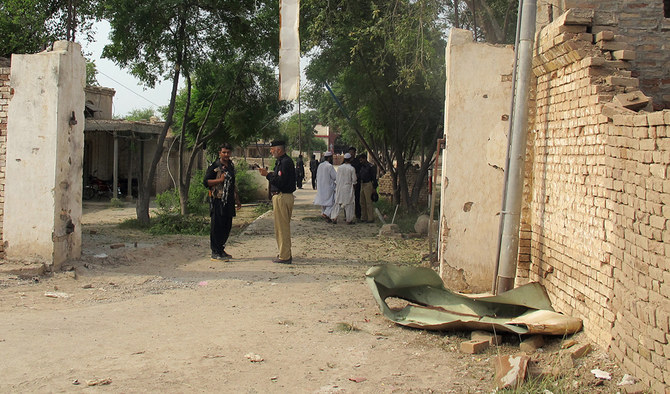
ISLAMABAD: Three militants, who targeted a police check post in the country’s northwestern Khyber Pakhtunkhwa (KP) province, were killed by Pakistani security forces on Tuesday who cordoned off the area to block all possible escape routes, said an official statement.
Pakistan has witnessed a major surged in militant violence in recent months after a proscribed network, Tehreek-e-Taliban Pakistan (TTP), unilaterally called off its fragile ceasefire with the government in November.
The TTP is said to have its leadership in Afghanistan and has mostly targeted civilians and security forces in Pakistan’s western provinces of KP and Balochistan.
The recent operation, which was launched by the security forces in Dera Ismail Khan, took place in the early hours of Tuesday after information about the attack on the police installation was received.
“After intense exchange of fire, three terrorists were sent to hell,” said the military’s media wing, ISPR, in the statement. “Weapons and ammunition were also recovered from the killed terrorists.”
The statement added that three security personnel, between the ages of 22 and 42, also lost their lives.
“Sanitization of the area is being carried out to eliminate any terrorists found in the area,” the statement added. “Pakistan Army is determined to eliminate the menace of terrorism and such sacrifices of our brave soldiers further strengthen our resolve.”

Security forces kill three militants in Pakistan’s northwest
https://arab.news/wnqg6
Security forces kill three militants in Pakistan’s northwest
- The militants were targeted after they launched an attack on a police check post in Dera Ismail Khan
- Three security personnel also lost lives amid heavy exchange of fire while trying to block escape routes
Pakistan weighs Trump Gaza board amid expert calls for Muslim allies’ consultations
- Former diplomats warn board could sideline UN, legitimize US unilateral plans
- Analysts say Pakistan should assert independent positions if it joins the body
ISLAMABAD: Pakistan is weighing an invitation from US President Donald Trump to join a proposed international “Board of Peace” on Gaza, a move that has sparked debate among former diplomats and foreign policy experts who warned Tuesday it could sideline the United Nations and urge Islamabad to consult close Muslim allies.
The White House announced on Friday some members of the board, which is expected to supervise the temporary governance of Gaza under a fragile ceasefire in place since October and continue beyond that transitional phase.
These names included US Secretary of State Marco Rubio, Trump’s special Middle East envoy Steve Witkoff, former British prime minister Tony Blair and Trump’s son-in-law Jared Kushner. Trump himself would chair the board, according to a plan unveiled by the White House in October.
Pakistan’s foreign office confirmed on Sunday that Prime Minister Shehbaz Sharif had also received an invitation to join the proposed body, stressing that “the country will remain engaged with international efforts for peace and security in Gaza, leading to a lasting solution to the Palestine issue in accordance with United Nations resolutions.”
“Since the Trump ‘Board of Peace’ is more like an international NGO now, which would include [Indian Prime Minister Narendra] Modi and [Israel’s Benjamin] Netanyahu, Pakistan should carefully take a decision in consultation with its close Muslim allies like Turkiye, Saudi Arabia, Qatar, Jordan, Egypt and Indonesia, and it should be a joint decision of these countries together,” Former federal minister and analyst Mushahid Hussain told Arab News.
“Otherwise, there is no point in being in the queue just to please Trump,” he added.
Israel and the Palestinian group Hamas have agreed that a Palestinian technocratic administration would operate under the oversight of an international board during a transitional period.
Hussain said that if Pakistan did decide to join the board, it should use the platform to clearly articulate its long-held positions.
“Pakistan should play the role of boldly promoting the right of self-determination of the peoples of Palestine and Kashmir, both occupied territories, and oppose any aggression against Iran, as peace and occupation or aggression cannot coexist,” he said.
International affairs analyst and author Naseem Zehra said Pakistan’s participation could still be justified if it allowed Islamabad to assert independent positions on global conflicts.
“Donald Trump has invited 60 heads of states and prime ministers to become part of the peace board, which is more like an alternative to the United Nations,” she said, referring to media reports about the board’s mandate. “If Pakistan is invited among 60 countries, it is acceptable for Pakistan to participate, and with a seat at the table, Pakistan can share its own view of how global issues can be resolved.”
Zehra added that Pakistan’s past diplomatic conduct showed it could maintain principled positions while engaging internationally.
Former ambassador to the United States Maleeh Lodhi took a stronger view, warning that the initiative appeared designed to bypass established international mechanisms.
“Pakistan should not join the Board for many reasons,” she said. “Its aim is for President Trump to get international support and legitimacy for his unilateral plans not just in Gaza but beyond, without member states having any real power.”
“It is being set up to supplant the UN in its primary role of maintaining international peace and security, with Trump effectively calling all the shots,” she added.
When contacted, Pakistan’s Defense Minister Khawaja Asif declined to comment and referred queries to the foreign office.
However, the foreign ministry spokesman Tahir Andrabi did not respond to Arab News requests for comment by the time of filing.
Pakistan has consistently supported Palestinian statehood under United Nations resolutions and has publicly criticized Israeli military operations in Gaza, while also opposing broader regional escalations, including attacks on Iran.


