

Benjamin Netanyahu softens pace, focus of Israel’s judicial overhaul

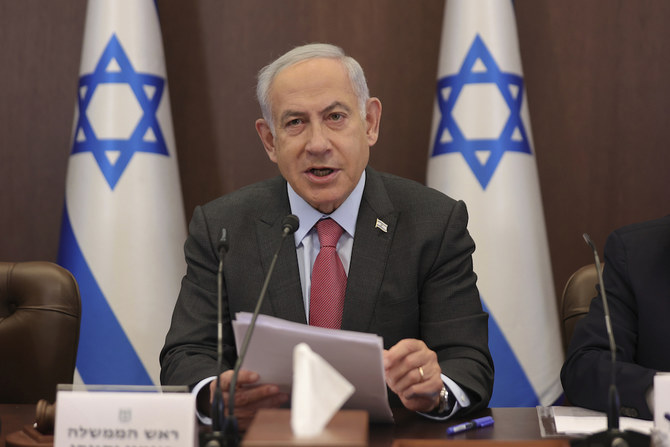
Critics have been accusing Israeli prime minister Benjamin Netanyahu of trying to curb independence of the courts. (AP)
Short Url
Updated 20 March 2023
Follow

Benjamin Netanyahu softens pace, focus of Israel’s judicial overhaul

  • Monday’s coalition statement uses more circumspect language than in the original bill introduced on January 4

JERUSALEM: Israeli Prime Minister Benjamin Netanyahu announced a softening on Monday of his hard-right government’s judicial overhaul plan, an apparent concession to more than two months of unprecedented nationwide protests and misgivings voiced by Western allies.

Wielding a parliamentary majority, Netanyahu had looked set to ratify the package of reforms by the Knesset’s April 2 recess. But most would now be shelved until it reconvenes on April 30, he and religious-nationalist coalition allies said.

The legislation still slated for ratification in the next two weeks would shake up Israel’s method of selecting judges – an issue at the heart of the reform controversy, with critics accusing Netanyahu of trying to curb independence of the courts.

He insists his goal is balance among branches of government.

Monday’s coalition statement used more circumspect language than in the original bill introduced on January 4, but said it would continue to check the power of judges on the selection panel to use what it deemed an “automatic veto” over nominations to the bench.

The statement further noted amendments made to the bill in a Knesset review session on Sunday, whereby the selection panel would be expanded from 9 to 11 members as originally planned but with a make-up that grants the government less potential clout.

Previously, the bill envisaged the panel including three cabinet ministers, two coalition lawmakers and two public figures chosen by the government — spelling a maximum 7-4 vote majority.

It is amended form, the bill envisages the panel being made up of three cabinet ministers, three coalition lawmakers, three judges and two opposition lawmakers. That could spell a slimmer, more precarious 6-5 majority for the government.

The amended bill further stipulates that no more than two Supreme Court justices can be appointed by regular panel voting in a given Knesset session. Any appointments beyond that would have to be approved by a majority vote including at least one judge and one opposition lawmaker among selection panel members.

Netanyahu called for a rethink by the political opposition, which has pledged to boycott ratification votes in the Knesset and encouraged street demonstrations that have reached into the ranks of the Israeli military, which is usually above politics.

“We are extending a hand to anyone who genuinely cares about national unity and the desire to reach an agreed accord,” the coalition statement said.


Iran FM criticizes Israel for ‘doctrine of domination’

Updated 19 min 38 sec ago
Follow

Iran FM criticizes Israel for ‘doctrine of domination’

  • Doctrine allows Israel to expand its military arsenal while pressuring other countries in the region to disarm
  • His remarks came a day after renewed nuclear talks with Washington in Oman

DOHA: Iran’s Foreign Minister Abbas Araghchi on Saturday criticized what he said was a “doctrine of domination” that allows Israel to expand its military arsenal while pressuring other countries in the region to disarm.
His remarks came a day after renewed nuclear talks with Washington, with previous talks collapsing when Israel launched an unprecedented bombing campaign against Iran last June that triggered a 12-day war.
Araghchi was speaking at the Al Jazeera Forum conference in Qatar but made no reference to Friday’s talks with the United States.
“Israel’s expansionist project requires that neighboring countries be weakened: militarily, technologically, economically and socially,” Araghchi said.
“Under this project Israel is free to expand its military arsenal without limits ... Yet other countries are demanded to disarm. Others are pressured to reduce defensive capacity. Others are punished for scientific progress,” he added.
“This is a doctrine of domination.”
During the 12-day war Israel targeted senior Iranian military officials, nuclear scientists and sites as well as residential areas, with the US later launching its own attacks on key nuclear facilities.
Iran responded at the time with drone and missile attacks on Israel, as well as by targeting the largest US military base in the Middle East, located in Qatar.
On Friday, Araghchi led the Iranian delegation in indirect nuclear talks with US Middle East envoy Steve Witkoff in Muscat.
The top Iranian diplomat later described the atmosphere as having been “very positive,” while US President Donald Trump said the talks were “very good,” with both sides agreeing to proceed with further negotiations.
The talks followed threats from Washington and its recent deployment of an aircraft carrier group to the region following Iran’s deadly crackdown on anti-government protests last month.
The United States has sought to address Iran’s ballistic missile program and its support for militant groups in the region — issues which Israel has pushed to include in the talks, according to media reports.
Tehran has repeatedly rejected expanding the scope of negotiations beyond the nuclear issue.