

Khyber Pakhtunkhwa governor retracts decision to hold provincial polls in May

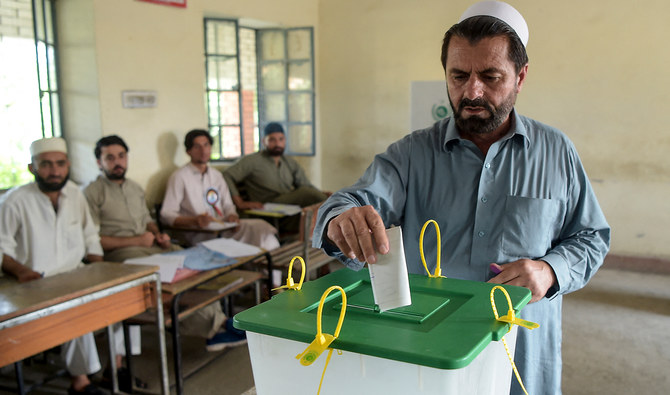
In this file photo, taken on July 20, 2019, a tribesman ballot casts his vote in a polling station for the first provincial elections in Jamrud, a town of the Khyber Pakhtunkhwa province. (Photo courtesy: AFP/File)
Short Url
Updated 18 March 2023
Follow

Khyber Pakhtunkhwa governor retracts decision to hold provincial polls in May

  • The governor says political parties may not get level playing field to contest the polls due to security reasons
  • He also maintains security situation in neighboring Afghanistan has created problems for Khyber Pakhtunkhwa

ISLAMABAD: The governor of Pakistan’s northwestern Khyber Pakhtunkhwa (KP) province reversed his decision to hold the provincial assembly election on May 28, just four days after announcing it, citing “internal security challenges” that need to be addressed first.

Former prime minister Imran Khan’s Pakistan Tehreek-e-Insaf (PTI) party dissolved the KP Assembly on January 18, shortly after the dissolution of the Punjab Assembly, in an effort to force early nationwide elections. The two federating units account for over half of the country’s population of 220 million.

According to the Pakistani constitution, fresh polls for the two provincial assemblies should be held within 90 days of their dissolution. The PTI has been counting on the national government’s inability to afford holding the provincial elections separately from a national election, which is otherwise due later this year.

After the country’s Supreme Court ruling to abide by the 90-day condition, Governor Hajji Ghulam Ali initially announced on Tuesday that the election would be held on May 28.

However, in a letter to the country’s election regulatory body written the very next day, a copy of which is available with Arab News, the governor backtracked on his decision.

He mentioned the changing situation in neighboring Afghanistan since the withdrawal of the US-led international forces while highlighting that it empowered the Pakistani Taliban who have been targeting the security forces and people.

“Existing kinetic threats [in KP] include IED [improvised explosive device] attacks, suicide bombing, cross-border attacks/fire raids, targeted killing, extortion, and abduction,” the letter said.

The governor cited the presence of militant groups in the province along with “terrorist threats from across the border” as reasons to delay the polls. He added political parties would not find a “level playing field” to contest the elections due to the looming threat.

The governor also cited financial issues and problems related to the census and delimitation of areas in the province as reasons for not holding the elections in May.

“Keeping in view the volatile security situation, non-availability of additional security personnel, fragile financial conditions, constitutional anomalies emanating from the census and delimitation process, it is recommended that before going to general elections, above mentioned challenges be addressed first,” he added.


Pakistan, other Muslim states raise alarm over Gaza situation after heavy flooding

Updated 8 sec ago
Follow

Pakistan, other Muslim states raise alarm over Gaza situation after heavy flooding

  • Cold winter rains have repeatedly lashed the sprawling tent cities, turning Gaza’s dirt roads into mud and causing damaged buildings to collapse
  • The situation has been compounded by lack of sufficient humanitarian access, acute shortages of essential life-saving supplies and materials

ISLAMABAD: Foreign ministers of Pakistan, Saudi Arabia and other Muslim nations on Friday voiced concern over the situation in Gaza, following severe flooding triggered by heavy rains in the territory.

As 2026 begins, the shaky 12-week-old ceasefire between Israel and Hamas has largely ended large-scale Israeli bombardment of Gaza. But Palestinians are still being killed almost daily by Israeli fire, and the humanitarian crisis shows no signs of abating.

Cold winter rains have repeatedly lashed the sprawling tent cities over past weeks, turning Gaza’s dirt roads into mud and causing buildings damaged in Israeli bombardment to collapse. UNICEF says at least six children have now died of weather-related causes.

In a joint message, foreign ministers of Pakistan, Saudi Arabia, Egypt, Indonesia, Jordan, Qatar, Türkiye, the United Arab Emirates, expressed their “deepest concern” over the situation, compounded by lack of sufficient humanitarian access, acute shortages of essential life-saving supplies, and the slow pace of the entry of essential materials required for the rehabilitation of basic services.

“The ministers highlighted that the severe weather has laid bare the fragility of existing humanitarian conditions, particularly for almost 1.9 million people and displaced families living in inadequate shelters,” the Pakistani foreign ministry said in a joint statement.

“Flooded camps, damaged tents, the collapse of damaged buildings, and exposure to cold temperatures coupled with malnutrition, have significantly heightened risks to civilian lives, including due to disease outbreaks, especially among children, women, the elderly, and individuals with medical vulnerabilities.”

The statement came a day after UNICEF said a 7-year-old, Ata Mai, had drowned Saturday in severe flooding that engulfed his tent camp in Gaza City. Mai had been living with his younger siblings and family in a camp of around 40 tents.

They lost their mother earlier in the war, according to the UN agency.

Video from Civil Defense teams, shown on Al Jazeera, showed rescue workers trying to get Mai’s body out of what appeared to be a pit filled with muddy water surrounded by wreckage of bombed buildings. The men waded into the water, pulling at the boy’s ankle, the only part of his body visible. Later, the body is shown wrapped in a muddy cloth being loaded into an ambulance.

Foreign minister of Pakistan, Saudi Arabia and other states appreciated the efforts of all United Nations (UN) organizations and agencies as well as non-government organizations (NGOs) in continuing to assist Palestinian civilians and deliver humanitarian assistance under extremely difficult and complex circumstances.

“They demanded that Israel ensure the UN and international NGOs are able to operate in Gaza and the West Bank in a sustained, predictable, and unrestricted manner, given their integral role in the humanitarian response in the Strip. Any attempt to impede their ability to operate is unacceptable,” the statement read.

The foreign ministers reaffirmed support to President Donald Trump’s plan for Gaza, with a view to ensuring the sustainability of the ceasefire, bringing an end to the war in Gaza, to secure a dignified life for the Palestinian people who have endured prolonged humanitarian suffering, and leading to a credible pathway to Palestinian self-determination and statehood.

“In this context, they stressed the urgent need to immediately initiate and scale up early recovery efforts, including the provision of durable and dignified shelter to protect the population from the severe winter conditions,” the statement read further.

“The ministers called on the international community to uphold its legal and moral responsibilities and to pressure Israel, as the occupying power, to immediately lift constraints on the entry and distribution of essential supplies including tents, shelter materials, medical assistance, clean water, fuel, and sanitation support.”